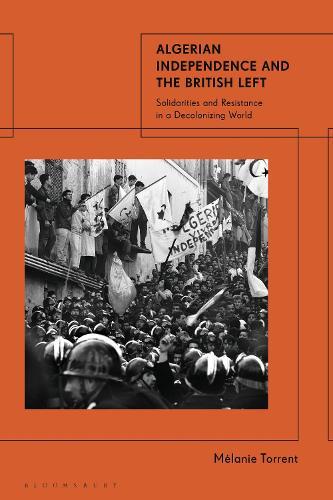
Full Product Details
Author: Professor Mélanie Torrent
Publisher: Bloomsbury Publishing PLC
Imprint: Bloomsbury Academic
Dimensions:
Width: 15.40cm
, Height: 3.80cm
, Length: 23.40cm
Weight: 0.920kg
ISBN: 9781350474918
ISBN 10: 1350474916
Pages: 616
Publication Date: 28 May 2026
Audience:
College/higher education
,
Tertiary & Higher Education
Format: Paperback
Publisher's Status: Active
Availability: Manufactured on demand

We will order this item for you from a manufactured on demand supplier.
Reviews
In this meticulously researched and cogently argued study, Mélanie Torrent delves beneath the world of diplomacy and international relations to reveal the importance of the struggle for Algerian independence in the imagination of the British anti-colonial left. This major work deepens and broadens understandings of internationalism and socialist solidarity in the heady age of post-war decolonisation. * Saul Dubow, Smuts Professor of Commonwealth History, Cambridge University, UK * Torrent has given us a truly connected history of the Algerian War, delving into British mobilization for independence and peace in France’s prized settler colony. She breaks through boundaries that have limited the scope of previous accounts: boundaries between grassroots mobilization and high-level diplomacy; boundaries between empires; and boundaries between individuals and national, regional, and global networks. This book is meticulously researched and expertly crafted and will be a must-read for historians of decolonization, internationalism, and the making of postwar Europe. * Jessica Lynne Pearson, Macalester College, USA * Connected and transnational history is renewing our understanding of the Cold War and the wars of decolonisation. Yet little work has been done on the impact of each of these conflicts on the national histories of other countries. This is particularly true of the war that pitted France against Algerian independence fighters for over seven years. Mélanie Torrent's work fills this gap by examining the consequences of the Algerian war for the British left. Unlike France, where the Socialists were in power for several years, the British Socialists were in opposition throughout the period. While this position facilitated criticism, it was not without its tensions. Firstly, within the Socialist International, where internationalist and anti-colonialist ideals were put to the test. But also within a much wider constellation on the left, made up of a diversity of parties, organisations and even individuals. Mélanie Torrent sheds light on this history with precision and finesse, using a variety of sources. Although the Left failed to reach a broad cross-section of British public opinion on the situation in Algeria, it succeeded in popularizing humanitarian issues, particularly that of refugees. It also forged links with the Algerian National Liberation Front, paving the way for relations in the aftermath of the war, a period which also saw the Left return to power in London. However, the study also reaffirms the preponderance of the national framework for understanding the effects of the Algerian War on the British left. The question of support for Algerian nationalists, solidarity within the socialist world and links with other ongoing and connected struggles, in the Arab world and Africa in particular, all serve to reveal the ways in which men and women on the British left envisage the future of their country and their ideas. By identifying the role of the Algerian conflict in the mutations of the British left, this book adds complexity not only to this history but also to the history of Britain's place in the world, between the end of the colonial empires, the construction of the European Community and the Atlanticist commitment. Beyond the agreements between governments, united in the defense of the dying colonial empires, the Algerian War reveals itself to be more broadly a British history. * Raphaëlle Branche, University of Paris Nanterre, France * A gripping and highly original account of the transnational entanglements between the British Left, broadly defined, and Algeria's struggle for independence from France. Much more than a history of one decolonising society's observations of another, Mélanie Torrent's book unravels the multiple connections, not just between party political strategists, but amongst rights activists, peace campaigners, anti-colonialists, and those appalled by the racism at the core of western colonialism. * Martin Thomas, University of Exeter, UK *
""In this meticulously researched and cogently argued study, Mélanie Torrent delves beneath the world of diplomacy and international relations to reveal the importance of the struggle for Algerian independence in the imagination of the British anti-colonial left. This major work deepens and broadens understandings of internationalism and socialist solidarity in the heady age of post-war decolonisation."" --Saul Dubow, Smuts Professor of Commonwealth History, Cambridge University, UK ""Torrent has given us a truly connected history of the Algerian War, delving into British mobilization for independence and peace in France's prized settler colony. She breaks through boundaries that have limited the scope of previous accounts: boundaries between grassroots mobilization and high-level diplomacy; boundaries between empires; and boundaries between individuals and national, regional, and global networks. This book is meticulously researched and expertly crafted and will be a must-read for historians of decolonization, internationalism, and the making of postwar Europe."" --Jessica Lynne Pearson, Macalester College, USA ""Connected and transnational history is renewing our understanding of the Cold War and the wars of decolonisation. Yet little work has been done on the impact of each of these conflicts on the national histories of other countries. This is particularly true of the war that pitted France against Algerian independence fighters for over seven years. Mélanie Torrent's work fills this gap by examining the consequences of the Algerian war for the British left. Unlike France, where the Socialists were in power for several years, the British Socialists were in opposition throughout the period. While this position facilitated criticism, it was not without its tensions. Firstly, within the Socialist International, where internationalist and anti-colonialist ideals were put to the test. But also within a much wider constellation on the left, made up of a diversity of parties, organisations and even individuals. Mélanie Torrent sheds light on this history with precision and finesse, using a variety of sources. Although the Left failed to reach a broad cross-section of British public opinion on the situation in Algeria, it succeeded in popularizing humanitarian issues, particularly that of refugees. It also forged links with the Algerian National Liberation Front, paving the way for relations in the aftermath of the war, a period which also saw the Left return to power in London. However, the study also reaffirms the preponderance of the national framework for understanding the effects of the Algerian War on the British left. The question of support for Algerian nationalists, solidarity within the socialist world and links with other ongoing and connected struggles, in the Arab world and Africa in particular, all serve to reveal the ways in which men and women on the British left envisage the future of their country and their ideas. By identifying the role of the Algerian conflict in the mutations of the British left, this book adds complexity not only to this history but also to the history of Britain's place in the world, between the end of the colonial empires, the construction of the European Community and the Atlanticist commitment. Beyond the agreements between governments, united in the defense of the dying colonial empires, the Algerian War reveals itself to be more broadly a British history."" --Raphaëlle Branche, University of Paris Nanterre, France ""A gripping and highly original account of the transnational entanglements between the British Left, broadly defined, and Algeria's struggle for independence from France. Much more than a history of one decolonising society's observations of another, Mélanie Torrent's book unravels the multiple connections, not just between party political strategists, but amongst rights activists, peace campaigners, anti-colonialists, and those appalled by the racism at the core of western colonialism."" --Martin Thomas, University of Exeter, UK
The book’s true strength is in its emphatic transnationalism, depicting not only the British political left’s relations with Algeria but also those with the pro-colonial Socialist government of Guy Mollet ... and with the French anti-war left, as well as British socialists’ wider links with anti-colonial and post-colonial African states and bodies. * Journal of Imperial and Commonwealth History * In this meticulously researched and cogently argued study, Mélanie Torrent delves beneath the world of diplomacy and international relations to reveal the importance of the struggle for Algerian independence in the imagination of the British anti-colonial left. This major work deepens and broadens understandings of internationalism and socialist solidarity in the heady age of post-war decolonisation. * Saul Dubow, Smuts Professor of Commonwealth History, Cambridge University, UK * Torrent has given us a truly connected history of the Algerian War, delving into British mobilization for independence and peace in France’s prized settler colony. She breaks through boundaries that have limited the scope of previous accounts: boundaries between grassroots mobilization and high-level diplomacy; boundaries between empires; and boundaries between individuals and national, regional, and global networks. This book is meticulously researched and expertly crafted and will be a must-read for historians of decolonization, internationalism, and the making of postwar Europe. * Jessica Lynne Pearson, Macalester College, USA * Covering the period from 1954 to 1965, this work is an impressive feat of scholarship ... For a better understanding of the evolution of the anti-imperialist movement in Britain Torrent’s book is a necessity. * Liberation * A gripping and highly original account of the transnational entanglements between the British Left, broadly defined, and Algeria's struggle for independence from France. Much more than a history of one decolonising society's observations of another, Mélanie Torrent's book unravels the multiple connections, not just between party political strategists, but amongst rights activists, peace campaigners, anti-colonialists, and those appalled by the racism at the core of western colonialism. * Martin Thomas, University of Exeter, UK * By identifying the role of the Algerian conflict in the mutations of the British left, this book adds complexity not only to this history but also to the history of Britain's place in the world, between the end of the colonial empires, the construction of the European Community and the Atlanticist commitment. * Raphaëlle Branche, University of Paris Nanterre, France *
Author Information
Mélanie Torrent is Professor of British and Commonwealth History at the Université de Picardie Jules Verne, France, Senior Research Fellow at the Institute of Commonwealth Studies, University of London, UK and was a junior member of the Institut universitaire de France. She is the author of Diplomacy and Nation-Building: Franco-British Relations and Cameroon at the End of Empire (2012).