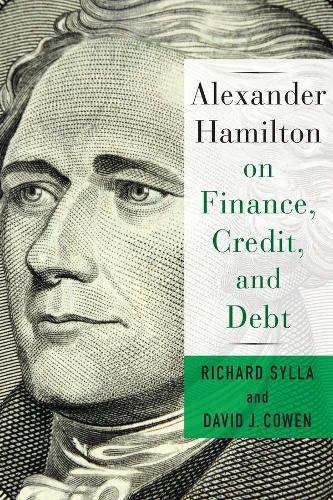
Full Product Details
Author: David Cowen ,
Richard Sylla
Publisher: Columbia University Press
Imprint: Columbia University Press
ISBN: 9780231184571
ISBN 10: 0231184573
Pages: 360
Publication Date: 19 November 2019
Audience:
College/higher education
,
Professional and scholarly
,
Tertiary & Higher Education
,
Professional & Vocational
Format: Paperback
Publisher's Status: Active
Availability: Available To Order

We have confirmation that this item is in stock with the supplier. It will be ordered in for you and dispatched immediately.
Reviews
Hamilton's writings always impress for their clarity of argument and, especially, for their prescient vision of the future of the American economy. Thanks to Richard Sylla and David J. Cowen for reminding us of that.--Ben Bernanke, former chairman of the Board of Governors of the Federal Reserve System Alexander Hamilton was the architect of the American financial system that endures to this day, making his founding-era writings on topics such as the national debt, trade, foreign investment, and central banking both resonant and relevant to contemporary readers. Sylla and Cowen provide helpful historical context, but they largely let Hamilton's genius speak for itself. From short essays that resemble the modern op-ed to legal documents to his reports to Congress as Treasury Secretary, the book offers a compelling window into Hamilton's visionary thinking on economic matters.--Robert E. Rubin, co-chair emeritus, Council on Foreign Relations, and former U.S. Treasury Secretary Seen the musical? Now read Hamilton's original letters setting out his vision for the financial revolution that created today's American economy--all excellently and helpfully edited by Richard Sylla and David J. Cowen.--Lord Mervyn King, former Governor of the Bank of England Sylla and Cowen make clear to readers that Hamilton had a solid historical foundation and a farsighted vision for his policy prescriptions. Without their expert guidance, this structure would often be missed even if one were to read through a larger set of writings. I could not imagine a better team to write this book.--Matthew Jaremski, Colgate University This is undoubtedly a treasure trove for financial and public policy geeks, and the book will also help lay readers go beyond the hit musical in understanding Hamilton's lasting significance.--Publishers Weekly A fascinating examination of Hamiltonian economics.--Washington Times
This is undoubtedly a treasure trove for financial and public policy geeks, and the book will also help lay readers go beyond the hit musical in understanding Hamilton's lasting significance.--Publishers Weekly Hamilton's writings always impress for their clarity of argument and, especially, for their prescient vision of the future of the American economy. Thanks to Richard Sylla and David J. Cowen for reminding us of that.--Ben Bernanke, former chairman of the Board of Governors of the Federal Reserve System Alexander Hamilton was the architect of the American financial system that endures to this day, making his founding-era writings on topics such as the national debt, trade, foreign investment, and central banking both resonant and relevant to contemporary readers. Sylla and Cowen provide helpful historical context, but they largely let Hamilton's genius speak for itself. From short essays that resemble the modern op-ed to legal documents to his reports to Congress as Treasury Secretary, the book offers a compelling window into Hamilton's visionary thinking on economic matters.--Robert E. Rubin, co-chair emeritus, Council on Foreign Relations, and former U.S. Treasury Secretary Seen the musical? Now read Hamilton's original letters setting out his vision for the financial revolution that created today's American economy--all excellently and helpfully edited by Richard Sylla and David J. Cowen.--Lord Mervyn King, former Governor of the Bank of England Sylla and Cowen make clear to readers that Hamilton had a solid historical foundation and a farsighted vision for his policy prescriptions. Without their expert guidance, this structure would often be missed even if one were to read through a larger set of writings. I could not imagine a better team to write this book.--Matthew Jaremski, Colgate University A fascinating examination of Hamiltonian economics.--Washington Times
Author Information
Richard Sylla is professor emeritus of economics and the former Henry Kaufman Professor of the History of Financial Institutions and Markets at New York University Stern School of Business. He is a research associate of the National Bureau of Economic Research and chairman of the Museum of American Finance. Among his books are Founding Choices: American Economic Policy in the 1790s (2011) and Alexander Hamilton: The Illustrated Biography (2016). David J. Cowen is president and CEO of the Museum of American Finance. He is author of The Origins and Economic Impact of the First Bank of the United States, 1791–1797 (2000) and coauthor of Financial Founding Fathers: The Men Who Made America Rich (2006).