Overview
Origins and Breed History The land that shaped the dog To understand the Alaskan Malamute, you have to begin with the place that formed it. Long before the breed had a name on kennel club papers, northern Alaska was a world of hard edges and long distances, where winter could feel endless and the margin for error was thin. The Arctic is not just cold; it is demanding. It rewards efficiency and punishes waste. Everything that lives there survives by being practical, resilient, and tuned to its environment. The Malamute's size, coat, stamina, and mind are not ""features"" in the modern pet sense. They are the result of a long partnership between people and dogs in one of the toughest regions on earth. In the Arctic, a dog is not simply a companion. Historically, it was transport, security, and sometimes the difference between reaching home or not. When food supplies were tight and storms could cut off travel, a dog that could haul, navigate rough terrain, and keep working even when conditions were unpleasant became priceless. Over generations, people kept and bred dogs that performed well and that fit into a household and camp life without being fragile or unpredictable. That selection process shaped what we now call the Alaskan Malamute: a heavy-duty hauling dog built for endurance and strength, with a temperament that blends boldness, steadiness, and a certain stubborn independence. The people behind the breed name The breed's name points directly to its roots. ""Malamute"" is tied to the Mahlemut (often spelled in various ways), an Inuit group from northwestern Alaska associated with the Kotzebue Sound region. Their daily life required movement across snow and ice, carrying supplies, and maintaining reliable lines of travel. Dogs were essential, and in a culture that relied on them, standards were high. Dogs needed to be strong enough to pull significant loads, smart enough to handle changing conditions, and stable enough to live closely with people. In practical terms, the most valued dogs were the ones that worked consistently, remained composed in the face of stress, and were able to cooperate with a team. It's important to picture what ""breeding"" meant in that context. This was not a hobby aimed at creating a certain color pattern or head shape. It was a survival-focused selection. Dogs that did not handle the job were not kept as breeding stock. Dogs that proved themselves-especially those that could work long distances, handle harsh weather, and fit well into camp life-became the foundation for the next generation. The Malamute's modern look and personality are a reflection of that long stretch of usefulness. A working dog, not a racing dog One of the easiest ways to misunderstand the Malamute is to assume it was designed for speed. That is not the breed's historical specialty. The Malamute is a freighting dog. In simple terms, it is built to pull heavy loads at a steady pace over long distances, rather than sprinting lightly and quickly like a racing sled dog. This is why the Malamute has a broader frame, heavier bone, and a powerful, compact strength that feels like a truck rather than a sports car. That difference matters, because it explains many modern traits. A dog designed to pull heavy freight needs traction, muscle, and an ability to lean into resistance. It needs a strong chest and shoulders, sturdy legs, and a mind that can stay focused even when the work is repetitive. Speed is exciting, but steadiness is what brings cargo home. Over time, that focus on steady hauling shaped a dog that can look calm and unhurried, even when it has energy to spare. Many Malamutes are not ""hyper"" in the frantic sense, but they are intense in their own way-capable of sustained effort and determined follow-through.
Full Product Details
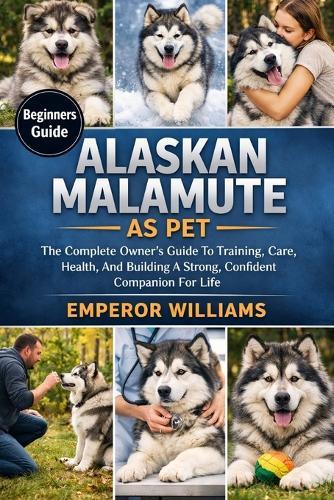
Author: Emperor Williams
Publisher: Independently Published
Imprint: Independently Published
Dimensions:
Width: 15.20cm
, Height: 1.30cm
, Length: 22.90cm
Weight: 0.340kg
ISBN: 9798259314665
Pages: 250
Publication Date: 28 April 2026
Audience:
General/trade
,
General
Format: Paperback
Publisher's Status: Active
Availability: Available To Order

We have confirmation that this item is in stock with the supplier. It will be ordered in for you and dispatched immediately.