Overview
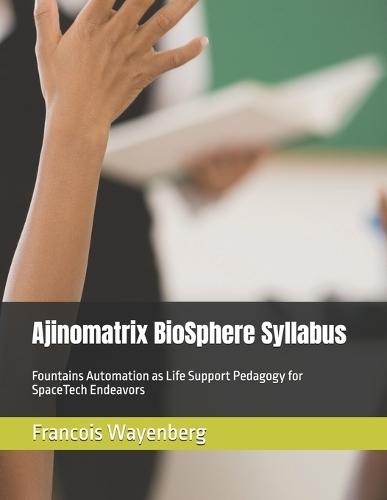
Ajinomatrix BioSphere Syllabus Fountain Automation as Life Support Pedagogy for SpaceTech Endeavors This syllabus presents a practical and accessible approach to learning automation, systems thinking, and applied artificial intelligence through a real-world, hands-on Life Support System (LSS) prototype: the Ajinomatrix BioSphere Fountain. Designed as a pedagogical tool for SpaceTech, FoodTech, and AI education, the syllabus demonstrates how small-scale automated fountains can serve as simplified, observable models of complex life-support systems-similar in principle to those required for space habitats, autonomous food production, and closed-loop ecological systems. Rather than starting from abstract theory, this course promotes learning through construction, observation, and iteration. By assembling and operating a compact fountain-based system, learners progressively acquire a deep understanding of: Automation logic Sensor-driven decision loops Energy management Water circulation and biological stability Data feedback and system resilience These same principles form the foundation of modern AI-assisted food production, autonomous greenhouses, and future space-based life support systems. Why Automation Is a Path to Higher KnowledgeAutomation is not presented here as an end in itself, but as a gateway to higher-order understanding. By building and tuning a small automated system, learners naturally encounter: Cause-and-effect reasoning Temporal sequencing Failure modes and recovery Data interpretation over time These are the same cognitive skills required to design, understand, and supervise AI systems-especially in FoodTech and SpaceTech, where autonomy, reliability, and sustainability are critical. In this sense, automation becomes a pedagogical bridge: From manual operation → to system thinking From intuition → to data-driven reasoning From isolated components → to integrated intelligence A Low-Cost, Real-World Learning PlatformOne of the core objectives of this syllabus is democratizing access to technology. The complete setup described in the course: Uses approximately 30 consumer-grade components All readily available online Requires no proprietary hardware Can be assembled incrementally Estimated total cost: 200- 300 $220-$330 This cost range makes the syllabus suitable for: Students and self-learners Research trainees Educators Makers and engineers Early-stage SpaceTech and FoodTech experimentation The emphasis is on learning by doing, experimentation ""on the ground,"" and developing intuition through practice-rather than relying on expensive industrial platforms. Intended Audience SpaceTech and Life Support System enthusiasts AI and automation learners FoodTech researchers Educators seeking applied pedagogy Makers interested in sustainable systems Position within the Ajinomatrix EcosystemThis syllabus complements the Ajinomatrix project by documenting how complex ideas can be learned through simple, physical systems. It reflects the broader Ajinomatrix philosophy: building advanced technological understanding from observable, reproducible, and affordable foundations.
Full Product Details
Author: Francois G Wayenberg
Publisher: Independently Published
Imprint: Independently Published
Dimensions:
Width: 21.60cm
, Height: 0.20cm
, Length: 27.90cm
Weight: 0.127kg
ISBN: 9798241122957
Pages: 44
Publication Date: 24 December 2025
Audience:
General/trade
,
General
Format: Paperback
Publisher's Status: Active
Availability: Available To Order

We have confirmation that this item is in stock with the supplier. It will be ordered in for you and dispatched immediately.