Overview
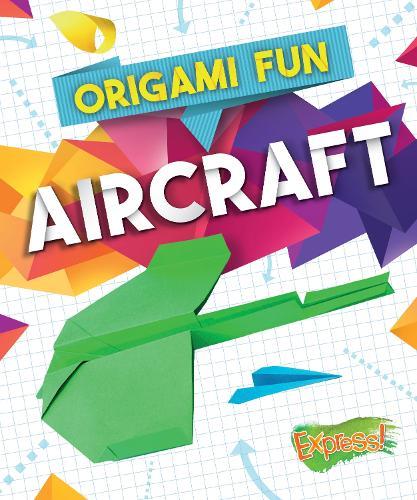
Sometimes all you need to craft a vehicle is a single sheet of paper. In this origami guide for kids, young flight enthusiasts will find easy-to-understand specs for building airplanes of all shapes and also an invitation to conduct test flights to compare the planes speeds and flight paths.
Full Product Details
Author: Robyn Hardyman
Publisher: Bellwether Media
Imprint: Express!
Volume: 8
Dimensions:
Width: 19.50cm
, Height: 0.80cm
, Length: 23.50cm
Weight: 0.227kg
ISBN: 9781626177079
ISBN 10: 1626177074
Pages: 24
Publication Date: 14 February 2019
Recommended Age: From 9 years
Audience:
Children/juvenile
,
Children / Juvenile
Format: Hardback
Publisher's Status: Active
Availability: Available To Order

We have confirmation that this item is in stock with the supplier. It will be ordered in for you and dispatched immediately.
Reviews
It is good to see a defense of public education. Education philosopher Feinberg distinguishes between public schools and public education. The latter is 'the process through which public values are shaped and transmitted,' those values being standards of behavior scrutinized and refined, 'compatible with core social ideals,' that 'shape civic judgement and guide individual behavior.' Public schools should do this, but other schools may do it too. (Feinberg acknowledges that schools have other purposes as well.) He examines the concepts of education and culture and the basic function of a public school to produce a public through communication, and proposes that the educator's task is to prepare a public to reflect on the present and engage a future that is not yet fully comprehended. And he suggests some curricula, pedagogical, and financial ideas to advance public education. Feinberg is a good philosopher. His extensive opening remarks admirably explain the role of philosophy in guiding the work of education. Especially useful is his idea that philosophy is best understood as 'a street discipline,' that is, 'grounded in the concerns of everyday people.' Summing Up: Recommended. Upper-division undergraduates through practitioners. * CHOICE * Feinberg is writing here, like Dewey did at intervals throughout his career, for a wide audience: this is a short book working to convey a sophisticated argument in an accessible way. Far more succinctly than did Democracy and Education, Feinberg's new book explains to lay readers why our society depends upon public education for its continuance as a democratic society. . . .Feinberg prompts us to think about the public aspects of education, leading us to consider both what our shared values are and how we foster social growth and change in those values. He valiantly balances the tension between complexity and clarity, between addressing a wider audience, who may at times have difficulty following his foray into theories of self and self-development, and the philosopher, who may yearn for him to elaborate in more areas, such as `deep' pluralism. Yet, Feinberg succeeds in both helping the broader audience consider important, neglected meanings and aims of public education and reminding philosophers of education of the most central pragmatist arguments for an educated public and what exactly that may mean. In doing the former, he performs the public intellectuals' job to make complex thoughts accessible to a more general audience-in this case, the important distinctions between education and schooling-without sacrificing rigor. In doing the latter, he contributes to contemporary philosophical work attempting to rearticulate and reconstruct public aims in education. * Philosophical Inquiry in Education *