Overview
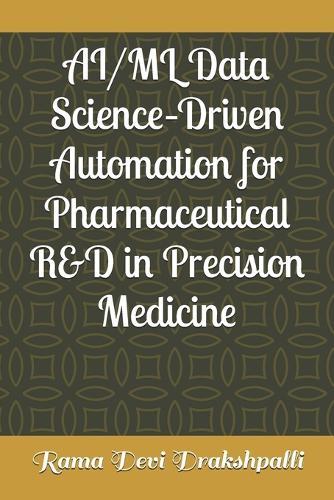
Artificial intelligence, machine learning, and advanced automation are increasingly shaping pharmaceutical research and development. Yet despite significant investment and technical progress, many organizations struggle to translate AI-driven innovation into sustained, trustworthy impact-particularly in precision medicine, where scientific decisions depend on the continuity, quality, and integrity of evidence across discovery and translational research. AI- and Data Science-Driven Automation for Pharmaceutical R&D in Precision Medicine addresses this challenge by introducing an evidence-grade approach to automation. Rather than focusing on algorithms, tools, or vendor platforms, the book examines how AI and data science must be embedded within research workflows that preserve reproducibility, traceability, and scientific intent as data, assays, and models evolve over time. A central theme of the book is the critical distinction between discovery and translational phases. Discovery research benefits from flexibility, exploration, and rapid learning, while translational research demands stability, comparability, and defensibility. Applying uniform automation strategies across these phases introduces hidden risk either constraining learning too early or allowing fragile evidence to inform high-impact decisions. This book shows how automation strategies should mature alongside evidence, tightening controls while maintaining agility where it matters most. The early chapters establish foundational principles for evidence-grade automation, including metadata-first design, automated quality gates, and workflow orchestration. Research data pipelines are reframed not as simple data movement mechanisms, but as evidence pipelines that transform raw experimental outputs into reusable, analysis-ready data products suitable for scalable analytics and AI. The book then explores how automated pipelines support reproducibility, cross-study learning, and reliable downstream reuse. It demonstrates how structured metadata, standardized curation layers, and versioned datasets reduce manual rework while strengthening confidence in analytical outcomes. Assay optimization is presented as a pivotal link between data infrastructure and biological insight. The book examines how AI-driven techniques such as predictive quality control, anomaly detection, parameter tuning, and active learning can improve assay robustness and learning efficiency when applied with translational intent. Rather than optimizing technical metrics in isolation, the emphasis remains on generating assay evidence that meaningfully supports target identification, biomarker discovery, and drug repurposing. Operationalizing AI is a major focus. Models in pharmaceutical R&D are not static assets deployed into stable environments; they are evolving hypotheses interacting with changing data, protocols, and scientific understanding. The book introduces a lifecycle-aware approach to AI build, validate, deploy, monitor, and improve supported by dataset, feature, and model versioning, automated run metadata capture, discovery-aware monitoring, and structured human-in-the-loop review workflows. Throughout, the book avoids vendor-specific solutions and algorithmic hype. Instead, it provides durable, technology-agnostic patterns, practical checklists, common failure modes, assay metrics, and a glossary tailored to pharmaceutical R&D contexts. Written for pharmaceutical R&D professionals, translational scientists, data engineers, applied AI teams, and R&D leaders, this book is intended to help organizations move beyond experimental AI adoption. By grounding automation in evidence-grade principles, it shows how AI can become a sustainable scientific capability accelerating innovation while strengthening the credibility and reuse of research outcomes.
Full Product Details
Author: Rama Devi Drakshpalli
Publisher: Independently Published
Imprint: Independently Published
Dimensions:
Width: 15.20cm
, Height: 0.50cm
, Length: 22.90cm
Weight: 0.145kg
ISBN: 9798279329304
Pages: 100
Publication Date: 21 December 2025
Audience:
General/trade
,
General
Format: Paperback
Publisher's Status: Active
Availability: Available To Order

We have confirmation that this item is in stock with the supplier. It will be ordered in for you and dispatched immediately.