Overview
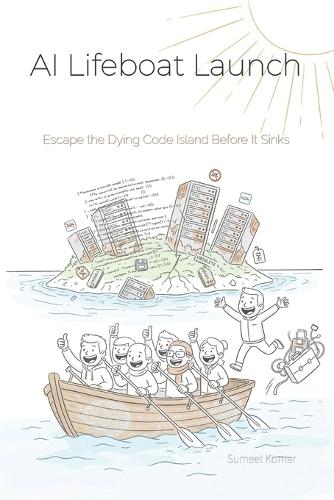
Your backend skills are depreciating. The sprint work you mastered now takes hours with AI-assisted tools. You're reviewing AI-generated PRs instead of designing systems - and your skip-level just asked you to ""own the RAG pipeline"" with zero context on what that means. This isn't a theoretical problem. Across FAANG-tier companies, growth-stage startups, and mature product organizations, the unit of engineering value has shifted from code correctness to output quality governance over probabilistic systems. The engineers commanding premium compensation aren't the ones who learned a few prompting tricks - they're the ones who design, measure, and control AI systems in production. Most resources on AI engineering give you either hype or academic theory. This book gives you neither. It's a practical field guide built for software engineers with 4-15 years of experience who need to understand exactly what the new roles look like, what the daily work actually involves, and what technical capabilities separate production-grade AI engineers from prompt tinkerers. What you'll learn: - How LLMs actually work - transformer architecture, tokenization, embeddings, and decoding strategies explained through the lens of distributed systems you already understand - Production RAG pipeline design from corpus construction through retrieval evaluation, including chunking strategies, embedding selection, hybrid search, re-ranking, and the data engineering that keeps retrieval systems reliable over time - Agent architectures and orchestration patterns - ReAct, Plan-Execute, tool-calling loops, multi-agent coordination, and the critical judgment of when autonomous agents are wrong and deterministic workflows are right - Evaluation as the skill that commands premium compensation - golden datasets, LLM-as-judge patterns, hallucination detection, and the quality-cost-latency trade-off framework - LLMOps for production systems - model routing, semantic caching, streaming, observability, tracing, prompt versioning, and cost modeling at scale - Safety, governance, and AI-native architecture - prompt injection mitigation, tenant-aware systems, human-in-the-loop workflows, and the design patterns that separate chatbot wrappers from real AI products - The complete developer ecosystem - model APIs, open-source runtimes, orchestration frameworks, eval platforms, and vector DB tooling with honest build-vs-buy guidance The book introduces three interlocking frameworks: the Depreciation Diagnostic to audit where your current engineering value is eroding, the Capability-Role Matrix to map your existing strengths to high-leverage AI engineering roles, and the Leverage Repositioning Framework - a concrete 90-day transition plan with weekly milestones that produces demonstrable production artifacts, not certificates. Sumeet Kumar has navigated this transition from the inside, building AI systems at production scale and watching firsthand which engineers thrived and which got left behind. The water is rising. This book is the blueprint for building your lifeboat - and launching it before the island sinks.
Full Product Details
Author: Sumeet Kumar
Publisher: Independently Published
Imprint: Independently Published
Dimensions:
Width: 15.20cm
, Height: 0.90cm
, Length: 22.90cm
Weight: 0.222kg
ISBN: 9798249303976
Pages: 160
Publication Date: 21 February 2026
Audience:
General/trade
,
General
Format: Paperback
Publisher's Status: Active
Availability: Available To Order

We have confirmation that this item is in stock with the supplier. It will be ordered in for you and dispatched immediately.