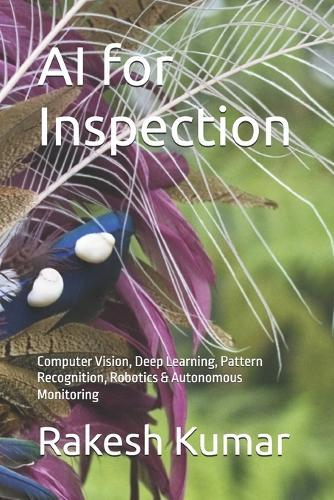
Overview
Inspection has always been at the heart of safety, quality, and reliability. From ancient builders examining stone structures to modern engineers inspecting microchips, the fundamental goal remains the same: detect flaws before they become failures. However, the scale, complexity, and speed of modern industries have surpassed the limits of manual and traditional inspection methods. Today, industries operate in environments defined by high-speed production, ultra-precision manufacturing, vast infrastructure networks, renewable energy farms, autonomous vehicles, and smart cities. In such systems, a single undetected defect can result in catastrophic failure, financial loss, regulatory penalties, or even loss of life. The demand for faster, more accurate, and scalable inspection methods has never been greater. This is where Artificial Intelligence transforms inspection from a reactive process into a proactive, intelligent system. AI-driven inspection combines computer vision, deep learning, robotics, IoT, edge computing, and autonomous systems to create powerful inspection platforms capable of detecting microscopic defects, predicting failures, and continuously improving over time. These systems do not merely observe-they learn, adapt, and evolve. Unlike traditional rule-based machine vision, modern AI systems can identify complex patterns, subtle anomalies, and unknown defect types. They operate across industries-from semiconductor fabrication and pharmaceutical manufacturing to wind farms, railway networks, and aerospace systems. They enable real-time decision-making, predictive maintenance, and autonomous monitoring in environments that are dangerous, remote, or inaccessible to humans. However, building such intelligent inspection ecosystems is not simply about deploying neural networks. It requires a deep understanding of image acquisition, data quality, model training, robotics integration, edge deployment, cybersecurity, regulatory compliance, and business alignment. It demands careful design, validation, and governance to ensure trustworthiness, reliability, and ethical responsibility. This book explores the complete journey-from foundational principles of computer vision and deep learning to real-world case studies of autonomous inspection systems. It bridges theory and practice, guiding readers through architecture design, deployment strategies, performance optimization, and emerging technologies such as digital twins, foundation models, and self-supervised learning. The future of inspection is not just automated-it is intelligent, autonomous, predictive, and adaptive. As industries move toward fully autonomous ecosystems, inspection systems will no longer function as isolated checkpoints. They will become integral components of intelligent infrastructure-continuously monitoring, learning, and ensuring safety at unprecedented scale. This book invites you to explore that future. The revolution in inspection has begun.
Full Product Details
Author: Rakesh Kumar
Publisher: Independently Published
Imprint: Independently Published
Dimensions:
Width: 15.20cm
, Height: 3.40cm
, Length: 22.90cm
Weight: 0.866kg
ISBN: 9798248076482
Pages: 658
Publication Date: 12 February 2026
Audience:
General/trade
,
General
Format: Paperback
Publisher's Status: Active
Availability: Available To Order

We have confirmation that this item is in stock with the supplier. It will be ordered in for you and dispatched immediately.