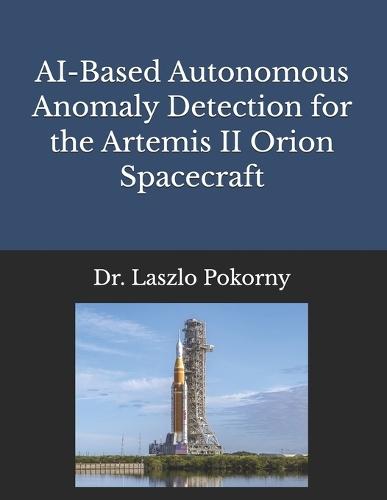
AI-Based Autonomous Anomaly Detection for the Artemis II Orion Spacecraft

Author:   Laszlo Pokorny
Publisher:   Independently Published
ISBN:  

9798258923301


Pages:   306
Publication Date:   26 April 2026
Format:   Paperback
Availability:   Available To Order   Availability explained
We have confirmation that this item is in stock with the supplier. It will be ordered in for you and dispatched immediately.

Our Price $46.33 Quantity:  
Add to Cart

Share |

AI-Based Autonomous Anomaly Detection for the Artemis II Orion Spacecraft


Overview

The safe execution of crewed deep-space missions demands autonomous spacecraft health monitoring systems capable of detecting anomalies in real time without reliance on ground-based intervention. This dissertation developed, implemented, and evaluated a hybrid deep learning framework for autonomous anomaly detection in spacecraft telemetry, designed for application to the Artemis II Orion Multi-Purpose Crew Vehicle-the first crewed lunar flyby mission in over 50 years. The study employed a semi-supervised learning paradigm, training six anomaly detection models-including a novel Hybrid Ensemble combining Long Short-Term Memory Autoencoder (LSTM-AE) and Transformer architectures-on the NASA Soil Moisture Active Passive (SMAP) and Mars Science Laboratory (MSL) benchmark telemetry datasets encompassing 20 channels and over 229,000 data points. The Hybrid Ensemble achieved an F1-score of .944, an area under the receiver operating characteristic curve (AUC-ROC) of .971, and a point-adjust F1-score of .995, substantially outperforming traditional baselines including One-Class Support Vector Machine (F1 = .618) and Isolation Forest (F1 = .629), as well as the individual LSTM-AE (F1 = .896) and Transformer (F1 = .889) models. Digital twin integration incorporating JPL Horizons trajectory analysis, NASA DONKI space weather monitoring, and multi-modal anomaly fusion demonstrated the feasibility of a comprehensive spacecraft health monitoring ecosystem. Computational efficiency analysis confirmed deployment viability on space-grade hardware, with the Hybrid Ensemble requiring only 0.941 MB of memory and achieving inference latency of 0.726 ms per telemetry window. These findings advance the state of the art in spacecraft integrated vehicle health management and provide an empirically validated framework for enhancing crew safety and mission assurance in the autonomous deep-space operations envisioned for Artemis III and future Mars expeditions.

Full Product Details

Author:   Laszlo Pokorny
Publisher:   Independently Published
Imprint:   Independently Published
Dimensions:   Width: 21.60cm , Height: 1.60cm , Length: 27.90cm
Weight:   0.712kg
ISBN:  

9798258923301


Pages:   306
Publication Date:   26 April 2026
Audience:   General/trade ,  General
Format:   Paperback
Publisher's Status:   Active
Availability:   Available To Order   Availability explained
We have confirmation that this item is in stock with the supplier. It will be ordered in for you and dispatched immediately.

Table of Contents

Reviews

Author Information

Tab Content 6

Author Website:  

Countries Available

All regions
Latest Reading Guide

MRGC26


Shopping Cart
Your cart is empty
Shopping cart
Mailing List