Overview
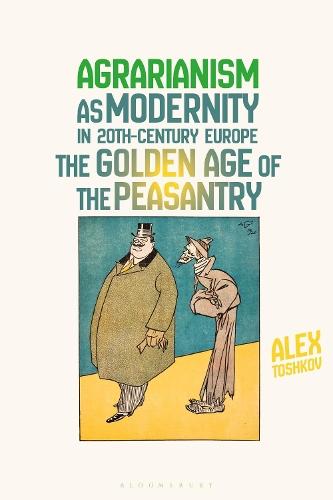
Whilst Soviet communism and its relationship with modernity has been widely studied to date, the agrarian experiment in Eastern Europe has been relegated to the margins of historical analysis. In this comparative study, Alex Toshkov uncovers the history of agrarianism after the First World War and explores its place as an alternative modernity to liberal democracy and capitalism. Drawing on a wealth of archival material, this book explores the transnational connections between the paradigmatic cases of Bulgaria, Yugoslavia and Czechoslovakia, as well as the International Agrarian Bureau in Prague, teasing out contradictions, hidden records and silenced interpretations of agrarianism. In addition, it uses a microhistorical approach to present an innovative theoretical framework which adds to our understanding of nationalism, political corruption, and alterity and the subaltern. This fascinating study restores interwar agrarianism to its rightful place as one of the most original and significant political currents in 20th-century Europe.
Full Product Details
Author: Dr Alex Toshkov (University of Toronto, Canada)
Publisher: Bloomsbury Publishing PLC
Imprint: Bloomsbury Academic
Weight: 0.517kg
ISBN: 9781350090552
ISBN 10: 1350090557
Pages: 240
Publication Date: 05 September 2019
Audience:
College/higher education
,
Tertiary & Higher Education
Format: Hardback
Publisher's Status: Active
Availability: Manufactured on demand

We will order this item for you from a manufactured on demand supplier.
Reviews
Agrarianism constituted one of the best alternatives for democratic, peaceful and equitable development in early 20th-century Europe. Alex Toshkov's fresh account provides a compelling analysis of peasant parties presenting them as an opportunity crushed by hostile forces. His unique, comparative approach makes the book a must-read for anyone interested in the modern political history of the region. * Ulf Brunnbauer, Leibniz Institute for East and Southeast European Studies, University of Regensburg, Germany * Alex Toshkov restores to history the Agrarian movements of Eastern Europe, deftly and expertly showing how their radical and forward-looking vision of modernity reshaped postwar politics and forced their opponents on the right and left to respond to them. This volume profoundly reshapes our understanding of the potential that Agrarian politics had in the aftermath of World War One and how the reaction against Agrarianism lies at the heart of the story of the interwar period. * Daniel Brett, Teaching Fellow in Social and Political Science, University College London, UK *
No doubt, Agrarianism as Modernity will provoke debates beyond the circle of specialists in the agrarian history of the interwar period. * Revue d'Histoire Moderne & Contemporaine (Bloomsbury Translation) * Agrarianism constituted one of the best alternatives for democratic, peaceful and equitable development in early 20th-century Europe. Alex Toshkov’s fresh account provides a compelling analysis of peasant parties presenting them as an opportunity crushed by hostile forces. His unique, comparative approach makes the book a must-read for anyone interested in the modern political history of the region. * Ulf Brunnbauer, Leibniz Institute for East and Southeast European Studies, University of Regensburg, Germany * Alex Toshkov restores to history the Agrarian movements of Eastern Europe, deftly and expertly showing how their radical and forward-looking vision of modernity reshaped postwar politics and forced their opponents on the right and left to respond to them. This volume profoundly reshapes our understanding of the potential that Agrarian politics had in the aftermath of World War One and how the reaction against Agrarianism lies at the heart of the story of the interwar period. * Daniel Brett, Teaching Fellow in Social and Political Science, University College London, UK *
Agrarianism constituted one of the best alternatives for democratic, peaceful and equitable development in early 20th century South-East and East-Central Europe. Alex Toshkov's fresh account provides a compelling analysis of peasant parties presenting them as an opportunity crushed by hostile forces. His unique, comparative approach makes the book a must-read for anyone interested in the modern political history of the region. * Ulf Brunnbauer, Leibniz Institute for East and Southeast European Studies, University of Regensburg, Germany *
Agrarianism constituted one of the best alternatives for democratic, peaceful and equitable development in early 20th century Europe. Alex Toshkov's fresh account provides a compelling analysis of peasant parties presenting them as an opportunity crushed by hostile forces. His unique, comparative approach makes the book a must-read for anyone interested in the modern political history of the region. * Ulf Brunnbauer, Leibniz Institute for East and Southeast European Studies, University of Regensburg, Germany * Alex Toshkov restores to history the Agrarian movements of Eastern Europe, deftly and expertly showing how their radical and forward-looking vision of modernity reshaped postwar politics and forced their opponents on the right and left to respond to them. This volume profoundly reshapes our understanding of the potential that Agrarian politics had in the aftermath of World War One and how the reaction against Agrarianism lies at the heart of the story of the interwar period. * Daniel Brett, Teaching Fellow in Social and Political Science, University College London, UK *
Agrarianism constituted one of the best alternatives for democratic, peaceful and equitable development in early 20th century South-East and East-Central Europe. Alex Toshkov's fresh account provides a compelling analysis of peasant parties presenting them as an opportunity crushed by hostile forces. His unique, comparative approach makes the book a must-read for anyone interested in the modern political history of the region. * Ulf Brunnbauer, Leibniz Institute for East and Southeast European Studies, University of Regensburg, Germany * Alex Toshkov restores to history the Agrarian movements of Eastern Europe, deftly and expertly showing how their radical and forward-looking vision of modernity reshaped postwar politics and forced their opponents on the right and left to respond to them. The Agrarians were both product of modernity but also strove to articulate and institute a more equitable modernity for the peasant masses, this vision was both domestic and international. This volume profoundly reshapes our understanding of the potential that Agrarian politics had in the aftermath of World War One and how the reaction against Agrarianism lies at the heart of the story of the interwar period. * Daniel Brett, University College London, UK *
No doubt, Agrarianism as Modernity will provoke debates beyond the circle of specialists in the agrarian history of the interwar period. * Revue d'Histoire Moderne & Contemporaine (Bloomsbury Translation) * Agrarianism constituted one of the best alternatives for democratic, peaceful and equitable development in early 20th-century Europe. Alex Toshkov's fresh account provides a compelling analysis of peasant parties presenting them as an opportunity crushed by hostile forces. His unique, comparative approach makes the book a must-read for anyone interested in the modern political history of the region. * Ulf Brunnbauer, Leibniz Institute for East and Southeast European Studies, University of Regensburg, Germany * Alex Toshkov restores to history the Agrarian movements of Eastern Europe, deftly and expertly showing how their radical and forward-looking vision of modernity reshaped postwar politics and forced their opponents on the right and left to respond to them. This volume profoundly reshapes our understanding of the potential that Agrarian politics had in the aftermath of World War One and how the reaction against Agrarianism lies at the heart of the story of the interwar period. * Daniel Brett, Teaching Fellow in Social and Political Science, University College London, UK *
Author Information
Alex Toshkov is Sessional Lecturer at the Centre for European, Russian, and Eurasian Studies at the University of Toronto, Canada.