Overview
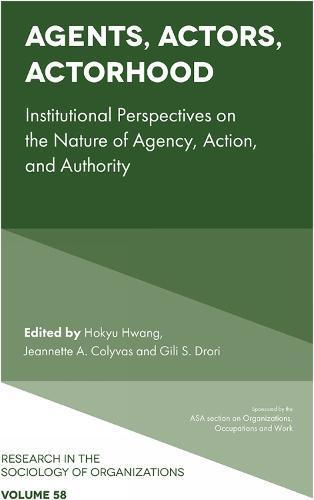
National governments are increasingly sharing the stage with many other forms of empowered social actors and authoritative players. Worldwide, alongside governmental bureaucracies, we witness the proliferation of non-for-profit and voluntary associations, business organizations and corporations, civic action committees and political parties, as well as celebrities and cultural icons. Importantly, whether they are individual- and collective social actors, these various actors are bestowed with the legitimate authority to speak their mind, act on their agenda, and influence the course of social progress. How might we conceptualize the role of such empowered social actors? This compilation of research and commentary gathers a range of institutional perspectives investigating what the devolution of state power and the so-called democratization of social action means for the nature of authority and how the multiplicity and variety of social actors impacts societies worldwide, extending from focus on agents to actors to actorhood.
Full Product Details
Author: Hokyu Hwang (University of New South Wales, Australia) , Jeannette A. Colyvas (Northwestern University, USA) , Gili S. Drori (The Hebrew University of Jerusalem, Israel)
Publisher: Emerald Publishing Limited
Imprint: Emerald Publishing Limited
Volume: 58
Dimensions:
Width: 15.20cm
, Height: 2.00cm
, Length: 22.90cm
Weight: 0.535kg
ISBN: 9781787560819
ISBN 10: 1787560813
Pages: 304
Publication Date: 05 April 2019
Audience:
Professional and scholarly
,
Professional & Vocational
Format: Hardback
Publisher's Status: Active
Availability: In Print 
This item will be ordered in for you from one of our suppliers. Upon receipt, we will promptly dispatch it out to you. For in store availability, please contact us.
Table of Contents
Introduction Part I: Overview 1. Institutions and Actors in Institutional Theory; Hokyu Hwang, Jeannette A. Colyvas, and Gili S. Drori Part II: Construction of Actors 2. What Difference Does it Make? An Institutional Perspective on Actors and Types Thereof; Raimund Hasse 3. School Principals as Agents: Autonomy, Embeddedness, and Script; Ravit Mizrahi-Shtelman 4. Me and My Avatar: Acquiring Actorial Identity; Anthony J. O’Tierney, Donncha Kavanagh, and Kevin Scally 5. Beyond Service Provision: Advocacy and the Construction of Nonprofits as Organizational Actors; Hokyu Hwang and David Suárez 6. Constructing the Consultant as a Legitimate Actor: The Role of Active Clients in Universities; Tim Sienderschnur and Georg Krücken 7. Constructing Organizations as Actors: Insights from Research Designs in the Literature On Institutional Logics; Guillermo Casasnovas and Marc Ventresca Part III: Work of Actors 8. Mentoring Institutional Change: Intergenerational Construction of Meso-Structure and the Emergence of New Logics in American Healthcare; Gina Dokko, Amit Nigam, and Daisy Chung 9. Machina ex Deus: From Distributed to Orchestrated Agency; Daniel Semper 10. Political and Institutional Influences on the Legal Codification of Nascent Markets: Incorporation of Islamic Banking and Organic Agriculture in Turkey, 1984-2015; Özgür Rahşan Çetrez 11. Institutional Work in High-Altitude Mountaineering: Rope-fixing, the 'Everest brawl', and Changes in Sherpa Actorhood; Marc Lenglet and Philippe Rozin 12. The Claim for Actorhood in Institutional Work; Merav Migdal-Picker and Tammar B. Zilber Part IV: Afterword 13. Reflections on Rationalization, Actors and Others; John W. Meyer
Reviews
Researchers from Europe, the US, Israel, and Australia present 13 essays that examine the emergence, construction, and transformation of actors and their agency, action, and authority in institutions in various contexts. The first section considers the meanings, construction, and emergence of actors in institutions, including different types of actors, school principals, the concept of actorial identity through the construction of legal persons as actors, nonprofits as organizational actors, the role of active clients in universities, and the institutional construction of organizations as actors. The second section discusses the work of actors in episodes of institutional change and stability, with discussion of the emergence of evidence-based medicine in American health care, the emergence of the profession of scientific winemaking in the Australian wine industry, the incorporation of Islamic banking and organic agriculture within the legal system in Turkey, changes in sherpa actorhood in mountaineering, and the struggle for legitimacy of the LGBT community in Israel. -- Annotation (c)2019 * (protoview.com) *
Author Information
Hokyu Hwang is Senior Lecturer in the UNSW Business School, University of New South Wales, Australia. He received his PhD in sociology from Stanford University, USA. He is editor of Globalization and Organization: World Society and Organizational Change.Jeannette A. Colyvas is Associate Professor of Learning Sciences, and Human Development and Social Policy, at Northwestern University, USA. She is also faculty (by courtesy) of the Kellogg School of Management. She received her PhD from Stanford University, USA. Gili S. Drori is Professor of Sociology at The Hebrew University of Jerusalem, Israel. She has held positions as Stanford University, University of California, Berkeley, the Technion and University of Bergamo, as well as guest appointments at University of Uppsala and Lund University.
Tab Content 6
Author Website:
Countries Available
All regions
|