Overview
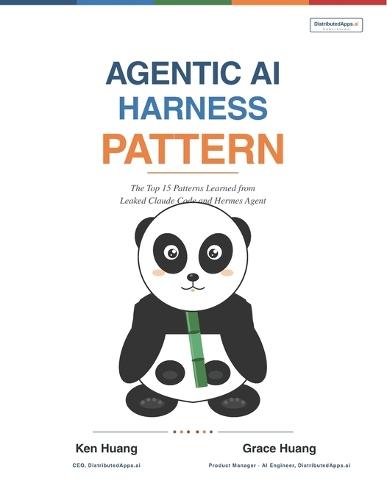
Most AI tutorials teach you prompts. This book teaches you patterns. Production AI engineering - the discipline of turning a language model into something reliable, safe, auditable, and shippable - is mostly undocumented. The libraries churn every quarter. The patterns endure. Agentic AI Harness Pattern distills 15 of those patterns by reading two mature production codebases side by side: Claude Code, Anthropic's TypeScript CLI for agentic coding, and Hermes, a Python agent built to run across messaging platforms. The two systems make different language choices, different concurrency choices, and different deployment choices - but the harness pattern they implement is the same. Every chapter follows the same rhythm: Name the pattern. What problem is the harness solving? Show Claude Code's implementation in real TypeScript. Show Hermes's implementation in real Python. Compare them as a table. Where do they diverge, and why? Recommend when to use which. A decision rule, not a hot take. Apply the pattern to a defensive cyber-security agent. A worked example that shows the pattern under operational pressure. Inside the 15 patterns The Harness Paradigm - why a model alone is not a product Tool Architecture and the Tool Contract - the boundary between reasoning and consequence The Query / Agent Loop - what happens between the model's tool call and the next turn Permission Systems and Safety Guardrails - gating the destructive set Tool Orchestration and Execution - partitioning safe vs. serial work Context Management at Scale - the five strategies before compaction Multi-Agent Coordination - when one agent isn't enough Memory Systems and State Persistence - three tiers, one cache Observability and Debugging - distributed tracing for non-deterministic systems Production Deployment Patterns - SDK-first vs. gateway-first Hook / Event-Driven Automation - the layer above the loop The Skill System Pattern - capabilities as content, not code MCP Integration - connecting agents to the world Model Routing and Provider Abstraction - falling back without falling over Structured Output and Schema-Constrained Generation - when free text isn't enough Who this book is for Engineers building AI products who keep hitting the same architectural questions and want vetted answers. Architects and tech leads making the build-vs-buy-vs-wrap decision for an agent platform. Security and compliance reviewers who need to understand how a production agent enforces a destructive-action gate, an audit trail, and an iteration budget. Each chapter stands alone. Read what you need; read end-to-end and the patterns compound. Either way, you'll close the book with a working mental model of how to design an AI agent that survives contact with production. About the authors Ken Huang is CEO of DistributedApps.ai, advising organizations on production-grade agent deployment at the intersection of AI, distributed systems, and security. Grace Huang is a Product Manager and AI Engineer at PIMCO, where she ships AI features for the world's largest fixed-income asset manager. Her focus is the engineering rigor that makes AI products trustworthy in regulated environments. The model is intelligence. The harness is the system. Start here.
Full Product Details
Author: Grace Huang ,
Ken Huang
Publisher: Independently Published
Imprint: Independently Published
Dimensions:
Width: 21.60cm
, Height: 1.50cm
, Length: 27.90cm
Weight: 0.676kg
ISBN: 9798196177972
Pages: 290
Publication Date: 09 May 2026
Audience:
General/trade
,
General
Format: Paperback
Publisher's Status: Active
Availability: Available To Order

We have confirmation that this item is in stock with the supplier. It will be ordered in for you and dispatched immediately.