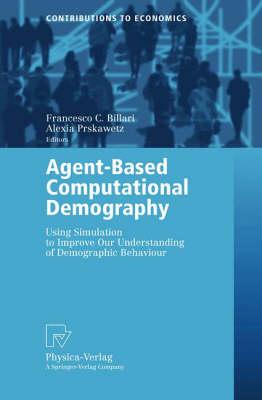
Agent-Based Computational Demography: Using Simulation to Improve Our Understanding of Demographic Behaviour

Author:   Francesco C. Billari ,  Alexia Prskawetz
Publisher:   Springer-Verlag Berlin and Heidelberg GmbH & Co. KG
Edition:   2003 ed.
ISBN:  

9783790815504


Pages:   210
Publication Date:   17 April 2003
Format:   Paperback
Availability:   In Print   Availability explained
This item will be ordered in for you from one of our suppliers. Upon receipt, we will promptly dispatch it out to you. For in store availability, please contact us.

Our Price $287.76 Quantity:  
Add to Cart

Share |

Agent-Based Computational Demography: Using Simulation to Improve Our Understanding of Demographic Behaviour


Overview

Full Product Details

Author:   Francesco C. Billari ,  Alexia Prskawetz
Publisher:   Springer-Verlag Berlin and Heidelberg GmbH & Co. KG
Imprint:   Physica-Verlag GmbH & Co
Edition:   2003 ed.
Dimensions:   Width: 15.50cm , Height: 1.20cm , Length: 23.50cm
Weight:   0.710kg
ISBN:  

9783790815504


ISBN 10:   3790815500
Pages:   210
Publication Date:   17 April 2003
Audience:   Professional and scholarly ,  Professional & Vocational
Format:   Paperback
Publisher's Status:   Active
Availability:   In Print   Availability explained
This item will be ordered in for you from one of our suppliers. Upon receipt, we will promptly dispatch it out to you. For in store availability, please contact us.

Table of Contents

Introduction: Agent-Based Computational Demography.- 1 Introduction: Demographers Are Almost Absent in a Flourishing Field of Research.- 2 The Gap Between Theory and Techniques in Demography.- 3 The Added Gains of Agent-Based Computational Demography.- 4 Difficulties and Challenges for Agent-Based Computational Demography.- 5 Agent-Based Models in Demography: Examples in this Book.- 6 Discussion: The Potential Roles of Agent-Based Computational Demography.- References.- Data, Models, Theory and Reality: The Structure of Demographic Knowledge.- 1 Introduction.- 2 The Methodology of Ansley J. Coale.- 3 Nathan Keyfitz on the Fruitfulness of Abstract Modelling.- 4 A Model-Based View of Science.- 5 Elements of Science.- 6 Assessing Scientific Knowledge.- 7 Coda: On the Dangers of Dichotomies.- References.- The Role of Agent-Based Modelling in Demographic Explanation.- 1 Introduction.- 2 The Problem of Thin Social Processes.- 3 The Problem of Relating Existing Theories to ABM.- 4 Representing Social Context.- 5 Representing Cognitive Complexity.- 6 Collecting Appropriate Data.- 7 Conclusion.- References.- Diffusion Processes in Demographic Transitions: A Prospect on Using Multi Agent Simulation to Explore the Role of Cognitive Strategies and Social Interactions.- 1 Introduction.- 2 Behavioural Rules in MAS.- 3 Decision Making.- 4 The Consumat Approach.- 5 A Possible Application of the Consumat Approach: The Diffusion of Contraceptives.- 6 Prospects for Applications of the Consumat Approach in Demographic Research Questions.- 7 Conclusions.- References.- The Collapse of the Berlin Wall: Simulating State -Level East to West German Migration Patterns.- 1 Introduction.- 2 Historical Background.- 3 Evidence on East to West German Migration.- 4 Theoretical Framework.- 5 Data and Stylized Facts.- 6 An Agent-Based Simulation Model.- 7 Conclusions.- References.- Agent-Based Modeling of Householders’ Migration Behavior and Its Consequences.- 1 Introduction.- 2 Agent-Based Modelling as a Tool for Analysis of Complex Multi-Agent Systems.- 3 Abstract Models of Residential Migration.- 4 A Real-World Agent-Based Model of Residential Choice and Migration.- 5 Discussion.- 6 Conclusions.- References.- Population-Wide Marriage Patterns Produced by Individual Mate-Search Heuristics.- 1 Introduction.- 2 The Demographic Patterns of Age at Marriage.- 3 Modeling Sequential Search Processes.- 4 Implications and Conclusions.- References.- On the Cultural Evolution of Age-at-Marriage Norms.- 1 Introduction.- 2 Background.- 3 An Agent-Based Model.- 4 Results and Discussion.- 5 Summary and Prospects for Future Research.- References.- Bringing Behavior Back into Micro-Simulation: Feedback Mechanisms in Demographic Models.- 1 Introduction.- 2 Data and Methods.- 3 Results.- 4 Summary of Findings.- References.- Consequences of Mortality Crises in Pre-Modern European Towns: A Multiagent-Based Simulation Approach.- 1 Introduction.- 2 James.- 3 Implementation in James.- 4 First Experiments and Some Preliminary Results.- 5 Conclusions and Future Prospects of the Model.- References.- Agents, Hierarchies and Sustainability.- 1 Setting: A Sugarscape-Like Grid.- 2 Agents: Overview.- 3 Experiments.- 4 Conclusion.- References.

Reviews

Author Information

Tab Content 6

Author Website:  

Countries Available

All regions
Latest Reading Guide

NOV RG 20252


Shopping Cart
Your cart is empty
Shopping cart
Mailing List