Overview
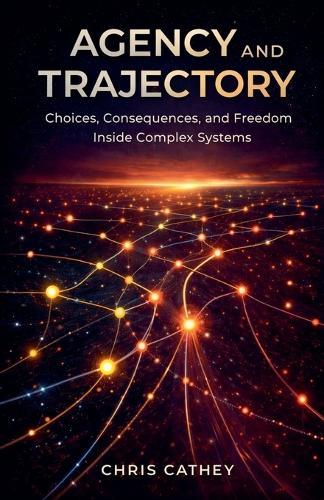
Most debates about free will and determinism fail because they ask the wrong question. Human beings experience themselves as choosing, yet often feel trapped by systems, circumstances, and consequences they did not intend. At the same time, modern culture alternates between blaming individuals for outcomes they could not realistically control and dismissing agency entirely by labeling everything ""systemic."" Both positions miss how agency actually works. Agency and Trajectory reframes freedom, responsibility, and choice through cybernetics and systems theory. Rather than treating agency as an all-or-nothing metaphysical property, this book shows how control emerges as a functional capacity within constrained, adaptive systems. Agency is not exemption from causality. It is the ability to regulate direction over time. Drawing on feedback loops, circular causality, equipotentiality, equifinality, and path dependence, the book explains why: Different starting conditions influence outcomes without fixing destiny Different choices often converge on the same results Small early decisions matter more than dramatic late ones Freedom collapses gradually as choice points narrow Determinism becomes visible only after trajectories harden Central to the model is a precise distinction between choice points and decision points. Choice points exist where multiple viable responses remain available. Decision points mark commitment, after which feedback, constraint, and causal momentum take over. Freedom lives earlier in the trajectory than most people realize. The book develops a coherent architecture of agency built on: Outcomes as reference values Feedback and sensory acuity Behavioral flexibility and requisite variety Reflexivity and second-order control Identity and narrative as self-constraints Ecological action across domains and time horizons Rather than promoting naïve voluntarism or fatalistic resignation, Agency and Trajectory offers a realistic account of freedom under constraint. It shows how agency is lost, why it sometimes cannot be restored by effort alone, and how it can be rebuilt by creating new leverage rather than chasing old options. Freedom, in this model, is not the absence of limits. It is the capacity to remain steerable within them.
Full Product Details
Author: Chris Cathey
Publisher: D&n Publishing
Imprint: D&n Publishing
Dimensions:
Width: 14.00cm
, Height: 0.60cm
, Length: 21.60cm
Weight: 0.118kg
ISBN: 9798235458376
Pages: 92
Publication Date: 31 January 2026
Audience:
General/trade
,
General
Format: Paperback
Publisher's Status: Active
Availability: Available To Order

We have confirmation that this item is in stock with the supplier. It will be ordered in for you and dispatched immediately.