Overview
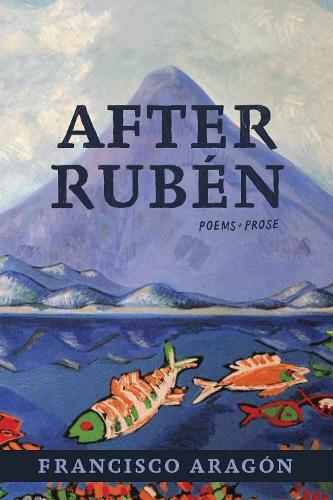
After Ruben unfolds as a decades-long journey in poems and prose, braiding the personal, the political & the historical, interspersing along the way English-language versions & riffs of a Spanish-language master: Ruben Dario. Whether it's biting portraits of public figures, or nuanced sketches of his father, Francisco Aragon has assembled his most expansive collection to date, evoking his native San Francisco, but also imagining ancestral spaces in Nicaragua. Readers will encounter pieces that splice lines from literary forebearers, a moving elegy to a sibling, a surprising epistle from the grave. In short: a book that is both trajectory & mosaic, complicating the conversation surrounding poetry in the Americas--above all as it relates to Latinx and queer poetics.
Full Product Details
Author: Francisco Aragon
Publisher: Red Hen Press
Imprint: Red Hen Press
Dimensions:
Width: 15.20cm
, Height: 1.30cm
, Length: 22.80cm
Weight: 0.227kg
ISBN: 9781597098571
ISBN 10: 1597098574
Pages: 160
Publication Date: 18 June 2020
Audience:
General/trade
,
General
Format: Paperback
Publisher's Status: Active
Availability: Temporarily unavailable

The supplier advises that this item is temporarily unavailable. It will be ordered for you and placed on backorder. Once it does come back in stock, we will ship it out to you.
Reviews
Marvel at Francisco's new collection and translations of Dario--there are soft, almost sepia-blurry portraits of unnamed figures, episodes, eras, and families. The Bay Area appears and dissolves as we journey with Aragon--we amble shoulder to shoulder and listen to intimate, almost impossible short phrases and we stop on occasion and notice the silence, the separations, aflutter in the light. The collaborations with the late Andres Montoya and Carmen Calatayud, and verses inspired by Machado, Dario, Apollinaire, and Cendrars are stellar. This is a book made of books, cultures, and languages, a search made of searches-- I tried to invent new flowers, new tongues, it says--and indeed Francisco has accomplished this task. Rare for its intimate, deep voices and expansive, chromatic treks. --Juan Felipe Herrera, Poet Laureate of the United States (2015-2017) Consider all of this / an excursus on origins, advises Francisco Aragon as he invites the reader into the queer Latinx literary lineage in After Ruben. Comprised of equal parts familial and scholarly figures and conflicts, the depiction of Ruben Dario's poetic legacy in this collection reveals his lasting impact on Aragon, whose verse illuminates a range of complex and passionate lives. Aragon's translations (the originals are reproduced in an appendix) and ekphrastic re-visions of ten of Dario's poems are daring and, indeed, blasphemous. --Carmen Gimenez Smith, author of Cruel Futures and Be Recorder Part imagined intimate diary of the poet Ruben Dario, part lyrical exploration of the rich inner life of poet Aragon, this pulsating book is an ode to the between-world of those who live a life dedicated to observation of words. Sonically charged lines that delve into solitude, travel, separation, grief, and the complex life of the outsider allow these poems to speak both to the individual Latinx experience and the universal desire to belong, to be heard. --Ada Limon, author of The Carrying and Bright Dead Things After Ruben es una maravilla. Its elegant, lapidary poems are whispered, intoned, delivered like manifestos, or sung in halting measures that transmute the ephemera of memory and witness into the flashes and trails of glimpsed truths. Francisco Aragon, an American poet of uncommon ambition, has created a bejeweled puzzle box of a book, a fragmented Mariposa memoir of a childhood in between worlds, set within an homage to the poets whose inspirations helped him find his voice, all of which is interwoven in a celebration, an elegy--an interrogation--of the legacy of his greatest literary mentor, the great Nicaraguan poet Ruben Dario. In this heady poetic idiom, bridging his home in San Francisco and scenes in Nicaragua with other places from his life in the States, Aragon's poetry hearkens again to the possibility of a poetics of las Americas, unbounded, unabashedly literary across cultures, languages, history, and journalism, unafraid to anatomize itself, and to regard and report the ever-shifting totalities of our Latinidad. --John Phillip Santos, author of Places Left Unfinished at the Time of Creation and The Farthest Home Is in an Empire of Fire What is remarkable about this book is Aragon's here, there, how ( Cancion )--the integration of history, identity, geography, homage, poetry, and prose that characterizes the collection. What contemporary Latinx poetry does best is defy division, instead affirming the complex and beautifully profound communion of beings pulsing through the poet's veins. I am large, wrote Whitman, I contain multitudes. This book embodies these words as a powerful argument for justice, compassion and love. --Valerie Martinez, author of Each and Her, Poet Laureate of Santa Fe, NM (2008-2010) As I read Francisco Aragon's fine new book, After Ruben, I couldn't avoid the thought that here's more evidence that the top of the twenty-first century is when American Poetry finally gets to catch up with itself, will be the moment that the blanks begin to get filled in. After Ruben is a breathtaking example of how a poet at the top of his game makes an irresistible space for his song. --Cornelius Eady, Professor of English SUNY Stony Brook Southampton
Marvel at Francisco's new collection and translations of Dario--there are soft, almost sepia-blurry portraits of unnamed figures, episodes, eras, and families. The Bay Area appears and dissolves as we journey with Aragon--we amble shoulder to shoulder and listen to intimate, almost impossible short phrases and we stop on occasion and notice the silence, the separations, aflutter in the light. The collaborations with the late Andres Montoya and Carmen Calatayud, and verses inspired by Machado, Dario, Apollinaire, and Cendrars are stellar. This is a book made of books, cultures, and languages, a search made of searches-- I tried to invent new flowers, new tongues, it says--and indeed Francisco has accomplished this task. Rare for its intimate, deep voices and expansive, chromatic treks. --Juan Felipe Herrera, Poet Laureate of the United States (2015-2017) Consider all of this / an excursus on origins, advises Francisco Aragon as he invites the reader into the queer Latinx literary lineage in After Ruben. Comprised of equal parts familial and scholarly figures and conflicts, the depiction of Ruben Dario's poetic legacy in this collection reveals his lasting impact on Aragon, whose verse illuminates a range of complex and passionate lives. Aragon's translations (the originals are reproduced in an appendix) and ekphrastic re-visions of ten of Dario's poems are daring and, indeed, blasphemous. --Carmen Gimenez Smith, author of Cruel Futures and Be Recorder Part imagined intimate diary of the poet Ruben Dario, part lyrical exploration of the rich inner life of poet Aragon, this pulsating book is an ode to the between-world of those who live a life dedicated to observation of words. Sonically charged lines that delve into solitude, travel, separation, grief, and the complex life of the outsider allow these poems to speak both to the individual Latinx experience and the universal desire to belong, to be heard. --Ada Limon, author of The Carrying and Bright Dead Things After Ruben es una maravilla. Its elegant, lapidary poems are whispered, intoned, delivered like manifestos, or sung in halting measures that transmute the ephemera of memory and witness into the flashes and trails of glimpsed truths. Francisco Aragon, an American poet of uncommon ambition, has created a bejeweled puzzle box of a book, a fragmented Mariposa memoir of a childhood in between worlds, set within an homage to the poets whose inspirations helped him find his voice, all of which is interwoven in a celebration, an elegy--an interrogation--of the legacy of his greatest literary mentor, the great Nicaraguan poet Ruben Dario. In this heady poetic idiom, bridging his home in San Francisco and scenes in Nicaragua with other places from his life in the States, Aragon's poetry hearkens again to the possibility of a poetics of las Americas, unbounded, unabashedly literary across cultures, languages, history, and journalism, unafraid to anatomize itself, and to regard and report the ever-shifting totalities of our Latinidad. --John Phillip Santos, author of Places Left Unfinished at the Time of Creation and The Farthest Home Is in an Empire of Fire What is remarkable about this book is Aragon's here, there, how ( Cancion )--the integration of history, identity, geography, homage, poetry, and prose that characterizes the collection. What contemporary Latinx poetry does best is defy division, instead affirming the complex and beautifully profound communion of beings pulsing through the poet's veins. I am large, wrote Whitman, I contain multitudes. This book embodies these words as a powerful argument for justice, compassion and love. --Valerie Martinez, author of Each and Her, Poet Laureate of Santa Fe, NM (2008-2010) As I read Francisco Aragon's fine new book, After Ruben, I couldn't avoid the thought that here's more evidence that the top of the twenty-first century is when American Poetry finally gets to catch up with itself, will be the moment that the blanks begin to get filled in. After Ruben is a breathtaking example of how a poet at the top of his game makes an irresistible space for his song. --Cornelius Eady, Professor of English SUNY Stony Brook Southampton Aragon draws inspiration from the life and work of Ruben Dario, building lyrics around responses to the latter's legacy. The result is a brilliant hybridity, filled with erasures, riffs, and interpretations of the maestro's lifework. --Rosebud Ben-Oni, Kenyon Review After Ruben reads like a haunted meditation on the complexity of literary traditions and on the many senses of after -inspired by Dario while seeking out a contemporary counter-genealogy in what is lost and what remains. --Urayoan Noel, 30 Books of Latinx Poetry, The Latinx Project The Poetry Society of America Feature On 1985 An interview with the Green Mountains Review ...a platform from which to examine family, politics, and his poetic inheritance. --Emily Perez, RHINO
Author Information
Francisco Aragón is the son of Nicaraguan immigrants. He is the author of Puerta del Sol and Glow of Our Sweat, as well as editor of The Wind Shifts: New Latino Poetry. His poems have appeared in twenty anthologies, most recently The Wandering Song: Central American Writing in the United States (Tia Chucha Press) and Nepantla: An Anthology Dedicated to Queer Poets of Color (Nightbook Books). Others include Inventions of Farewell: A Book of Elegies (W.W. Norton), Deep Travel: American Poets Abroad (Ninebark Press), and Poetry of Resistance: Voices for Social Justice (University of Arizona Press). In 2017, he was a finalist for Split This Rock’s Freedom Plow Award for Poetry & Activism. A native of San Francisco, CA, he directs Letras Latinas, the literary initiative at the University of Notre Dame’s Institute for Latino Studies. Aragón divides his time between Washington, D.C. and South Bend, IN.