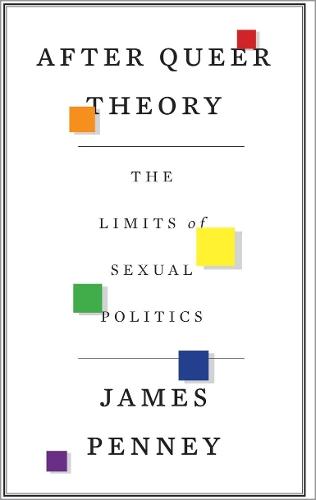
Full Product Details
Author: James Penney
Publisher: Pluto Press
Imprint: Pluto Press
Dimensions:
Width: 13.50cm
, Height: 1.80cm
, Length: 21.50cm
Weight: 0.291kg
ISBN: 9780745333786
ISBN 10: 0745333788
Pages: 224
Publication Date: 08 November 2013
Audience:
Professional and scholarly
,
Professional & Vocational
Format: Paperback
Publisher's Status: Active
Availability: Out of stock

The supplier is temporarily out of stock of this item. It will be ordered for you on backorder and shipped when it becomes available.
Reviews
The audacious and sound thesis of Penney's new book - that the political as such is structured by sexuality - reties the knot between Freud and Marx in a way that exposes just how politically anemic theories of their pairing have become in recent years. Opting for an emancipatory rather than lifestyle politics, After Queer Theory wrests the anti-homophobic project from the grip of an at once hopelessly narrow and uselessly general queer theory. -- Joan Copjec, Brown University James Penney has done it again. As with his previous work, he is careful, in After Queer Theory, to explain his key theoretical terms and ground them in an informed and nuanced history of where the terms come from. Perhaps one of the most original (and intriguing) aspects of the project is his idea of the homosexual unconscious , which is worked out dialectically through reference to a multiplicity of urgent, current, socio-political events. He is correct to state that Queer Theory is now at a crucial turning point, when the only option is to undertake a radical and thorough critique of its presuppositions and present state. No other critics have undertaken such a project at the present time. -- Clive Thompson, School of Languages and Literatures, University of Guelph
The audacious and sound thesis of Penney's new book - that the political as such is structured by sexuality - reties the knot between Freud and Marx in a way that exposes just how politically anemic theories of their pairing have become in recent years. Opting for an emancipatory rather than lifestyle politics, After Queer Theory wrests the anti-homophobic project from the grip of an at once hopelessly narrow and uselessly general queer theory. -- Joan Copjec, Brown University James Penney has done it again. As with his previous work, he is careful , in After Queer Theory, to explain his key theoretical terms and ground them in an informed and nuanced history of where the terms come from. Perhaps one of the most original (and intriguing) aspects of the project is his idea of the homosexual unconscious , which is worked out dialectically through reference to a multiplicity of urgent, current, socio-political events. He is correct to state that Queer Theory is now at a crucial turning point, when the only option is to undertake a radical and thorough critique of its presuppositions and present state. No other critics have undertaken such a project at the present time. -- Clive Thompson, School of Languages and Literatures, University of Guelph
Author Information
James Penney teaches cultural theory at Trent University, Canada. He is the author of The Structures of Love (SUNY Press, 2012), and The World of Perversion (SUNY Press, 2006) and After Queer Theory (Pluto, 2013).