Overview
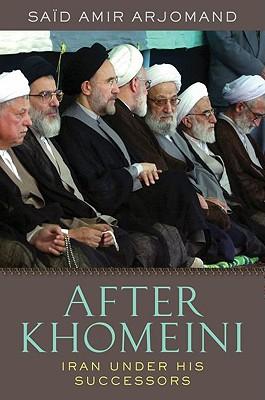
For many Americans, Iran is our most dangerous enemy--part of George W. Bush's axis of evil even before the appearance of Ahmadinejad. But what is the reality? How did Ahmadinejad rise to power, and how much power does he really have? What are the chances of normalizing relations with Iran?In After Khomeini, Said Amir Arjomand paints a subtle and perceptive portrait of contemporary Iran. This work, a sequel to Arjomand's acclaimed The Turban for the Crown, examines Iran under the successors of Ayatollah Khomeini up to the present day. He begins, as the Islamic Republic did, with Khomeini, offering a brilliant capsule biography of the man who masterminded the revolution that overthrew the Shah. Arjomand draws clear distinctions between the moderates of the initial phrase of the revolution, radicals, pragmatists, and hardliners, the latter best exemplified by Mahmud Ahmadinejad. Taking a chronological and thematic approach, he traces the emergence and consolidation of the present system of collective rule by clerical councils and the peaceful transition to dual leadership by the ayatollah as the supreme guide and the subordinate president of the Islamic Republic of Iran. He explains the internal political quarrels among Khomeini's heirs as a struggle over his revolutionary legacy. And he outlines how the ruling clerical elite and the nation's security forces are interdependent politically and economically, speculating on the potential future role of the Revolutionary Guards. Bringing the work up to current political events, Arjomand analyzes Iran's foreign policy as well, including the impact of the fall of Communism on Iran and Ahmadinejad's nuclear policy.Few countries loom larger in American foreign relations than Iran. In this rich and insightful account, an expert on Iranian society and politics untangles the complexities of a nation still riding the turbulent wake of one of history's great revolutions.
Full Product Details
Author: Said Amir Arjomand (Distinguished Service Professor of Sociology and Director of the Stony Brook Institute for Global Studies, Stony Brook University)
Publisher: Oxford University Press Inc
Imprint: Oxford University Press Inc
Dimensions:
Width: 16.30cm
, Height: 2.00cm
, Length: 24.20cm
Weight: 0.520kg
ISBN: 9780195391794
ISBN 10: 0195391799
Pages: 280
Publication Date: 26 November 2009
Audience:
General/trade
,
General
Format: Paperback
Publisher's Status: Out of Print
Availability: In Print

Limited stock is available. It will be ordered for you and shipped pending supplier's limited stock.
Reviews
A clear analysis of Iran's political and ideological transformation in the post-Khomeini period. Dealing with a broad range of issues from political development and constitutional politics to Islamic reformism and the rise of new conservatives, this book is a valuable addition to Iranian studies and current debates in the sociology of revolution. --Ali Gheissari, University of San Diego Said Arjomand illuminates post-revolutionary Iran by placing it in its broad historical and sociological setting. His familiarity with Islamic texts, together with his careful reading of modern revolutions, makes him exceptionally well qualified to understand and communicate what religion in this case has done to revolution and, perhaps even more importantly, what revolution has done to Shi'ite Islam in Iran. Coming twenty years after his masterful analysis of the Iranian revolution in The Turban for the Crown, this treatment of the revolution After Khomeini removes some of the mystery from one of the most consequential events of our times. --Gary Sick, Columbia University With an unsurpassed command over the material and events and a comparativist perspective, Said Amir Arjomand rescues our entrapped understanding of Iran and sets a superior standard for a new generation of scholarship. It is impossible to understand what has happened in Iran of the last three decades without a careful reading of this uncommonly perceptive and extraordinary book. --Hamid Dabashi, author of Iran: A People Interrupted After Khomeini may indeed prove to be a conceptually ground-breaking work of great interest to both lay people and specialists in Iranian, Middle Eastern, Islamic studies, and the sociology of revolution....The work constitutes an invaluable contribution to a genuine theoretical understanding of post-revolutionary and post-reformist Iran, insofar as it seeks to uncover the complex interplay of the intended as well as of the unintended consequences of the 1979 revolution. --American Journal of Islamic Social Sciences In this timely book, Amir Arjomand concisely presents an analytical perspective on the post-Khomeini Iran that one expects from much longer books...Arjomand's analysis here and in other parts of the book, I believe, may open exciting paths to pursue for graduate students in the field of Iranian studies. --Contemporary Islam
<br> A clear analysis of Iran's political and ideological transformation in the post-Khomeini period. Dealing with a broad range of issues from political development and constitutional politics to Islamic reformism and the rise of new conservatives, this book is a valuable addition to Iranian studies and current debates in the sociology of revolution. --Ali Gheissari, University of San Diego<br> Said Arjomand illuminates post-revolutionary Iran by placing it in its broad historical and sociological setting. His familiarity with Islamic texts, together with his careful reading of modern revolutions, makes him exceptionally well qualified to understand and communicate what religion in this case has done to revolution and, perhaps even more importantly, what revolution has done to Shi'ite Islam in Iran. Coming twenty years after his masterful analysis of the Iranian revolution in The Turban for the Crown, this treatment of the revolution After Khomeini removes some of the mystery from one
Author Information
Said Amir Arjomand is Distinguished Service Professor of Sociology and Director of the Stony Brook Institute for Global Studies at Stony Brook University. He is the founder and president of the Association for the Study of Persianate Societies and the editor of the Journal of Persianate Studies. He is the author of The Turban for the Crown.