Overview
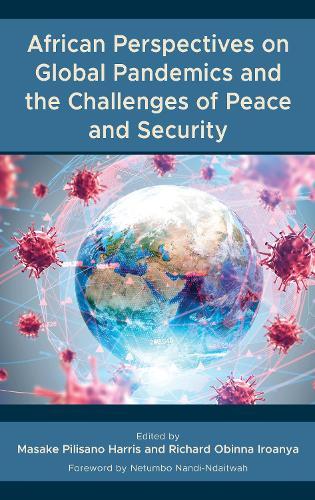
African Perspectives on Global Pandemics and the Challenges of Peace and Security by Masake Pilisano Harris and Richard Obinna Iroanya dissects the effects of pandemics in Africa and the possibilities for countering pandemic outbreaks in the future. The contributors of this volume bring new perspectives on the legal and security challenges of pandemics, covering political, socio-economic, health, security, and legal facets of pandemics nationally and regionally. This book discusses essential topics including: securitization, state behavior and actions during the COVID-19 pandemic, public health and political measures during pandemics, the amplification of the insecurities in African states, the increase of crime and criminality related to pandemic challenges, and the economic impacts that surround pandemic outbreaks. Harris and Iroanya bring these thematic areas to light not only to comprehensively analyze countermeasures towards pandemics in Africa, but also to encourage security policies that reflect the multidimensional nature of state authority and functions to tackle the next outbreak more affectively.
Full Product Details
Author: Masake Pilisano Harris ,
Richard Obinna Iroanya (University of Namibia, Namibia) ,
Shipena Dortea ,
Nguluwe Gabriella
Publisher: Bloomsbury Publishing Plc
Imprint: Lexington Books
Dimensions:
Width: 15.80cm
, Height: 2.30cm
, Length: 23.60cm
Weight: 0.544kg
ISBN: 9781666924800
ISBN 10: 1666924806
Pages: 236
Publication Date: 15 October 2023
Audience:
Professional and scholarly
,
Professional & Vocational
Format: Hardback
Publisher's Status: Active
Availability: Manufactured on demand

We will order this item for you from a manufactured on demand supplier.
Reviews
I highly recommend this book as it provides a novel exploration of how the COVID-19 pandemic could be understood in terms of the theories and concepts relating to our evolving understanding of threats to international relations, national security, human security and civil-military relations through an African perspective. The value of the book is in the contextualization of international relations theory, the human security paradigm, and securitization within African case studies. It also includes useful analyses of how threats to peace and security could be expanded to include epidemics and pandemics. This book provides readers with original insights into the developments in the current debates relating to African security and will be of particularly great use to students of political science, security studies, military history, civil-military relations, and military sociology.
I highly recommend this book as it provides a novel exploration of how the COVID-19 pandemic could be understood in terms of the theories and concepts relating to our evolving understanding of threats to international relations, national security, human security and civil-military relations through an African perspective. The value of the book is in the contextualization of international relations theory, the human security paradigm, and securitization within African case studies. It also includes useful analyses of how threats to peace and security could be expanded to include epidemics and pandemics. This book provides readers with original insights into the developments in the current debates relating to African security and will be of particularly great use to students of political science, security studies, military history, civil-military relations, and military sociology. --Laetitia Olivier, Stellenbosch University I highly recommend this book as it provides a novel exploration of how the COVID-19 pandemic could be understood in terms of the theories and concepts relating to our evolving understanding of threats to international relations, national security, human security and civil-military relations through an African perspective. The value of the book is in the contextualization of international relations theory, the human security paradigm, and securitization within African case studies. It also includes useful analyses of how threats to peace and security could be expanded to include epidemics and pandemics. This book provides readers with original insights into the developments in the current debates relating to African security and will be of particularly great use to students of political science, security studies, military history, civil-military relations, and military sociology.
Author Information
Masake Pilisano Harris is associate dean for the School of Human Sciences and Education at the Namibia University of Science and Technology. Richard Obinna Iroanya is senior lecturer of the School of Military Science at the University of Namibia, Windhoek.