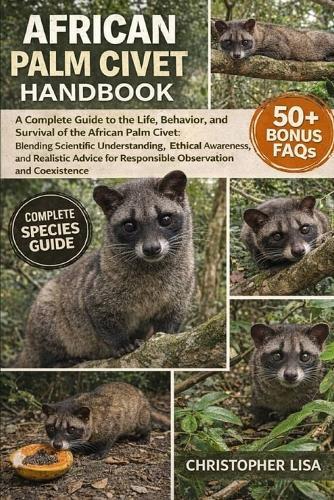
Overview
Introduction to the African Palm CivetA Quiet Animal With a Strong PresenceThe African palm civet is the kind of animal people often live near without realizing it. It does not announce itself with daytime movement, loud calls, or obvious tracks across open ground. Instead, it belongs to the hours when most households settle down and most forests shift into their night rhythm. In many parts of Africa where dense vegetation, plantations, farm edges, and fruiting trees overlap, the African palm civet moves like a shadow with purpose-unhurried, observant, and intensely guided by scent. It can feel almost invisible to casual observers, yet it leaves behind a clear story for anyone who understands what to look for: a pattern of careful travel routes, deliberate feeding stops, and scent marking that quietly declares, ""This place is known."" What makes the African palm civet especially interesting is how it blends two worlds. It has the instincts of a forest animal shaped by cover, climbing, and night movement, but it also shows a notable ability to live along the edges of people's spaces when conditions allow. That adaptability does not mean it is ""easy,"" ""tame,"" or suited to being forced into close human handling. It means the species has a flexible toolkit-one designed by evolution to survive changing food availability, seasonal shifts, and the complexity of African landscapes. Understanding the African palm civet begins with respecting that it is not a novelty animal, and not a simple creature defined by one behavior. It is a skilled generalist with a life built on privacy, scent, and steady routine. What People Mean When They Say ""Civet"" The word ""civet"" is used broadly in everyday conversation, and that sometimes causes confusion. People hear ""civet"" and picture one single animal type, when in reality the term can refer to several related species across Africa and Asia that share certain traits-most famously their scent glands and their mostly nocturnal lifestyles. The African palm civet belongs to that wider civet story, but it also has its own identity shaped by African ecosystems and its particular lineage. In other words, it is not simply ""a civet."" It is a specific kind of civet with a specific ecological role and a distinct set of behaviors that make sense when you understand where it comes from. In practical terms, when people describe a civet, they are usually noticing a combination of features: a long body, relatively short legs compared to body length, a face that can look catlike at a quick glance, and movement that is low, careful, and controlled. But civets are not cats. Their similarities to cats are more about shared lifestyle pressures-night hunting, stealth, and the need to move quietly through cover-than about being close relatives. The African palm civet is best understood on its own terms, without forcing it into ""cat"" or ""dog"" expectations. When you do that, its behavior becomes clearer and more predictable.
Full Product Details
Author: Christopher Lisa
Publisher: Independently Published
Imprint: Independently Published
Dimensions:
Width: 15.20cm
, Height: 0.70cm
, Length: 22.90cm
Weight: 0.191kg
ISBN: 9798248531349
Pages: 136
Publication Date: 18 February 2026
Audience:
General/trade
,
General
Format: Paperback
Publisher's Status: Active
Availability: Available To Order

We have confirmation that this item is in stock with the supplier. It will be ordered in for you and dispatched immediately.