Overview
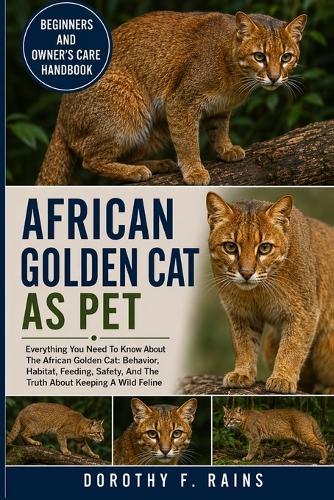
Introduction Understanding the African Golden Cat The African golden cat is one of Africa's most elusive wild felines, a species that many people will never see even once in a lifetime. In photographs it can look almost mythic-coppery red in one image, smoky gray in another, sometimes patterned with faint spots and sometimes nearly plain, as if the forest itself changed its paintbrush from season to season. But the most defining feature of the African golden cat is not its coat or its size. It is its invisibility. This is a cat built for deep cover, for quiet travel, for living where people are least present and where the light is filtered by leaves. That rarity is exactly what fuels curiosity. When something is difficult to find, people often want it more. When something is hard to understand, some people want to own it. And when a wild animal carries an aura of mystery, the line between admiration and possession can become dangerously thin. If you are holding a book titled African Golden Cat as Pet, you might be coming to it with excitement, questions, or a sincere desire to learn what it would take to care for a rare feline. You might be comparing it to other exotic cats you've heard about, or you might be trying to understand whether this species is even remotely suitable for life in captivity. This introduction is here to meet you at the beginning of that journey with clarity and honesty. The African golden cat is not a domesticated animal. It is not a breed shaped over generations to thrive alongside people. It is a predator shaped to survive in a complex ecosystem, with instincts and needs that do not shrink simply because walls are built around it. The biggest mistake people make when thinking about wild cats is assuming that love, good intentions, or money can rewrite biology. Those things can improve conditions in captivity, but they cannot turn a wild animal into a safe, predictable household companion. A responsible approach begins with the right mindset. The goal is not to ""win"" the animal's affection or to prove that you can keep something unusual. The goal is to understand the species so well that you can make ethical decisions about its welfare, its safety, and the impact of captivity on the animal and on the world around it. Sometimes that decision leads to supporting conservation and observation rather than ownership. Sometimes it leads to a specialized, highly regulated form of care in professional settings. What matters is that the decision is grounded in reality, not fantasy. Rarity Is Not a Reason Rarity can be intoxicating. People chase rare shoes, rare cars, rare collectors' items. But an animal is not an object, and rarity in nature usually carries a deeper meaning. A rare species is often rare because it lives in a narrow ecological niche, because it has specific habitat requirements, because it reproduces slowly, or because it has been pressured by human activity. Rarity can also mean we don't fully understand the species. With the African golden cat, the sense of mystery is partly because it lives in dense forests and avoids people so successfully. It is not a cat built for open plains or for frequent daylight visibility. Much of what people ""know"" about it comes from limited sightings, camera traps, and research that is still developing. That matters because keeping a wild species in captivity requires a deep understanding of its needs. When knowledge is incomplete, the risk of unintended harm rises. Imagine caring for an animal whose stress signals are subtle and whose coping strategies are to hide, avoid, and flee. In a home environment, those instincts collide with daily life-voices, foot traffic, unfamiliar smells, visitors, household routines, and unpredictable noise. What might look like calm behavior could be shutdown stress. What might look like play could be the rehearsal of predatory behavior.
Full Product Details
Author: Dorothy F Rains
Publisher: Independently Published
Imprint: Independently Published
Dimensions:
Width: 15.20cm
, Height: 1.50cm
, Length: 22.90cm
Weight: 0.386kg
ISBN: 9798196932458
Pages: 286
Publication Date: 14 May 2026
Audience:
General/trade
,
General
Format: Paperback
Publisher's Status: Active
Availability: Available To Order

We have confirmation that this item is in stock with the supplier. It will be ordered in for you and dispatched immediately.