Overview
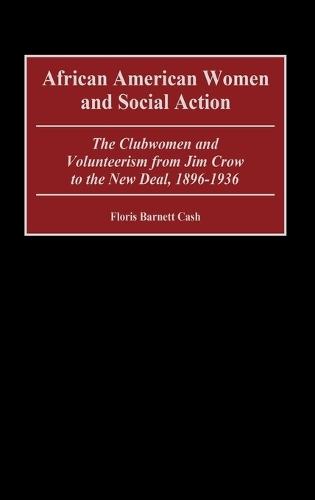
Black women have a long history of collective struggle to create welfare organizations, schools, orphanages, and health centers for African Americans. Their clubs evolved for many reasons, including self-education, community improvement, and to raise the standards of black women. Many of these women, educated beyond their race and gender and with a commitment to their communities, turned to volunteer work. This book examines the volunteer efforts of black clubwomen in the National Association of Colored Women from 1896 to 1936, and explores how their work influenced the impact and direction of social services in black communities, especially during the Progressive era. The innovative role black clubwomen played at this time aided the African American community in both social change and community survival. A variety of factors motivated black women to organize club associations, including the urgent social needs of poor African Americans who were excluded from all public relief, an increasing number of educated middle-class black women, and the growth of urban black communities due to migration from the South. The pioneer clubwomen of this time period established successful social service programs and agencies, and laid the foundation for opportunities and assistance in education, political and religious leadership, and social service within the African American community. Social services established by the clubwomen, such as travelers' aid, job training and placement, settlement houses, child and family welfare services, and preventive health care services, provided the foundation for the Urban League and the emergence of professional black social workers. The first black school of social work, the Atlanta School of Social Work, was a direct outgrowth of the activities of the Neighborhood Union Settlement.
Full Product Details
Author: Floris B. Cash
Publisher: Bloomsbury Publishing Plc
Imprint: Praeger Publishers Inc
Volume: No. 188
Dimensions:
Width: 15.60cm
, Height: 1.50cm
, Length: 23.50cm
Weight: 0.482kg
ISBN: 9780313315633
ISBN 10: 0313315639
Pages: 248
Publication Date: 30 April 2001
Recommended Age: From 7 to 17 years
Audience:
College/higher education
,
Professional and scholarly
,
Undergraduate
,
Postgraduate, Research & Scholarly
Format: Hardback
Publisher's Status: Active
Availability: Manufactured on demand

We will order this item for you from a manufactured on demand supplier.
Reviews
Cash provides a valuable national view of a process that has been well documented at state and local levels. Graduate students and faculty. -Choice ?Cash provides a valuable national view of a process that has been well documented at state and local levels. Graduate students and faculty.?-Choice ?Floris Barnett Cash has written a compact study of black clubwomen's voluntarism from the 1890s to the 1930s....[C]ash's work stands as a nice primer on middle-class black women's activism in the early twentieth century. The book's copious details reveal the range of black women's accomplishments, and Cash capably distills a rapidly expanding body of literature. Beginning students of southern. African American, and women's history could do worse than to begin with Cash's book before tackling the more distinguished scholarship that underlines it.?-Journal of Southern History Floris Barnett Cash has written a compact study of black clubwomen's voluntarism from the 1890s to the 1930s....[C]ash's work stands as a nice primer on middle-class black women's activism in the early twentieth century. The book's copious details reveal the range of black women's accomplishments, and Cash capably distills a rapidly expanding body of literature. Beginning students of southern. African American, and women's history could do worse than to begin with Cash's book before tackling the more distinguished scholarship that underlines it. -Journal of Southern History
Floris Barnett Cash has written a compact study of black clubwomen's voluntarism from the 1890s to the 1930s....[C]ash's work stands as a nice primer on middle-class black women's activism in the early twentieth century. The book's copious details reveal the range of black women's accomplishments, and Cash capably distills a rapidly expanding body of literature. Beginning students of southern. African American, and women's history could do worse than to begin with Cash's book before tackling the more distinguished scholarship that underlines it. -Journal of Southern History ?Cash provides a valuable national view of a process that has been well documented at state and local levels. Graduate students and faculty.?-Choice ?Floris Barnett Cash has written a compact study of black clubwomen's voluntarism from the 1890s to the 1930s....[C]ash's work stands as a nice primer on middle-class black women's activism in the early twentieth century. The book's copious details reveal the range of black women's accomplishments, and Cash capably distills a rapidly expanding body of literature. Beginning students of southern. African American, and women's history could do worse than to begin with Cash's book before tackling the more distinguished scholarship that underlines it.?-Journal of Southern History Cash provides a valuable national view of a process that has been well documented at state and local levels. Graduate students and faculty. -Choice
Floris Barnett Cash has written a compact study of black clubwomen's voluntarism from the 1890s to the 1930s....[C]ash's work stands as a nice primer on middle-class black women's activism in the early twentieth century. The book's copious details reveal the range of black women's accomplishments, and Cash capably distills a rapidly expanding body of literature. Beginning students of southern. African American, and women's history could do worse than to begin with Cash's book before tackling the more distinguished scholarship that underlines it. -Journal of Southern History
Author Information
FLORIS BARNETT CASH is an Assistant Professor of Africana Studies and History at the State University of New York, Stony Brook. She teaches in the Department of Africana Studies and has courses affiliated with Women's Studies.