Overview
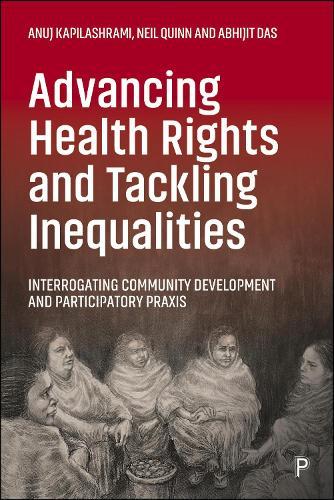
In our post-pandemic world, the international community and national governments are searching for new solutions to build healthy and resilient societies. This timely book focuses on community participation in building healthier populations, placing people at the heart of such planning and solutions in both the Global North and South. Drawing on international research and practical examples, it addresses the role and potential of community development in addressing inequalities and restoring the right to health.
Full Product Details
Author: Anuj Kapilashrami (University of Essex) ,
Neil Quinn (University of Strathclyde, Glasgow) ,
Abhijit Das (Center for Health and Social Justice, Basement of Young Women’s)
Publisher: Bristol University Press
Imprint: Policy Press
ISBN: 9781447361404
ISBN 10: 1447361407
Pages: 240
Publication Date: 21 May 2025
Audience:
Professional and scholarly
,
General/trade
,
Professional & Vocational
,
General
Format: Paperback
Publisher's Status: Active
Availability: Manufactured on demand

We will order this item for you from a manufactured on demand supplier.
Reviews
“This book is a rich resource of analysis and examples on inequality, participation/power and rights in health. The authors' research and experience in India and other regions show the widespread impacts in marginalised populations north and south of a neo-colonial, neoliberal political economy. Their sharp unbundling of disempowering narratives, and examples and critical reflections shared on local, national, and transnational level responses make it relevant for a range of academic, practitioners and activists linking knowledge to change.” Rene Loewenson, Training and Research Support Centre, Zimbabwe “Social and health inequalities worldwide have never been so great. These crises have many economic and policy causes, yet perhaps the greatest systemic problem is the lack of public engagement in co-creating solutions. This fine and wise book shows how communities can participate and make changes that improve lives. A superb insight into how to create better futures.” Jules Pretty, University of Essex “I strongly recommend this rich, accessible, interdisciplinary, challenging book. It comes from the head and heart. Theory and praxis. Professional and personal. Intersectionality and decoloniality are woven throughout to offer a distinctive gaze to several mainstream discourses on participation and health rights. It’s replete with instructive case studies. The authors focus on health, but they speak to anyone committed to a more just world.” Paul Hunt, first UN Special Rapporteur on the Right to Health & Chief Commissioner for New Zealand Human Rights Commission ""This comprehensive overview of community development and collective action for health justice creatively bridges theory and practice. The focus on countervailing power from below offers a timely counterpoint - both to top-down approaches to community consultation and to the conventional framing of social determinants of health in terms of individual characteristics."" Jonathan Fox, American University “Understanding who has power, how it is used, and how power relationships can be changed, has never been more important for those of us seeking to reduce health inequalities. This book provides an essential guide to that urgent task."" Gerry McCartney, University of Glasgow
“This book is a rich resource of analysis and examples on inequality, participation/power and rights in health. The authors' research and experience in India and other regions show the widespread impacts in marginalised populations north and south of a neo-colonial, neoliberal political economy. Their sharp unbundling of disempowering narratives, and examples and critical reflections shared on local, national, and transnational level responses make it relevant for a range of academic, practitioners and activists linking knowledge to change.” Rene Loewenson, Training and Research Support Centre, Zimbabwe “Social and health inequalities worldwide have never been so great. These crises have many economic and policy causes, yet perhaps the greatest systemic problem is the lack of public engagement in co-creating solutions. This fine and wise book shows how communities can participate and make changes that improve lives. A superb insight into how to create better futures.” Jules Pretty, University of Essex “I strongly recommend this rich, accessible, interdisciplinary, challenging book. It comes from the head and heart. Theory and praxis. Professional and personal. Intersectionality and decoloniality are woven throughout to offer a distinctive gaze to several mainstream discourses on participation and health rights. It’s replete with instructive case studies. The authors focus on health, but they speak to anyone committed to a more just world.” Paul Hunt, University of Essex ""This comprehensive overview of community development and collective action for health justice creatively bridges theory and practice. The focus on countervailing power from below offers a timely counterpoint - both to top-down approaches to community consultation and to the conventional framing of social determinants of health in terms of individual characteristics."" Jonathan Fox, American University
Author Information
Neil Quinn is Professor of Social Work and Health Equity and Founding Director of the Centre for Health Policy at the University of Strathclyde. Anuj Kapilashrami is Professor & Chair in Health Policy & Equity at the School of Health & Social Care, University of Essex and Senior Lecturer in Global Health, Queen Mary University London.