Overview
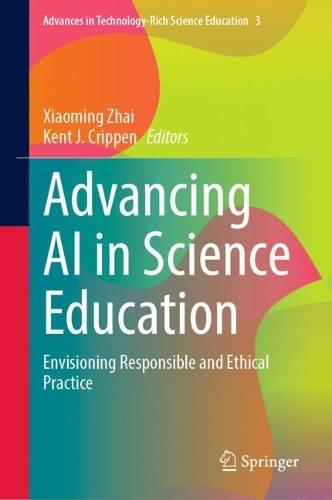
This edited volume offers a timely, domain-specific examination of how artificial intelligence (AI) is reshaping the foundations of science teaching and learning. As AI transforms scientific work, societal expectations, and the skills future citizens need, science education stands at a pivotal crossroads. This book highlights the major shifts AI is driving—redefining educational goals, reshaping classroom procedures, expanding learning materials, enabling dynamic assessment, and altering the competencies students must develop to thrive in an AI-driven world of scientific inquiry and decision-making. Through critical analysis and vivid examples from core scientific practices, the authors reveal AI’s dual capacity to enrich and complicate science education. AI offers unprecedented personalization, efficiency, and access to authentic scientific practices, yet also raises concerns around fairness, transparency, privacy, accountability, and the preservation of human judgment. To navigate these tensions, this book introduces the Responsible and Ethical Principles (REP) framework, an action-oriented lens for guiding design, use, and governance that ensures AI advances equity, scientific integrity, and democratic participation. Scholars demonstrate how REP principles inform ethical goals, inclusive materials, trustworthy assessments, and transformative learning outcomes, sometimes constraining as well as enabling AI use as a partner rather than a replacement. Ultimately, Advancing AI in Science Education argues that even as AI reshapes schooling, science education must remain fundamentally human. Empathy, creativity, ethical judgment, and shared meaning-making within scientific communities anchor responsible AI-supported learning and guide an equitable, human-centered future for science education.
Full Product Details
Author: Xiaoming Zhai ,
Kent J. Crippen
Publisher: Springer Nature Switzerland AG
Imprint: Springer Nature Switzerland AG
ISBN: 9783032168702
ISBN 10: 3032168708
Pages: 312
Publication Date: 15 May 2026
Audience:
Professional and scholarly
,
Professional & Vocational
Format: Hardback
Publisher's Status: Forthcoming
Availability: Not yet available

This item is yet to be released. You can pre-order this item and we will dispatch it to you upon its release.
Author Information
Xiaoming Zhai, Associate Professor in Science Education and AI, (courtesy) Associate Professor in Computer Science and in Statistics, serves as Directors of the AI4STEM Education Center and the National GENIUS Center at University of Georgia, USA. His research pioneers the use of AI to transform STEM education. He has published widely, serves as guest editor of various journals, chaired the 2022 and 2025 AI in STEM education conferences, and co-founds and -leads NARST’s RAISE group. He edited Uses of Artificial Intelligence in STEM Education (Oxford, 2024) and Artificial Intelligence in STEM Education Research (Springer, 2026). Dr. Zhai is a leading voice in shaping the future of AI for STEM education. Kent J. Crippen, Professor of STEM Education at University of Florida, USA. His research advances a resilient STEM workforce by designing environments that immerse students in authentic science and engineering practices. The Crippen Research Group investigates learning and participation across interdisciplinary contexts, including extended reality, AI and data science, engineering design, and molecular modeling. With strong funding and national honors, including as AAAS Fellow, Crippen’s scholarship emphasizes innovation, integrity, impact, and teamwork. He serves as Editor-in-Chief of the Journal of Science Education and Technology, founding editor of the Advances in Technology-Rich Science Education book series, and co-leads NARST’s RAISE RIG.