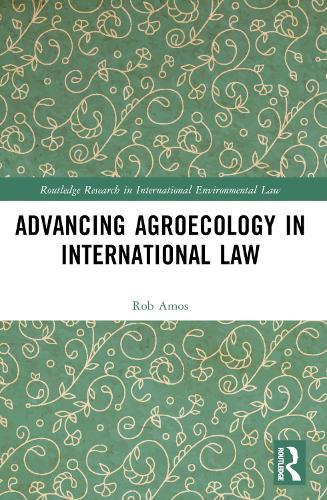
Advancing Agroecology in International Law

Author:   Rob Amos
Publisher:   Taylor & Francis Ltd
ISBN:  

9781032595665


Pages:   268
Publication Date:   30 January 2025
Format:   Paperback
Availability:   In Print   Availability explained
This item will be ordered in for you from one of our suppliers. Upon receipt, we will promptly dispatch it out to you. For in store availability, please contact us.

Our Price $83.99 Quantity:  
Add to Cart

Share |

Advancing Agroecology in International Law


Overview

Full Product Details

Author:   Rob Amos
Publisher:   Taylor & Francis Ltd
Imprint:   Routledge
Weight:   0.530kg
ISBN:  

9781032595665


ISBN 10:   1032595663
Pages:   268
Publication Date:   30 January 2025
Audience:   College/higher education ,  Tertiary & Higher Education
Format:   Paperback
Publisher's Status:   Active
Availability:   In Print   Availability explained
This item will be ordered in for you from one of our suppliers. Upon receipt, we will promptly dispatch it out to you. For in store availability, please contact us.

Table of Contents

Foreword xii Preface and Acknowledgements xiv Table of International Treaties and Agreements xv PART 1 Protecting Diversity 1 Introduction: Agroecology and the Law 3 Defining Agroecology 5 Locating Agroecology in the Law 8 The Structure of This Book 12 1 Conservation of Agrobiodiversity 14 International Conservation Law and Agriculture 14 The Convention on Biological Diversity 16 The UN Food and Agriculture Organisation 29 Conclusions 33 2 Monocultures and Genetic Diversity 34 The Rise of the Monoculture 34 Invasive/Alien Species and Disease 35 Intellectual Property Rights and Crop Genetic Diversity 39 Protecting Traditional Agricultural Knowledge 50 Conclusions 55 3 Genetically Modified Organisms and Organic Agriculture 56 GMOs in Socioecological Networks 56 Organic Agriculture and GMOs in the Context of Agroecology 57 Responding to the Risks of GMOs 61 Creating Space for GM Crops in Agroecological Networks 74 Conclusions 76 4 Landscapes 78 Defining ‘Landscape’ 78 A Right to Landscape? 80 International Programmes for Landscape Protection 83 Conclusions 90 PART 2 Supporting Socioecological Relationships 91 5 Ecosystem Services 93 Ecosystem Services and Agroecology 93 Ecosystem Services and International Conservation Law 95 Incorporating Ecosystem Services into International Law 99 Conclusions 110 6 Soil Conservation and Land Degradation 112 Soil and Sustainability 112 Soil Conservation in International Law 113 A Soil Treaty? 117 Land Degradation and Desertification 122 Conclusions 129 7 Water Conservation 131 Our Changing Perceptions of Water 131 Natural Water Infrastructure 132 Protecting Freshwater Ecosystems in International Law 135 Aquaculture 143 Conclusions 148 8 Climate Change 150 Agriculture and Climate Change 150 The UN Framework Convention on Climate Change 152 Climate Change Adaptation in Kiribati 154 Conclusions 163 PART 3 Agroecology in a Globalised World 165 9 Environmental Assessment 167 The Origins of Environmental Assessment 167 Defining Environmental Assessment 168 Environmental Assessment in International Law 177 (Re)Introducing Ecology to Environmental Assessment 184 Conclusions 188 10 Transboundary Pollution 189 Agriculture and Pollution 189 Transboundary Air Pollution 191 Persistent Organic Pollutants 199 Unified Approaches to Hazardous Substances and Pollutants 203 Conclusions 207 11 International Trade 209 Neoliberalism and Agroecology 209 Agroecology, Trade and the Environment in the WTO 211 The WTO’s Rules on Agricultural Trade 215 Regulating the Drivers of Zoonotic Disease 221 Conclusions 230 PART 4 Agroecology in Society 231 12 Tracing a Path from Food Security to Food Justice 233 Food (In)Security and International Law 233 Food Security 235 The Right to Food 239 Food Sovereignty 242 Food Justice 246 Conclusions 251 Conclusion: Finding Space for Agroecology 253 Index 263

Reviews

Rob Amos makes an important and timely intervention on the impacts of agriculture on biodiversity at a time of planetary crisis. His creative approach and justification for international law’s facilitation of agroecology recognises the importance of reconceptualising how humans, and law, interact with the environment. Dr Emily Webster, University of Cambridge (UK) This is a much-needed work on a hugely important topic. Through carefully selected case studies, Advancing Agroecology in International Law provides a thought-provoking and detailed analysis of the ability of international legal frameworks to support a transition to agroecology. It is essential reading for anyone interested in creating food systems that feed us while also sustaining the planet. Dr Helena Howe, University of Sussex (UK) Rob Amos has produced a work of rigorous and measured scholarship on a topic that implicates us all: the deeply-rooted interconnections between global agriculture, the global environment, and international law. His case study on the climate crisis’s impacts on Kiribati is both a cautionary tale and a convincing argument that the agroecology framework can help map a way forward. Prof. Mehmet Konar-Steenberg, Mitchell Hamline School of Law (Minnesota, USA). An in depth dive into international law and what this means for agroecology. From clearly defining legal concepts to highlighting conflicting policy goals, Rob Amos's case studies allow us to understand and question how international law may help encourage agroecological systems. Ellen Fay, Executive Co-Director of the Sustainable Soils Alliance (SSA)


Author Information

Rob Amos is a Lecturer in Law at Greenwich University, UK.

Tab Content 6

Author Website:  

Countries Available

All regions
Latest Reading Guide

MRG 26 2


Shopping Cart
Your cart is empty
Shopping cart
Mailing List