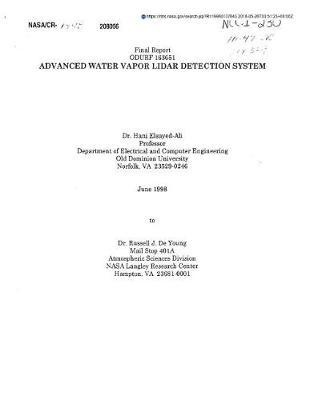
Advanced Water Vapor Lidar Detection System

Author:   National Aeronaut Administration (Nasa)
Publisher:   Createspace Independent Publishing Platform
ISBN:  

9781725070424


Pages:   26
Publication Date:   10 August 2018
Format:   Paperback
Availability:   In Print   Availability explained
This item will be ordered in for you from one of our suppliers. Upon receipt, we will promptly dispatch it out to you. For in store availability, please contact us.

Our Price $60.69 Quantity:  
Add to Cart

Share |

Advanced Water Vapor Lidar Detection System


Overview

In the present water vapor lidar system, the detected signal is sent over long cables to a waveform digitizer in a CAMAC crate. This has the disadvantage of transmitting analog signals for a relatively long distance, which is subjected to pickup noise, leading to a decrease in the signal to noise ratio. Generally, errors in the measurement of water vapor with the DIAL method arise from both random and systematic sources. Systematic errors in DIAL measurements are caused by both atmospheric and instrumentation effects. The selection of the on-line alexandrite laser with a narrow linewidth, suitable intensity and high spectral purity, and its operation at the center of the water vapor lines, ensures minimum influence in the DIAL measurement that are caused by the laser spectral distribution and avoid system overloads. Random errors are caused by noise in the detected signal. Variability of the photon statistics in the lidar return signal, noise resulting from detector dark current, and noise in the background signal are the main sources of random error. This type of error can be minimized by maximizing the signal to noise ratio. The increase in the signal to noise ratio can be achieved by several ways. One way is to increase the laser pulse energy, by increasing its amplitude or the pulse repetition rate. Another way, is to use a detector system with higher quantum efficiency and lower noise, on the other hand, the selection of a narrow band optical filter that rejects most of the day background light and retains high optical efficiency is an important issue. Following acquisition of the lidar data, we minimize random errors in the DIAL measurement by averaging the data, but this will result in the reduction of the vertical and horizontal resolutions. Thus, a trade off is necessary to achieve a balance between the spatial resolution and the measurement precision. Therefore, the main goal of this research effort is to increase the signal to noise ratio by a factor of 1...

Full Product Details

Author:   National Aeronaut Administration (Nasa)
Publisher:   Createspace Independent Publishing Platform
Imprint:   Createspace Independent Publishing Platform
Dimensions:   Width: 21.60cm , Height: 0.10cm , Length: 27.90cm
Weight:   0.088kg
ISBN:  

9781725070424


ISBN 10:   1725070421
Pages:   26
Publication Date:   10 August 2018
Audience:   General/trade ,  General
Format:   Paperback
Publisher's Status:   Active
Availability:   In Print   Availability explained
This item will be ordered in for you from one of our suppliers. Upon receipt, we will promptly dispatch it out to you. For in store availability, please contact us.

Table of Contents

Reviews

Author Information

Tab Content 6

Author Website:  

Countries Available

All regions
Latest Reading Guide

April RG 26_2


Shopping Cart
Your cart is empty
Shopping cart
Mailing List