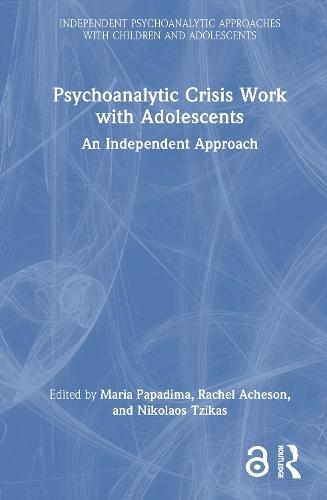
Full Product Details
Author: Maria Papadima ,
Rachel Acheson ,
Nikolaos Tzikas
Publisher: Taylor & Francis Ltd
Imprint: Routledge
ISBN: 9781032972251
ISBN 10: 1032972254
Pages: 336
Publication Date: 25 February 2026
Audience:
Professional and scholarly
,
Professional & Vocational
Format: Hardback
Publisher's Status: Forthcoming
Availability: Not yet available

This item is yet to be released. You can pre-order this item and we will dispatch it to you upon its release.
Reviews
‘This book provides a most welcome and admirable addition to the Independent series and should reach audiences far beyond those already involved in offering psychologically informed treatment to troubled adolescents. In a way that is often scholarly but always accessible it considers adolescence from many different viewpoints, offering new ideas about risk, self-harming behaviours and how to help the young person and their families engage with those offering services in a way that enhances their capacity to think and be less destabilised by the struggles of adolescence. The authors state ‘Psychoanalytic work in this field requires two things that at first glance appear opposite: immediacy and depth’. The ideas contained in this book, brought vividly to life through composite vignettes, show this principle in action. While taking a wider, systemic approach, recognizing that culture, language, and social pressures shape the form crises take, this book is firmly rooted in psychoanalytic thinking, yet many of the chapters will also be inspirational to those working with adolescents in a wide variety of settings.’ Dr Janine Sternberg, Child and Adolescent Psychotherapist ‘This is psychoanalytic psychotherapy at its best – creative, grounded in clinical experience and grappling with the many urgent problems that adolescents bring to the clinician. The papers are written in the main by psychoanalytic child and adolescent psychotherapists who draw on the Independent psychoanalytic tradition to develop new ways of working. The urgency of the risk laden problems that their patients bring to the consulting room, make the depth of understanding and experience that come from the psychoanalytic tradition all the more significant. These are clinicians working within the severely overloaded Child and Adolescent Mental Health interdisciplinary teams of our times, but still managing to find new ways of helping their patients and their families. This ground-breaking collection of papers is a major contribution to clinical practice which will be enormously helpful to clinicians for many years to come.’ Monica Lanyado, Ph.D., Child and Adolescent Psychotherapist
‘This book provides a most welcome and admirable addition to the Independent series-and should reach audiences far beyond those already involved in offering psychologically informed treatment to troubled adolescents. In a way that is often scholarly but always accessible it considers adolescence from many different viewpoints, offering new ideas about risk, self-harming behaviours and how to help the young person and their families engage with those offering services in a way that enhances their capacity to think and be less destabilised by the struggles of adolescence. The authors state ‘Psychoanalytic work in this field requires two things that at first glance appear opposite: immediacy and depth’. The ideas contained in this book, brought vividly to life through composite vignettes, show this principle in action. While taking a wider, systemic approach, recognizing that culture, language, and social pressures shape the form crises take, this book is firmly rooted in psychoanalytic thinking, yet many of the chapters will also be inspirational to those working with adolescents in a wide variety of settings.’ Dr Janine Sternberg, Child and Adolescent Psychotherapist ‘This is psychoanalytic psychotherapy at its best – creative, grounded in clinical experience and grappling with the many urgent problems that adolescents bring to the clinician. The papers are written in the main by psychoanalytic child and adolescent psychotherapists who draw on the Independent psychoanalytic tradition to develop new ways of working. The urgency of the risk laden problems that their patients bring to the consulting room, make the depth of understanding and experience that come from the psychoanalytic tradition all the more significant. These are clinicians working within the severely overloaded Child and Adolescent Mental Health interdisciplinary teams of our times, but still managing to find new ways of helping their patients and their families. This ground-breaking collection of papers is a major contribution to clinical practice which will be enormously helpful to clinicians for many years to come.’ Monica Lanyado, Ph.D., Child and Adolescent Psychotherapist
Author Information
Maria Papadima is a child and adolescent psychotherapist based in London, UK. She trained at the Independent Psychoanalytic Child and Adolescent Psychotherapy Association (IPCAPA) and works in an NHS crisis adolescent team in London, as well as privately, with young people and their families. Rachel Acheson is a child and adolescent psychotherapist based in Holywood, Northern Ireland. She trained at the Independent Psychoanalytic Child and Adolescent Psychotherapy Association (IPCAPA). Nikolaos Tzikas is a child and adolescent psychotherapist based in Athens, Greece. He trained at the Independent Psychoanalytic Child and Adolescent Psychotherapy Association (IPCAPA) and is a member of the Association of Child Psychotherapists (ACP) and the Hellenic Child and Adolescent Psychoanalytic Psychotherapy Society.