Overview
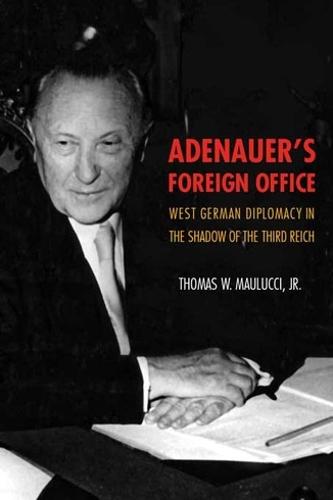
The creation of the Foreign Office under Adenauer tells us much about the possibilities and limits of professional diplomacy in the mid-twentieth century. It also demonstrates three themes central to the early history of the Federal Republic: the integration of the new state into the international community, the cooptation of German elites and traditions by the new political system, and the creation of government in a state under foreign occupation. In this important study, Thomas Maulucci argues that, despite an improvised start and a considerable continuity of practice and personnel with pre-1945 Germany, the changed international anddomestic situation proved decisive in creating a ministry that could help to implement new directions in German foreign policy. In addition, Maulucci explores the interactions between international, political, and social history, contributing to a literature that bridges the gap between the pre- and post-World War Two eras that characterized previous writing on German history. Based on extensive research in German, American, British, and French archives, Adenauer's Foreign Office is the only English-language book of its kind. The troubling question of personnel continuity in the German diplomatic service is of considerable importance today, especially because of the Foreign Office's previous attempts to portray its past in the best possible light. Of interest to scholars and students of German history and politics as well as non-specialists, this book provides new insights into post-war diplomacy, the sociology of German elites, and the problems involved in creating a new government after losing a major war.
Full Product Details
Author: Thomas Maulucci
Publisher: Cornell University Press
Imprint: Northern Illinois University Press
Dimensions:
Width: 15.20cm
, Height: 3.30cm
, Length: 22.90cm
Weight: 0.907kg
ISBN: 9780875804637
ISBN 10: 0875804632
Pages: 304
Publication Date: 15 November 2012
Audience:
General/trade
,
General
Format: Hardback
Publisher's Status: Active
Availability: To order

Stock availability from the supplier is unknown. We will order it for you and ship this item to you once it is received by us.
Reviews
Maulucci is forthright in discussing the role that diplomats played in Nazi Germany, and also their efforts to obscure their unsavory past. At the same time, however, he avoids sensationalism and apology....Any reader who hopes to understand Germany's transition will find this book to be a rich resource. -- Yearbook of German American Studies With impressive knowledge of the archival material and a broad perspective on the research literature, [Maulucci] analyzes the 'return' of the German diplomats from 'automatic arrest, ' Allied internment camps, and denazification procedures. -- American Historical Review Thomas Maulucci's comprehensive analysis is both a study in continuities and discontinuities in post-World War II West German foreign policy and a deeply researched prosopography with mental maps of the Wilhelmstrae veterans in the Federal Republic's newly created Foreign Office in March 1951. This fine study belongs in every research library . --Central European History
Maulucci adds significantly to our understanding of the West German Foreign Office in the first decade after World War II. He has moved through a mass of diplomatic correspondences, private papers, and personnel documents to reveal the many challenges facing the Federal Republic of Germany (FRG) as it reengaged in international relations after Nazism. The study touches on themes of potentially wide interest, such as the position of ex-Nazis in the higher echelons of the West German government. -S. Jonathan Wiesen, Professor of History at Southern Illinois University Carbondale This book traces institutional, personal, and intellectual continuities in the German Foreign Ministry from the Nazi era into the post-war period. It examines the postwar West German Auswartiges Amt from several perspectives, including that of Chancellor Konrad Adenauer, West Germany's allies, diplomats, and journalists. As such it is an important contribution to the social, political, and international history of the Federal Republic. Maulucci's knowledge of the sources and his overall command of hissubject are truly impressive. -Susanna Schrafstetter, University of Vermont
Maulucci is forthright in discussing the role that diplomats played in Nazi Germany, and also their efforts to obscure their unsavory past. At the same time, however, he avoids sensationalism and apology....Any reader who hopes to understand Germany's transition will find this book to be a rich resource. -Ronald J. Granieri, Yearbook of German American Studies
Maulucci adds significantly to our understanding of the West German Foreign Office in the first decade after World War II. He has moved through a mass of diplomatic correspondences, private papers, and personnel documents to reveal the many challenges facing the Federal Republic of Germany (FRG) as it reengaged in international relations after Nazism. The study touches on themes of potentially wide interest, such as the position of ex-Nazis in the higher echelons of the West German government. -- S. Jonathan Wiesen, Professor of History at Southern Illinois University Carbondale This book traces institutional, personal, and intellectual continuities in the German Foreign Ministry from the Nazi era into the post-war period. It examines the postwar West German Auswartiges Amt from several perspectives, including that of Chancellor Konrad Adenauer, West Germany's allies, diplomats, and journalists. As such it is an important contribution to the social, political, and international history of the Federal Republic. Maulucci's knowledge of the sources and his overall command of his subject are truly impressive. -- Susanna Schrafstetter, University of Vermont Maulucci has produced a very readable account of Adenauer's foreign office, of its origins and traditions, and of its myths. -- German History
Author Information
Thomas W. Maulucci, Jr., is associate professor and chair of the History Department and the International Studies Program at American International College.