Overview
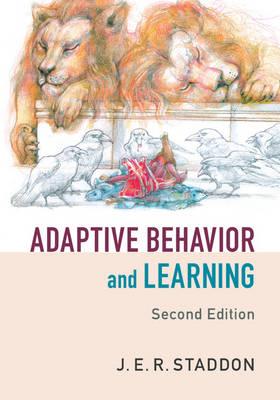
Every day at about 4:30, Jazz, a Hungarian Vizsla dog, leaps up on the sofa and looks out for his owner who always comes home at 5:00. He doesn't need an internal clock because he has an acute sense of smell that allows him to measure how long his master has been absent. Explaining complex behavior in simple ways, this book is a fascinating exploration of the evolution, development and processes of learning in animals. Now in its second edition, there is increased emphasis on development, evolution and dynamics; new accounts of taxic orientation, reflex induction, habituation and operant learning in organisms; more discussion of spatial learning and the processes underlying it; expanded chapters on choice and completely new chapters on molar laws, classical conditioning theories and comparative cognition. J. E. R. Staddon provides a definitive summary of contemporary theoretical understanding suitable for graduates and advanced undergraduates.
Full Product Details
Author: J. E. R. Staddon (Duke University, North Carolina)
Publisher: Cambridge University Press
Imprint: Cambridge University Press
Edition: 2nd Revised edition
Dimensions:
Width: 18.00cm
, Height: 3.00cm
, Length: 25.30cm
Weight: 1.350kg
ISBN: 9781107082472
ISBN 10: 1107082471
Pages: 611
Publication Date: 10 March 2016
Audience:
Professional and scholarly
,
College/higher education
,
Professional & Vocational
,
Tertiary & Higher Education
Format: Hardback
Publisher's Status: Active
Availability: Temporarily unavailable 
The supplier advises that this item is temporarily unavailable. It will be ordered for you and placed on backorder. Once it does come back in stock, we will ship it out to you.
Table of Contents
1. The evolution, development, and modification of behavior; 2. Variation and selection: kineses; 3. Reflexes; 4. Direct orientation and feedback; 5. Operant behavior; 6. Reward and punishment; 7. Feeding regulation: a model motivational system; 8. The optimal allocation of behavior; 9. Choice: dynamics and decision rules; 10. Foraging and behavioral ecology; 11. Stimulus control and cognition; 12. Stimulus control and performance; 13. Molar laws; 14. Time and memory, I; 15. Time and memory, II; 16. Template learning; 17. Learning, I; 18. Models of classical conditioning; 19. Learning, II; 20. Learning, III: procedures; 21. Comparative cognition.
Reviews
'... a remarkable contribution that will appeal to a broad range of scientists.' Andrea S. Griffin, The Quarterly Review of Biology
'… a remarkable contribution that will appeal to a broad range of scientists.' Andrea S. Griffin, The Quarterly Review of Biology
Author Information
J. E. R. Staddon is James B. Duke Professor of Psychology and Professor of Biology and Neurobiology Emeritus at Duke University. He has written and lectured on public policy issues such as education, evolution, traffic control and the effects of sociobiological aspects of the financial system, and is the author of over 200 research papers and five books, including The New Behaviorism (2014), Unlucky Strike (2013), The Malign Hand of the Markets (2012) and Adaptive Dynamics: The Theoretical Analysis of Behavior (2001).
Tab Content 6
Author Website:
Countries Available
All regions
|