Reviews
'John Kinsella delights in disturbance. (He) writes like an Australian storm at full blow' The Observer
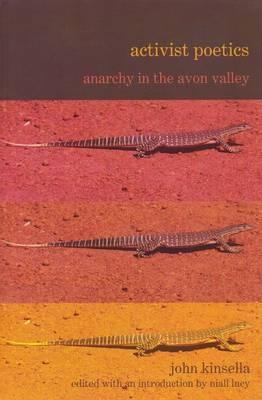
"John Kinsella delights in disturbance. (He) writes like an Australian storm at full blow. John Kinsella's Activist Poetics argues that poetry can act as a form of resistance to social and ethical ills, especially ecological damage and abuse, by provoking responses. In these personal essays, memoirs, polemics, poems and critical readings of Australian poems, written over the past twenty years, Kinsella shows the ways in which he has attempted to engage with the world as he sees it in the Avon Valley, Western Australia. The book is not so much of a manifesto as an apologia, an attempt to show the ways in which he has seen and written about the injustices and disturbances in that area. His approach to issues such as immigration, refugees, animal rights, zoos, forest preservation, land erosion, telecommunication masts, and so on, is applicable elsewhere and that is what makes his 'linguistic disobedience', energetic involvement and ability to look, bear witness and become involved, so striking. This book of essays by the vegananarchist-pacifist poet John Kinsella on the relationship between political activism and poetry raises two big questions: how do we live in modernity? and what is it like to live beyond the mainstream? The first question lies behind the great cultural movements of the West, from Romanticism to postmodernism. Whether writers have embraced modernity or rejected it, they have long struggled with the very conditions that brought literary culture into existence. The utopian possibilities of modernity have always been in conflict with modernity's material realities. Activist Poetics deals repeatedly with the ambiguous conditions of modernity and human society, showing how these two concepts are profoundly interdependent. The limits, or lack of limits, that we place on the development of modernity are clearly related to what we perceive as social goods. The degradation of the environment, the exploitation and harm of animals, and the systematic undermining of minorities' rights (to name Kinsella's major interests) can all be seen as effects of modernity and of a particular conception of society. But all of this ignores the ambitious project at the heart of this intense book: to trace the relationship between political action and poetic speech. W.H. Auden has much to answer for with his gnomic observation that 'poetry makes nothing happen'. (The phrase appears in an elegy, and while elegy cannot raise the dead, it certainly is a form of 'emotional activism'.) Kinsella doesn't fall for simplistic instrumentalist/aesthetic models of poetry. Rather, he traces the many complexities, ironies, and contradictions of writing poetry out of a profound desire to bring together one's political and ethical beliefs and one's actions. Actions, as Kinsella makes clear, can legitimately include creative practice. As he writes in the book's opening essay, '""Environmentalism"", for want of a better word, is what I do in life and in my writing.' One of the many implicit arguments in Activist Poetics is that poetry, being creative, is open-ended, and therefore its effects are open-ended. In this sense, the book is a theory of creativity as a form of playful opposition. Interestingly, this chimes with the view of the English psychoanalyst D.W. Winnicott that the opposite of play (which is the basis of creativity) is not work, but compliance. Given the nature of politics and ideology, and the workings of the state, this insight gives creativity considerable political potential. Avoiding compliance involves spontaneity, originality, and subjectivity. These three things are, indeed, the hallmarks of Kinsella's book, if not his entire oeuvre. Kinsella's engagement in Activist Poetics with modernity and society is not disinterested (that great facet of Enlightenment modernity). Rather, the book is marked by a profoundly personal engagement with the issues and ideas it raises. This personal engagement is not, however, a politically 'weak' position. As the book's editor, Niall Lucy, states in the Introduction, 'In its many eccentricities ... this book is not concerned to charm its way into readers' hearts, but rather to find out who might have the mettle to bear witness to it'. Bearing witness is what Kinsella himself does repeatedly in these essays, which cover, among other things, pacifism, veganism, 'Plagues and Bioethics', 'Refugees and Australia', environmentalism and creative practice, poetry and justice. A literary work's originality can be measured by the difficulty we have in characterising it. This work is especially difficult to characterise. While Activist Poetics has been published by a university press, it avoids the usual procedures of a scholarly work: it is intensely subjective; sometimes prolix, sometimes casual in tone; and it can be funny (a feature of Kinsella's work that seems to have bypassed a number of readers). Activist Poetics is also, unlike most scholarly books, unconcerned with hiding the exigencies and occasions of its composition. The essays routinely quote from Kinsella's emails, journals, blog, letters, and poems. All of this is consistent with Kinsella's valuing of spontaneity and energy, as well as with the importance of the particularities of a given locale ('context' being the textual equivalent of locality). Readers who find Kinsella's self-quotation 'selfindulgent' or unscholarly have seriously missed the point of this book. Lucy characterises the essays as testimonials, closer in spirit to the apologia than the manifesto. As he writes, the apologia 'asks not that we take ""action"", although of course it doesn't preclude us from doing so. It asks, rather, only for our countersignature.' Although the apologia has strong links with religious discourse, one of the strengths of Activist Poetics is its avoidance of dogma and stridency (that is, the rhetoric of compliance). Kinsella's account of living in modernity and refusing to live in the 'mainstream' is compelling for the humane, detailed way that it is presented. While Activist Poetics may be 'unscholarly' in the traditional sense, not least because it is written from a position of 'interest', it is far from anti-intellectual. Indeed, the book has an extraordinary intellectual breadth, with subjects ranging from animal rights and GM crops, to literary theory and local history. All of these aspects are seen, for instance, in 'Half-Masts: A Prosody of Telecommunications', an essay that ingeniously brings together the rhythm of radiation (the basis of wireless telecommunication) and the prosody of poetry. Communication is ultimately what this book is about. Kinsella commonly refers to poems as setting up dialogues, and the book itself sets up possible ones. As with verbal dialogue, the book allows for readers to disagree with it or to find it unconvincing at times. It is appropriate, too, that the book ends literally with dialogue, as seen in the coda which incorporates the book's editor into the body of the book itself, and two dialogues between Kinsella and his partner, the poet Tracy Ryan. Such an ending is wholly consistent with the book's aims and draws attention to its already-dialogic condition through the inclusion of numerous notes by the editor that are interpolated into the text, rather than beneath the text as footnotes, as is customary in academic works. The book's coda, 'Visitors', notes that Kinsella has been increasingly cutting himself 'off from contact with the ""outside world""'. In light of the book's themes, such 'cutting off ', as a narrative conclusion, could be viewed as a plangent, if not pessimistic, ending. But, as Kinsella relates, living near York, in Western Australia, with Ryan and their family, is a type of activism, a localism that is perhaps inevitable for someone keen to 'opt out' of the state (despite the fact that he continues to work for that state institution, the university). It is a strangely moving ending. Modernity, as Kinsella relates in Activist Poetics, is often seen as a force that annihilates distance. Kinsella seeks to recognise those 'annihilated' distances. In part this is to recognise the rights and histories of those 'others' who occupy those spaces. But there is another aspect to this project of recognising distance. Modernity, the annihilator of distance, also requires distance to allow its 'darker' workings to continue. Hence, animals are slaughtered out of sight, consumer goods are produced in unknown conditions in unknown places, and the state does its work with as much secrecy as its citizens will tolerate. It is not easy to look at the slaughterhouses, the detention centres, and the laboratories of modernity, but it is important that we remain aware of them. Otherwise, modernity and the society it creates may well destroy us. If Kinsella feels like this, too, it is to his credit that his work is as humane and playful as it is. Les Murray Taller When Prone: Poems Farrar, Straus, and Giroux, February 2012. 96 pp. John Kinsella Activist Poetics: Anarchy in the Avon Valley Liverpool University Press, September 2010. 224 pp. As far as most American poetry readers are concerned, ""Down Under"" might as well be synonymous with ""Out of Sight, Out of Mind."" The most recent edition of The Norton Anthology of Modern and Contemporary Poetry, for example, includes approximately 130 authors from the United States and nearly 50 from the United Kingdom and the Republic of Ireland. In contrast, Australia, a country with a vibrant, well developed, two-centuries-long tradition of English-language verse, is represented by a mere three names: A. D. Hope, Judith Wright, and Les Murray. This list is bizarrely truncated. It omits a slew of major figures, from modernists such as Christopher Brennan, R. D. FitzGerald, and Kenneth Slessor to contemporaries such as Ali Alizadeh, Pam Brown, John Forbes, and John Tranter. One will look in vain, too, for such influential Aboriginal poets as Oodgeroo Noonuccal, Kevin Gilbert, and Lionel Fogarty. ""Globalization"" might have been a rallying cry in intellectual circles for over a decade, but the Norton's forty-to-one bias in favor of the United States over Australia is sadly suggestive of America's ongoing parochialism when it comes to what is taught in the classroom and what is sold in bookstores. We'll happily import Fosters beer and Crocodile Hunter, but poetry? Do Aussies have time to write the stuff between barbecuing, playing didgeridoos, and chasing wombats around the Outback? The American publication of Les Murray's Taller When Prone (now in paperback) is a rare and welcome breach in the Kangaroo Curtain. Murray continues to write in the same vigorous, vivid, peculiar style for which he has been known since 1965's The Ilex Tree, and this new collection can serve as a good introduction to his poetics. He delights in off-rhymes and odd rhymes that hover between inspired and silly (""Melech ha-olam / Miss Havisham,"" ""dado / fado,"" ""lorgnette / born yet,"" ""beetles / foetals,""). When he opts for regular meter, it is generally rough-to-jagged, as in these tetrameter lines about a corpse found in a river: ""After three months, he could only / generalise, and had started smiling."" His imagery can be condensed, clotted, or otherwise perplexing, as when he labels the Taj Mahal a ""bloc hail,"" that is, a mass of sparkling hailstones, or when he compares the Milky Way to ""sugarbag [a kind of honey] / in a char [burnt?] branch / fronted by chinning [chattering?] bees."" Why not ""block of hail"" instead of ""bloc hail,"" or ""charred branch"" instead of ""char branch""? When reading Murray, you eventually cease to ask such questions. You simply know that he is going to spring surprise after surprise on you, wild metaphors such as ""black cockatoos ... unflapping as Bleriot monoplanes"" and ""ocean cliffs / stacked high as a British address."" He is an eccentric and an original who belongs to no movement or tendency; you must accept him as he is, he implies, or move along pronto. Taller When Prone reprises many of Murray's characteristic themes. He writes sympathetically about soldiers, veterans, and the laboring poor. He lovingly describes Australian flora and fauna, including, yes, kangaroos. He visits Antipodean sites such as Blue Lookout Mountain and Bass Strait, which separates the island of Tasmania from the mainland. He elegizes eminent Australians such as Matt Laffan, a disabled activist and rugby enthusiast; Isaac Nathan, a composer who collaborated with Lord Byron; and Harry Reade, a cartoonist who fought on Castro's side in the Cuban Revolution. As usual, Murray enjoys presenting himself as a rural bard. In ""Hesiod on Bushfire,"" for example, he gives advice on where and how to build a house in gum forests, which are uniquely susceptible to wildfires: ""Never build on a summit or gully top: / fire's an uphill racer."" In other poems, such as ""The Sharman Drum,"" ""Cherries from Young,"" and ""The Relative Gold,"" he turns back the clock, too, echoing the ballads of late nineteenth-century Bush Poets like Henry Lawson and A.B. ""Banjo"" Paterson. Murray's love for an idealized, working-class rural past also goads him, yet again, into attacks on know-nothing, snobbish, city-dwelling leftists. In ""The 41st Year of 1968"" he blames ""[h]ippies"" for a ban on ""[s]ettler-style clear felling"" that he holds directly responsible for the 2009 Black Saturday bushfires that killed hundreds. If only, he contends, environmentalists had let ""rednecks"" clear out all the highly flammable ""spindly second growth,"" disaster could have been averted. Interspersed among his Australia-focused poems are a second, contrasting set of lyrics that present the poet as a world-traveler and enthusiastic tourist. He visits Brazil, France, India, and Portugal. In Israel he takes a dip in the Dead Sea and experiences first-hand ""the appalling / caustic and thistlehead bite"" of its saline waters. He stops by Geneva and takes it as an occasion to thumb his nose at ""John Calvin, unforgiver"": ""when you were God, / sermons went on all day / without numen or presence. / Children were denied play."" What about his own self-presentation? Murray is careful to show that international acclaim and invitations to speak all over the globe have not given him a swelled head. In ""Fame,"" a woman at a SoHo restaurant appears to recognize him and comes over to the table where he is eating. He prepares to play the magnanimous celebrity. She gushes, ""I just wanted you to know / I have got all your cookbooks!"" He salvages his pride with a quip, but the larger point has been made. While he might have won prestigious literary prizes, he is acutely aware that he is no Olivia Newton-John, not even a Kylie Minogue. For readers already familiar with Murray's verse, Taller When Prone offers a couple new twists, things not seen in earlier collections such as Subhuman Redneck Poems, Poems the Size of Photographs, and The Biplane Houses. He might be in his seventies, but he seems to be keeping up with the trends in Anglophone poetics elsewhere. In ""Infinite Anthology,"" for example, he offers his take on the current international vogue for conceptualism, the wholesale appropriation and reframing of preexisting texts with minimal authorial comment. He provides a playful glossary of words and phrases intended to reveal the poetry lurking in everyday speech: audiation - daydreaming in tunes papped - snapped by paparazzi whipping side - right hand side of a convict or sheep hepcat, hip (from Wolof hipi-kat, one who knows the score) - spirit in which modernist art goes slumming instant - (Australian) Nescafe The collection's title comes from ""The Conversations,"" a lyric that consists of a string of non sequitur sentences, a manner of writing originally associated with the San Francisco branch of Language poetry but today nearly ubiquitous among young poets seeking a reputation as daring experimentalists: Your brain can bleed from a sneeze-breath. A full moon always rises at sunset and a person is taller when prone. Donald Duck was once banned in Finland because he didn't wear trousers ""The Conversations"" turns out to be one of the best poems in the book. It repeats certain lines such as ""A full moon always rises at sunset"" in a staggered irregular fashion, giving the lyric the feel of a fractured villanelle. The individual epigrammatic sentences vary pleasingly from proverb-like to bawdy to beautiful. While Murray might not match the precise wit or preternatural intelligence of Lyn Hejinian, who perfected this mode of composition back in 1980 with her book-length poem My Life, he proves to be unexpectedly at home with the form, able to display, as if in a curiosity cabinet, samples of the full range of his craft, from demotic populism to modernist obliquity to reverential wonder. .. If Taller When Prone is the only collection by an Australian poet that you read this year, you might be tempted to conclude that the art form must be hearty and hale back in Murray's homeland, perhaps a bit careless when it comes to details but also imbued with a saving, amiable sense of mateship. Herein lies the danger of generalizing from too little information. Without counterexamples or context, it is easy to accept Murray's view of things as gospel, especially when he writes so memorably and with such self-confidence: We're one Ireland, plus at least six Great Britains welded around Mars and cross-linked by cars This description of twenty-first century Australia is terse and vivid. It presents the country as half colonized and half wild. Life in the urban littoral might be modern and Europeanized, he explains, but this civilized fringe has been forcibly, artificially imposed on an unwelcoming alien place (""welded around""). The nation's core remains barren, waterless, and utterly other (""Mars""), visited occasionally, maybe, but not really inhabited (""cross-linked by cars""). In four lines, the poet is able to summarize and update a vision of Australian history popular since the founding of the New South Wales colony in 1788. This myth also informs such literary masterpieces as Patrick White's 1957 novel Voss. It is not, however, a storyline that all Australians today would happily endorse. To choose just one example: The center of the country might be Mars to Murray, but to the Pitjantjatjara, an indigenous people whose sacred places include Uluru (Ayers Rock), it is home. In the decades since the 1973 election of the Whitlam Labor government, what it means to be Australian has become an increasingly complex, vexed question. The recognition of Aboriginal land rights, a surge in immigration from Asia, a push to legalize same-sex marriage, and the election of the first female prime minister: in the wake of such momentous events, terms such as kinship, citizenship, community, and nationality have grown contested and slippery. ""Australia"" can no longer be straightforwardly or accurately imagined as a procession of white settler families arriving from the British Isles and gradually encroaching on terra nullius. A good pairing with Taller When Prone, then, might be John Kinsella's recent essay collection Activist Poetics: Anarchy in the Avon Valley. Kinsella is a prominent, highly prolific poet from the Western Australian city of Perth who, like Murray before him, has managed the nearly impossible feat of attracting the attention of the American poetry establishment. Several of his recent books - Peripheral Light, The New Arcadia, Divine Comedy, and the new Jam Tree Gully - have been published by Norton, and his supporters have included such influential academics as Harold Bloom and Marjorie Perloff. In addition, he is an important, seemingly tireless anthologist, editor, and critic. He is responsible, for instance, for such recent high-profile endeavors as the Penguin Anthology of Australian Verse and a splendid new edition of Judith Wright's A Human Pattern: Selected Poems just out from Carcanet. Activist Poetics gathers together a series of essays, blog posts, interviews, manifestoes, poems, letters, and other pieces that elucidate, pursue, or promote a variety of sociopolitical and economic causes. Among Kinsella's recurrent topics are pacifism, anarchism, environmentalism, indigeneity, human rights, and decolonization. He does not hesitate to take a stand (""zoos to me are concentration camps ... not places of preservation""), and he does so again and again, opposing, for example, genetically modified crops, the death penalty, the erection of cell phone towers, and ""jingoistic and isolationist"" legislation, such as the Border Control Act of 2001. Reminiscent of Leo Tolstoy and Henry David Thoreau, Kinsella advocates nonviolence, a vegan diet, and living as self-sufficiently as possible. And, almost point by point, he dismantles the heroic myths to which Murray nostalgically subscribes, criticizing the ""core image in nationalistic Australian thinking"" of an empty ""arid heart"" that ""modernity and ... technology"" strive to tame and ""irrigate."" The vacant ""bigness"" of the continent, he argues, tempts poets in particular to take ""national pride"" in their ability to fill the nothingness by singing loudly and expansively - but such whooping and hollering registers as ""'real' singing,"" that is, as authentic manly acts of self-assertion, only because authors and audiences choose to ignore the ""songlines of the Aboriginal people"" that crisscross the continent and that predate by thousands of years Captain Cook's arrival in Botany Bay. Kinsella, significantly, is not especially interested in taking Murray to task or singling out other authors for criticism or demystification. When it comes to poets, he tends to be inclusive and forgiving. He typically isolates and praises the good in their work, good both in the moral and aesthetic senses of the word. For instance, he provides close and sympathetic readings of lyrics, such as Brennan's ""The Wanderer"" and Hope's ""The Death of the Bird,"" that overlap little with his own characteristic preoccupations beyond a shared fascination with Australia's topography and wildlife. He exhibits, too, a lively antiquarian interest in writers from Western Australia, commenting insightfully on nearly forgotten nineteenth-century poets such as Henry E. Clay, C.W. Andree Hayward, and John Boyle O'Reilly. In general, despite the utopian leftism that pervades Activist Poetics, it is fair to say that the book succeeds more as a stirring work of literary criticism than as a defense of revolutionary politics. He writes powerfully about the ability of poetry to ""motivate investigation,"" provoke ""a suggestive disturbance,"" and provide ""forms of affirmation and resistance."" Any poet unhappy with the status quo will feel tempted to pontificate, that is, to use verse as a vehicle for ""political or ethical instruction."" But, he argues, ""straight declaration"" is only one and not always the most effective means of addressing and persuading an audience. Sometimes ""radically linguistically innovative"" writing can be useful, too. He concludes that ""poems can stop bulldozers. Not because they just say 'stop bulldozer,' but because the intricacies of language challenge, distract, and entangle the bulldozer."" Repeatedly, Activist Poetics shows how specific occasions, current events, sights, and sites motivate Kinsella to write this or that poem in this or that manner. He provides access to the nitty-gritty of his compositional process, and you learn that moral intuitions and rational judgments often prompt but do not predetermine the course that his imagination takes. Who would ever have guessed, for instance, that a poem cobbled together from excerpts from Thomas Lovell Beddoes's creepy crazed verse-drama Death's Jest Book originated in a desire to mimic the ""appropriation, carried out in Australia for over two hundred years, of Indigenous cultures""? Knowing that fact, however, certainly adds new resonance to the final product: murdered in his dream of heaven, embracing his damnation. A commonplace story? A tale? Now, for another shape, now for fate, now for the wheeling world. Does he speak? Doth he speak? The indeterminacy in these verses, the uncertainty regarding who speaks and whose story is being told, is not merely a series of artful Ashberyan dodges. Kinsella has deliberately suppressed the referents. We hear about a murder, we learn about dispossession, but the relevant facts and the dramatis personae have been willfully erased from the text in front of us. The disorientation a reader feels here is, one supposes, akin to the vertigo of a (white) Australian contemplating the true void at the root of his or her nation's history, the more than one hundred peoples and languages lost forever through epidemics, forced relocation, and assimilation. Perhaps most valuably for readers curious about Kinsella's writings, Activist Poetics describes what he calls templating, a procedure he has frequently used to create a dialogic structure between a foundational templated work and the one I am writing which converses with it. From tracts by explorers, through to Philip Sidney's Old Arcadia and Dante's Divine Comedy, I take a pre-existing ""historical"" and cultural artefact - a text - and write away from it. Doing this with ""classics"" of European literature has many implications when set in a colonised space such as Australia ... I don't write ""over""; I write away. Kinsella's own Divine Comedy, one of the most ambitious English-language long poems of the last ten years, can be both exhilarating and frustrating to read. Its focus is the Avon Valley northwest of Perth, where Kinsella and his family now reside. In free verse tercets he describes the dry climate, the rocky terrain, and its human and animal inhabitants. He recounts the area's history and recites its place names, both settler and Aboriginal. Throughout, there are scattered references to and quotations from Dante's epic, but they do not, in the manner of Derek Walcott's Omeros or James Joyce's Ulysses, serve as indications of deeper, sustained structural parallels between a new and a classic work of literature. Activist Poetics helps one see that Kinsella's goal in a work such as his Divine Comedy is neither homage nor parody. First he locates himself within the canon, within what T.S. Eliot famously labeled the Mind of Europe, and then he looks around for the exits. He acknowledges, yet feels no responsibility to adhere to, centuries of conventions concerning genre, style, and prosody. Such a stance toward tradition must be liberating: It gives you permission to proceed in any direction you wish toward whatever end you desire. .. How about other Australian poets, ones who might also be producing first-rate work but have not yet made a name for themselves in the United States? Murray and Kinsella are only two participants in a large, diverse, multicultural poetry scene that has thrived ever since the so-called Generation of '68 stirred things up. There are, however, only a handful of resources readily available to American readers who might wish to learn more about what is currently going on Down Under. You can turn to e-zines such as Jacket2 (http://jacket2.org) and the Cordite Poetry Review (http://cordite.org.au). London's Salt Publishing maintains a strong list of titles by Australian and New Zealand poets. Antipodes, the journal of the American Association of Australasian Literary Studies, occasionally prints pertinent scholarly articles. Otherwise, I fear, it might be time to book a ticket to Sydney."