Overview
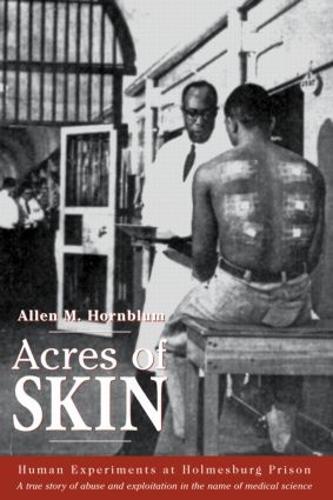
At a time of increased interest and renewed shock over the Tuskegee syphilis experiments, Acres of Skin sheds light on yet another dark episode of American medical history. In this disturbing expose, Allen M. Hornblum tells the story of Philadelphia's Holmesburg Prison. For more than two decades, from the mid-1950s through the mid-1970s, inmates were used, in exchange for a few dollars, as guinea pigs in a host of medical experiments. Based on in-depth interviews with dozens of prisoners as well as the doctors and prison officials who, respectively, performed and enforced these experimental tests, Hornblum paints a disturbing portrait of abuse, moral indifference, and greed. Central to this account are the millions of dollars many of America's leading drug and consumer goods companies made available for the all too eager doctors seeking fame and fortune through their medical experiments. Many of these doctors established their illustrious careers on the backs of the inmates who served as the ideal test subjects--isolated, cheap, and locked behind bars. Acres of Skin argues that at Holmesburg the American medical establishment betrayed the ideals of the Hippocratic Oath and the Nuremberg Code. An array of doctors, in conjunction with the University of Pennsylvania and prison officials, established Holmesburg as a laboratory testing ground. Hundreds of prisoners were used to test products from facial creams and skin mosturizers to perfumes, detergents, and anti-rash treatments. Other experiments used the inmates as test subjects for far more hazardous, even potentially lethal, substances such as radioactive isotopes, LSD, and chemical warfare agents. Acres of Skin is an account of serious medical abuse and exploitation that is rigorously researched and shocking in its depiction of men treated as laboratory animals. This book should be read by anyone concerned with medical ethics, human rights, research ethics, and prison treatment. In often graphic detail, Acres of Skin exposes what really happened behind the locked doors of this American prison. Allen M.Hornblum's extensive criminal justice background includes academic and professional experience. Over the last 25 years he has served on numerous city and state crime fighting organizations, including: The Board of Trustees of the Philadelphia Prison System, The Pennsylvania Crime Commission, and The Pennsylvania Commission on Crime and Delinquency. Hornblum has also served as the Chief of Staff of Philadelphia's Sheriff's Office. He currently teaches courses at Temple University in urban studies, criminal justice, and political science.
Full Product Details
Author: Allen M. Hornblum
Publisher: Taylor & Francis Ltd
Imprint: Routledge
Dimensions:
Width: 15.20cm
, Height: 3.00cm
, Length: 22.90cm
Weight: 0.560kg
ISBN: 9780415919906
ISBN 10: 0415919908
Pages: 336
Publication Date: 14 April 1998
Audience:
College/higher education
,
Professional and scholarly
,
Tertiary & Higher Education
,
Professional & Vocational
Format: Hardback
Publisher's Status: Active
Availability: In Print

This item will be ordered in for you from one of our suppliers. Upon receipt, we will promptly dispatch it out to you. For in store availability, please contact us.
Reviews
Hornblum delineates the contours of the injustice in fine detail. . . In recent years historians of science and medicine have turned their attention to the paradox of American research practices involving human subjects in the wake of Nuremburg. This book is a welcome empirical contribution to the ongoing scholarly discussion. --M. Susan Lindee for Isis: Journal of the History of Science Society, Vol. 91, No, 2, June 2000. This admirably comprehensive story of the use of prisoners for medical research is embarrassingly painful to read . . . This encyclopedic, well-documented treatise . . . is a fascinating story. - Journal of the American Medical Association Hornblum's book is awesome, revealing the sanctimonious venality of American medicine . . . Excellent! Highly recommended. - Choice A recently released expose has sparked new interest in this controversial chapter of American medical history. - Village Voice A startling new book. - Philadelphia Tribune
Hornblum himself witnessed the reality of the large-scale testing of products on prisoners when he was running a creative writing course in a Philadelphia prison. Startled by the sight of men with their bodies covered in gauze pads and tape, he enquired further and learned that the men were participating in 'perfume tests' being run by the University of Pennsylvania, and that other local prisons were also running a wide variety of tests on prisoners. Hornblum discovered that many prisoners were being used as experimental guinea pigs, often for just a few dollars, and that this practice had become an accepted part of prison culture over nearly 20 years, having been initiated by Albert Kligman, an ambitious dermatologist in need of vast amounts of test material. Hornblum tells the story of Kligman and the many experiments he carried out as part of his own research, and for other bodies including the US Army. Many of the experiments were highly questionable and went far beyond his own speciality, and indeed his capabilities, involving as they did potentially lethal substances such as dioxin and radioactive isotopes. Prisoners were rarely informed of what was being tested, or what the effects were likely to be. Hornblum argues that they were not in a position to give consent and were in fact ruthlessly exploited. His book is based on extensive interviews with many of those involved and paints a bleak picture of ignorance, injury, greed and ambition. (Kirkus UK)
Hornblum delineates the contours of the injustice in fine detail. . . In recent years historians of science and medicine have turned their attention to the paradox of American research practices involving human subjects in the wake of Nuremburg. This book is a welcome empirical contribution to the ongoing scholarly discussion. --M. Susan Lindee for Isis: Journal of the History of Science Society, Vol. 91, No, 2, June 2000. <br> This admirably comprehensive story of the use of prisoners for medical research is embarrassingly painful to read . . . This encyclopedic, well-documented treatise . . . is a fascinating story. <br>- Journal of the American Medical Association <br> Hornblum's book is awesome, revealing the sanctimonious venality of American medicine . . . Excellent! Highly recommended. <br>- Choice <br> A recently released expose has sparked new interest in this controversial chapter of American medical history. <br>- Village Voice <br> A startling new book. <br>- Philadelphia Tribune <br>
Hornblum delineates the contours of the injustice in fine detail. . . In recent years historians of science and medicine have turned their attention to the paradox of American research practices involving human subjects in the wake of Nuremburg. This book is a welcome empirical contribution to the ongoing scholarly discussion. --M. Susan Lindee for Isis: Journal of the History of Science Society, Vol. 91, No, 2, June 2000. This admirably comprehensive story of the use of prisoners for medical research is embarrassingly painful to read . . . This encyclopedic, well-documented treatise . . . is a fascinating story. - Journal of the American Medical Association Hornblum's book is awesome, revealing the sanctimonious venality of American medicine . . . Excellent! Highly recommended. - Choice A recently released expose has sparked new interest in this controversial chapter of American medical history. - Village Voice A startling new book. - Philadelphia Tribune
Author Information
Allen M. Hornblum teaches Urban Studies at Temple University. He has served on the Board of Trustees of the Philadelphia Prison System and as the Chief of Staff of Philadelphia's Sheriff's Office.