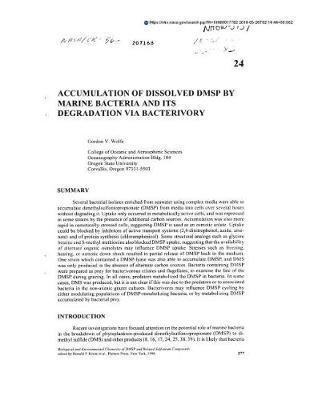
Accumulation of Dissolved Dmsp by Marine Bacteria and Its Degradation Via Bacterivory

Author:   National Aeronaut Administration (Nasa)
Publisher:   Createspace Independent Publishing Platform
ISBN:  

9781725061378


Pages:   32
Publication Date:   10 August 2018
Format:   Paperback
Availability:   In Print   Availability explained
This item will be ordered in for you from one of our suppliers. Upon receipt, we will promptly dispatch it out to you. For in store availability, please contact us.

Our Price $60.69 Quantity:  
Add to Cart

Share |

Accumulation of Dissolved Dmsp by Marine Bacteria and Its Degradation Via Bacterivory


Overview

Several bacterial isolates enriched from seawater using complex media were able to accumulate dimethylsulfoniopropionate (DMSP) from media into cells over several hours without degrading it. Uptake only occurred in metabolically active cells, and was repressed in some strains by the presence of additional carbon sources. Accumulation was also more rapid in osmotically-stressed cells, suggesting DMSP is used as an osmotic solute. Uptake could be blocked by inhibitors of active transport systems (2,4-dinitrophenol, azide, arsenate) and of protein synthesis (chloramphenicol). Some structural analogs such as glycine betaine and S-methyl methionine also blocked DMSP uptake, suggesting that the availability of alternate organic osmolytes may influence DMSP uptake. Stresses such as freezing, heating, or osmotic down shock resulted in partial release of DMSP back to the medium. One strain which contained a DMSP-lyase was also able to accumulate DMSP, and DMS was only produced in the absence of alternate carbon sources. Bacteria containing DMSP were prepared as prey for bacterivorous ciliates and flagellates, to examine the fate of the DMSP during grazing. In all cases, predators metabolized the DMSP in bacteria. In some cases, DMS was produced, but it is not clear if this was due to the predators or to associated bacteria in the non-axenic grazer cultures. Bacterivores may influence DMSP cycling by either modulating populations of DMSP-metabolizing bacteria, or by metabolizing DMSP accumulated by bacterial prey. Wolfe, Gordon V. Unspecified Center NASA/CR-96-207168, NAS 1.26:207168 NAGw-3737...

Full Product Details

Author:   National Aeronaut Administration (Nasa)
Publisher:   Createspace Independent Publishing Platform
Imprint:   Createspace Independent Publishing Platform
Dimensions:   Width: 21.60cm , Height: 0.20cm , Length: 27.90cm
Weight:   0.102kg
ISBN:  

9781725061378


ISBN 10:   1725061376
Pages:   32
Publication Date:   10 August 2018
Audience:   General/trade ,  General
Format:   Paperback
Publisher's Status:   Active
Availability:   In Print   Availability explained
This item will be ordered in for you from one of our suppliers. Upon receipt, we will promptly dispatch it out to you. For in store availability, please contact us.

Table of Contents

Reviews

Author Information

Tab Content 6

Author Website:  

Countries Available

All regions
Latest Reading Guide

April RG 26_2


Shopping Cart
Your cart is empty
Shopping cart
Mailing List