Overview
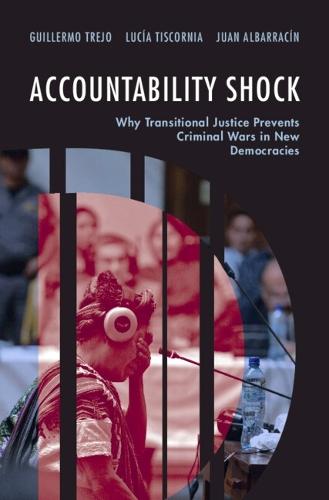
Accountability Shock presents the first systematic explanation of why some 'Third Wave' democracies developed peacefully while others became the world's most violent. The book demonstrates how robust transitional justice processes – combining truth commissions with prosecution of autocratic-era atrocities – prevent criminal violence in new democracies. By holding authoritarian specialists in violence accountable, new democracies can break state impunity, preventing them from becoming key actors in the production of large-scale criminal violence and reshaping the logic of state coercion in democracy. With in-depth analyses of six Latin American cases, the work illuminates why transitional justice is crucial for addressing state-criminal collusion in hybrid contexts. Forged out of a close collaboration between transitional justice scholars and practitioners, Accountability Shock strengthens existing connections while offering practical insights for countries still grappling with authoritarian legacies and violence.
Full Product Details
Author: Guillermo Trejo (University of Notre Dame, Indiana) ,
Lucía Tiscornia (University College Dublin) ,
Juan Albarracín (University of Illinois, Chicago)
Publisher: Cambridge University Press
Imprint: Cambridge University Press
Weight: 0.500kg
ISBN: 9781009667746
ISBN 10: 1009667742
Pages: 408
Publication Date: 05 March 2026
Audience:
General/trade
,
General
Format: Hardback
Publisher's Status: Forthcoming
Availability: Not yet available, will be POD

This item is yet to be released. You can pre-order this item and we will dispatch it to you upon it's release. This is a print on demand item which is still yet to be released.
Reviews
'Trejo, Tiscornia, and Albarracín's Accountability Shock will become an indispensable work not just for those interested in transitional justice, but also in security studies, criminology, and in peacebuilding. Impeccably researched, careful methodologically, the authors offer a novel way of understanding the impact of transitional justice. Avoiding the tendency to think that transitional justice measures are 'cure for all ills,' a common feature of the early literature in the field, they concentrate on the impact of truth and criminal trials (what they call an 'accountability shock') on future organized crime related deaths. Their ingenious explanation, which they manage to establish by means of mixed method methodologies, is that truth and justice take out of the armed forces 'authoritarian violence experts' whose continued presence in police or military forces invite militarized 'iron-fist' policies, protect criminals using their positions of state power, or defect to organized crime, all of which are associated with increases in deaths characteristic of postauthoritarian countries that fail to implement transitional justice policies.' Pablo de Greiff, (first) United Nations Special Rapporteur on the promotion of truth, justice, reparation, and guarantees of non-recurrence, Senior Fellow and Director, Prevention Project, School of Law, New York University 'This groundbreaking book argues that building peaceful democracies requires confronting authoritarian legacies and holding perpetrators accountable. Drawing from an impressive array of evidence across Latin America and beyond, Accountability Shock shows that truth commissions, criminal trials, and other accountability mechanisms play a transformative role in dismantling entrenched networks of 'state specialists in violence' tied to the repressive apparatus that otherwise enable organized crime to flourish. A vital contribution to the study of democratization, violence, and the role of justice in shaping post-authoritarian societies.' Beatriz Magaloni, Graham H. Stuart Professor of International Relations, Stanford University 'This is the best book ever written on the consequences of transitional justice. Featuring a combination of imaginative theorising, large-N analyses, and rigorously paired case studies, Trejo, Tiscornia and Albarracín explain why robust truth and justice policies in the aftermath of dictatorship and armed conflict can prevent crime epidemics.' Ezequiel Gonzalez-Ocantos, Professor of Comparative & Judicial Politics, University of Oxford
Author Information
Guillermo Trejo is Professor of Political Science at the University of Notre Dame and Director of the Violence and Transitional Justice Lab at the Kellogg Institute for International Studies. He studies criminal and political violence, human rights, and transitional justice. Trejo is the co-author of Votes, Drugs, and Violence: The Political Logic of Criminal Wars in Mexico (2020, with Sandra Ley) and the author of Popular Movements in Autocracies: Religion, Repression, and Indigenous Collective Action in Mexico (2012). Lucía Tiscornia is Assistant Professor in the School of Politics and International Relations at University College Dublin and Faculty Fellow at the Geary Institute for Public Policy. She studies police and criminal violence, criminal governance, transitional justice, and mixed-methods approaches to research. Juan Albarracín is Assistant Professor of Political Science at the University of Illinois, Chicago. He studies criminal governance/politics, criminal and political violence, transitional justice, and electoral politics.