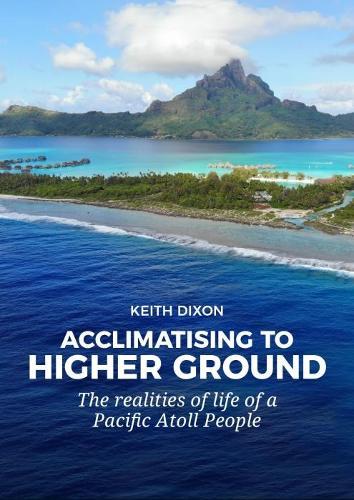
Acclimatising to Higher Ground: The realities of life of a Pacific Atoll People

Author:   Keith Dixon
Publisher:   Sidestone Press
ISBN:  

9789464260304


Pages:   260
Publication Date:   28 December 2021
Format:   Hardback
Availability:   In Print   Availability explained
This item will be ordered in for you from one of our suppliers. Upon receipt, we will promptly dispatch it out to you. For in store availability, please contact us.

Our Price $316.80 Quantity:  
Add to Cart

Share |

Acclimatising to Higher Ground: The realities of life of a Pacific Atoll People


Overview

Life for people on atolls is hard, affected by droughts, rough seas and other adverse climatic conditions, and now, rise in sea level threatens their very inhabitance. No wonder kinship is the foundation of atoll societies, traditional and modern! This book presents a multidisciplinary, retrospective analysis of a Pacific Atoll People living in several countries but held together as a diaspora through notions of kinship. The People have ancestral, cultural, social and continuing residential connections with Nikunau Atoll, at the centre of the Pacific Ocean and once a Cinderella of the British Empire. The analysis explicates their present diasporic circumstances and the pathways through which these arose historically. The intention is to provide a basis for better prospects for succeeding generations from a critical, better-informed standpoint. The analysis relies on the partisan stance of the author, whose kinship ties with I-Nikunau (= people who identify with Nikunau) are affinal, and his 30-year immersion among the People in question. In addition, a large quantity of literature sources and other secondary data are woven into the analysis, as situations and events are grappled with, articulated, interpreted and written into the book. The circumstances are analysed under 14 themes, namely, geographical, demographical, economic, environmental, cultural, societal, etc. The analysis should stir the waters of recent research about Nikunau and Kiribati, much of it concerned with environmental changes making uninhabitable Nikunau, Tarawa and other atolls where I-Nikunau reside, and imagining their resettlement on higher ground, for example, New Zealand, where several diasporic communities exist already. This recent research refers frequently to the social, cultural and economic matters covered in this book, indicating how relevant and important these matters are to the future of I-Nikunau and I-Kiribati. Furthermore, this relevance and importance may apply to the future of other peoples still inhabiting the world’s atolls and facing whatever challenges this future may bring, climate-related and otherwise. Abstract in Gilbertese Te Abam’akoro ae Nikunau, e riki inanon ana tai Te Tia Karikib’ai ae Nareau ngke e tabe n anenea kunana ni katabwenaa te Boo ma Te Maaki. Mai ikanne ao a tia ni maeka anti ma aomata ma aomata ake a bungiaki iaona. A m’akuriia abaia b’a ana toronib’ai man inaomata ao ni kukurei. Kaaro ma tiibu a wantongaia ataei karakinan Nikunau, katein Nikunau ao karinean tuan M’aneaban Nikunau. Rikiaia naba kain Nikunau b’a te boborau n taai akekei ni karokoa ngkai. Te nako Tarawa, Nutiran, Buritan ao ai aaba aika raroa nako. Ana kamateb’ai Te -Imatang aei e boboto iaon karakinan te I-Nikunau ma ana kakam’akuri ma ana waaki iaon abana ae Nikunau AO ni boboto riki iaon m’am’a nangaia nakon aaba ake itinanikun Nikunau ike a riki b’a ianena ao tera aroia ni kakam’akuri mani waaki ngkai ai te naan I-Abatera ngaiia.

Full Product Details

Author:   Keith Dixon
Publisher:   Sidestone Press
Imprint:   Sidestone Press
ISBN:  

9789464260304


ISBN 10:   9464260300
Pages:   260
Publication Date:   28 December 2021
Audience:   Professional and scholarly ,  Professional & Vocational
Format:   Hardback
Publisher's Status:   Active
Availability:   In Print   Availability explained
This item will be ordered in for you from one of our suppliers. Upon receipt, we will promptly dispatch it out to you. For in store availability, please contact us.

Table of Contents

I INTRODUCTION   1 Research Approach 1.1 Validity of Chosen Themes 1.2 Validity of I-Nikunau as a Study Identity 1.2.1 Utu 1.3 Empirical Materials 1.4 Intent of Applying My Methods   II I-NIKUNAU IN THE PRESENT   2 On Nikunau Atoll   3 On (South) Tarawa   4 Beyond Kiribati 4.1 On Great Britain 4.2 On Te Ika-a-Maui and Te Waipounamu (New Zealand)   III RETROSPECTIVE ANALYSIS OF I-NIKUNAU AND INTERPRETATION OF THEIR CIRCUMSTANCES   5 Geographical Circumstances (te mauri) 5.1 Comings and Goings, and Seeds of Diaspora 5.2 Diaspora taking Roots 5.2.1 Tarawa: Centralisation and Precedence 5.2.2 Consequences for I-Nikunau of Centralisation 5.2.3 Phoenix, Solomon and Line Islands 5.2.4 Metropolitan Countries   6 Demographical Circumstances (te mauri) 6.1 Population of I-Nikunau and of Nikunau 6.2 Settlements on Nikunau 6.3 Settlements in the Diaspora   7 Economic Circumstances (te tabomoa) 7.1 Copra and Money and Non-Traditional Entities on Nikunau 7.2 Dynamics of Economic and Related Developments on and Away from Nikunau 7.2.1 Bartering with Foreign Visitors 7.2.2 Private Trade Stores 7.2.3 Cooperative Trade Stores 7.3 Further Aspects of Economic Change in Kiribati 7.3.1 Tarawa’s Economy 7.3.2 Nikunau’s Economy 7.4 Metropolitan Countries 7.4.1 Backwash and Spread Effects on Tarawa from Metropolitan Countries   8 Environmental Circumstances (te mauri) 8.1 Tarawa’s “Worrisome Trend” 8.2 On Nikunau 8.3 Diasporic Communities on Higher Ground 8.4 Climate Change and Emigration 8.4.1 Immigration Information   9 Biological Circumstances (te mauri)   10 Nutritional and Corporeal Circumstances (te mauri) 10.1 On Nikunau 10.2 Tarawa 10.3 New Zealand   11 Political Circumstances (te raoi) 11.1 Government in Kiribati 11.2 From Mwaneaba District Autonomy on Nikunau to Rule from Tarawa 11.2.1 I-Nikunau governing themselves traditionally on Nikunau 11.2.2 Informal Colonialism on Nikunau 11.2.3 British Colonial Rule 11.2.3.1 Rule De Jure 11.2.3.2 Rule de Facto and de Jure 11.2.4 Rule by I-Kiribati 11.3 I-Nikunau in the Political System 11.4 Quasi-traditional Governance on Nikunau and within Diasporic Communities   12 Spiritual Circumstances (te raoi) 12.1 I-Nikunau’s Traditional Spiritual Beliefs 12.2 Religious “Conversion” 12.2.1 Fundraising 12.3 Consequences of Christianity for I-Nikunau   13 Educational Circumstances (te mauri) 13.1 Outline of Formal Education 13.2 Retrospective Analysis of Education on Nikunau and within Kiribati 13.2.1 Traditional Education 13.2.2 Mission Schools 13.2.3 Primary Schools 13.2.4 Secondary Schools 13.2.5 Tertiary Study 13.3 Esteem and Impact of Non-Traditional Education 13.3.1 Qualifying to Emigrate 13.3.2 Knowledge Varying by Location 13.3.3 Conflicts between Traditional and Formal Education 13.4 Formal Education and its Wider Consequences   14 Social Circumstances (te mauri ao te raoi) 14.1 Mwenga as the Basic Kin Units 14.2 Community Activities and Botaki 14.3 Aba, Lands and People 14.4 Te Katei ni Kiribati and Differentiation 14.5 Unimane, Unaine and other Age and Gender Statuses 14.6 Genealogical Accounts 14.7 Social Categories and Resources of a Colonial and Post-Colonial Nature   15 Organisational Circumstances (te raoi) 15.1 Tradition and Effects of Initial Challenges 15.1.1 The Maritime Trade 15.1.2 Island Administration 15.2 Colonial and Traditional Traits in Present-day Organisations 15.3 Conflicts between the Traditional and Non-traditional 15.4 Diasporic Communities   16 Distributional Circumstances (te tabomoa) 16.1 Distributions among I-Nikunau 16.2 Distributions between I-Nikunau and Others 16.3 Distributions between I-Nikunau Communities   17 Cultural Circumstances (te raoi) 17.1 I-Nikunau Culture 17.2 External Influences on I-Nikunau Culture   18 Societal Circumstances (te mauri ao te raoi)   IV CONCLUSION   References

Reviews

Author Information

Keith Dixon presently lives in Christchurch. The author’s family ties are to Northumbria; and his wife’s to Nikunau Island. They have been members of I-Nikunau or I-Kiribati diasporic communities on Te Ika-a-Maui, Tarawa, Great Britain and Te Waipounamu. The author has worked for organisations as diverse as Wolverhampton, Cannock and Nottinghamshire Councils, the UK Government Department for International Development, the Institute of Public Administration of Papua New Guinea, Kiribati Institute of Technology, Kiribati Centre of the University of the South Pacific, and Massey, Keele and the Open Universities. He has been at the University of Cantey Te Whare Wānanga o Waitaha since 2007. As well as work on Kiribati, his academic outputs have mainly concerned organisational change, social responsibility, governments, universities, hospitals, mining corporations and accountant education.

Tab Content 6

Author Website:  

Countries Available

All regions
Latest Reading Guide

NOV RG 20252


Shopping Cart
Your cart is empty
Shopping cart
Mailing List