Overview
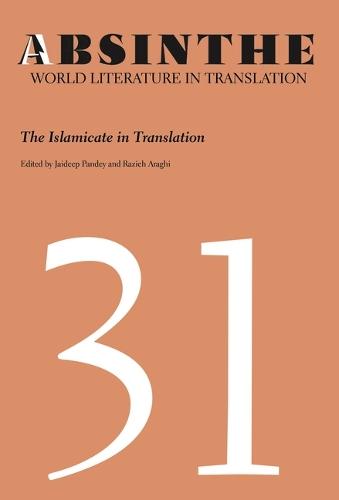
Guest-edited by Razieh Araghi and Jaideep Pandey, this special issue explores the rich, multilingual, and transregional literary worlds shaped by and within the Islamicate sphere. From the Mughal court to Metro Detroit, from Malayalam ghazals to Kurdish-inflected Persian prison poetry, this issue brings together literary translations and critical reflections that unsettle assumptions about language, identity, and belonging. Rather than framing the Islamicate as a fixed geography or religious category, Absinthe 31 approaches it as a set of fluid crossings—linguistic, cultural, historical, and affective. The issue features work in and from an expansive range of languages, including Persian, Arabic, Malayalam, Kurdish, Assamese, Amazigh, Armeno-Turkish, Dari, and Urdu—foregrounding both canonical and marginalized voices. It includes new English translations of ghazals, sīrahs, biographies, and poems originally written by poets and thinkers working across sectarian, linguistic, and national boundaries, and often negotiating minority or diasporic positionalities. In addition to the translated works, many contributions are accompanied by translator commentaries that reflect on the ethics, politics, and poetics of translating from within the Islamicate literary landscape. Together, they suggest that translation is not just a means of access, but a mode of thinking—a method native to the Islamicate tradition itself. Spanning from the premodern courts of empire to contemporary diasporic communities, Absinthe 31 offers readers a vibrant and pluralistic vision of the Islamicate as a dynamic literary terrain shaped by continual movement, negotiation, and transformation.
Full Product Details
Author: Jaideep Pandey ,
Razieh Araghi
Publisher: Michigan Publishing Services
Imprint: Michigan Publishing Services
ISBN: 9781607859536
ISBN 10: 160785953
Pages: 184
Publication Date: 02 February 2026
Audience:
General/trade
,
General
Format: Paperback
Publisher's Status: Active
Availability: In Print

This item will be ordered in for you from one of our suppliers. Upon receipt, we will promptly dispatch it out to you. For in store availability, please contact us.
Author Information
Absinthe: World Literature in Translation is an open access literary magazine that emphasizes the publication of works previously untranslated into English. We prioritize contemporary works of fiction, poetry, and creative nonfiction. Absinthe does not publish scholarly articles nor does it accept unsolicited submissions. Founded by Dwayne D. Hayes in Farmington Hills, Michigan, Absinthe has been publishing works in translation since 2003. In 2014, Absinthe was relocated to the University of Michigan’s Department of Comparative Literature, where the journal expanded its reach from European literature to world literature. Published once a year in digital form and in print, Absinthe is edited by graduate students in the Department of Comparative Literature, as well as by occasional guest editors. Each issue focuses on a specific theme, with an emphasis on transnational approaches.