|
|
|||
|
||||
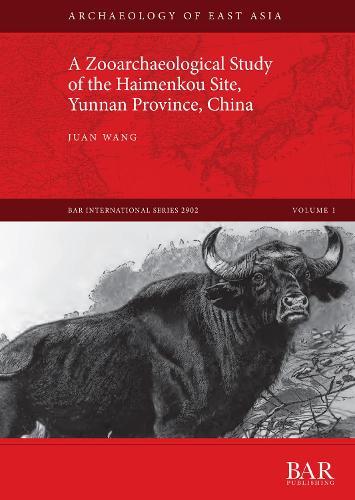
OverviewHaimenkou was an important location, with trade and cultural links connecting parts of modern Southeast Asia and northwestern China in ancient times. This book is based on an analysis of the faunal assemblage recovered from the Haimenkou site during the 2008 field season in Yunnan Province, China. It investigates the human-animal relationships at Haimenkou through a time span running from the late Neolithic Period to the middle Bronze Age (ca. 5000-2400 BP). The animal exploitation patterns, local animal domestication processes, human subsistence strategies and communication networks linking Haimenkou and other regions in prehistoric China are studied. Domesticated pig, dog and sheep bones were identified. Over sixteen wild mammal species as well as bird and fish bones and mollusc shells were also recovered. The results suggest that the Haimenkou people developed a mixed subsistence economy, consisting of crop farming, plant food gathering, animal husbandry, hunting and fishing. Full Product DetailsAuthor: Juan WangPublisher: BAR Publishing Imprint: BAR Publishing Weight: 0.861kg ISBN: 9781407316130ISBN 10: 1407316133 Pages: 216 Publication Date: 31 July 2018 Audience: Professional and scholarly , Professional & Vocational Format: Paperback Publisher's Status: Active Availability: Available To Order We have confirmation that this item is in stock with the supplier. It will be ordered in for you and dispatched immediately. Table of ContentsList of Figures List of Tables List of Abbreviations Abstract Chapter 1 Introduction 1.1 Aims of Faunal Analysis at the Haimenkou Site 1.2 Brief Introduction to the History of Zooarchaeology in China and Yunnan Province 1.3 Date and Citation Style 1.4 Structure of the Book Chapter 2 Environmental Setting and Archaeological Background of the Haimenkou Site 2.1 Introduction 2.2 Site Location and Environmental Setting 2.3 Excavations at the Site 2.4 Summary Chapter 3 Procedure of Faunal Analysis 3.1 Introduction 3.2 Material for Analysis 3.3 Identification and Recording 3.4 Problems Arising before Analysis 3.5 Summary Chapter 4 Range and Relative Importance of Identified Taxa 4.1 Introduction 4.2 Methods of Quantification 4.3 Results and Analysis 4.4 Summary Chapter 5 Skeletal Part Representation and Bone Modification 5.1 Introduction 5.2 Skeletal Part Representation 5.3 Bone Modification 5.4 Summary Chapter 6 Kill-off Patterns for Domestic Animals 6.1 Introduction 6.2 Methods 6.3 Results and Analysis 6.4 Summary Chapter 7 Discussion and Conclusion 7.1 Introduction 7.2 Human-Animal Relationships at Haimenkou 7.3 Subsistence Economy of the Haimenkou People 7.4 Communication Networks Linking Haimenkou and Other Regions in Prehistoric China 7.5 Directions for Future Research Bibliography Appendix 1 Recording System for the Faunal Assemblage from Haimenkou Appendix 2 Measurements of Animal Bones from HaimenkouReviews'An invaluable contribution to an understudied area of Chinese archaeology.' Prof. Roderick B. Campbell, Institute for the Study of the Ancient World, New York University 'Wang does an admirable job presenting baseline data that is critical for understanding the zooarchaeological record in southwestern China. Her work is one of the first zooarchaeological analyses for the region that goes beyond simply identifying taxa in order to examine taphonomic and demographic trends. ... It will be of great value to those doing future archaeological research in Yunnan.' Dr Katherine Brunson, Joukowsky Institute for Archaeology and the Ancient World, Brown University Author InformationJuan Wang is a Research Associate in the Zooarchaeology Laboratory at Henan Provincial Institute of Cultural Heritage and Archaeology, China. Her specific research interests focus on human-animal relationships and animal sacrifice in ancient China. Tab Content 6Author Website:Countries AvailableAll regions |
||||