Awards
- Nominated for Coral Horton Tullis Memorial Prize 2013
- Nominated for Ray Allen Billington Prize 2015
- Winner of MLA Prize for a First Book 2013
- Winner of Renato Ramírez Scholarly Book Award 2014
Overview
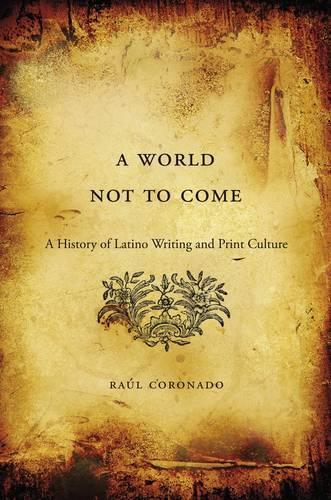
A shift of global proportions occurred in May 1808. Napoleon Bonaparte invaded Spain and deposed the Spanish king. Overnight, the Hispanic world was transformed forever. Hispanics were forced to confront modernity, and to look beyond monarchy and religion for new sources of authority. A World Not to Come focuses on how Spanish Americans in Texas used writing as a means to establish new sources of authority, and how a Latino literary and intellectual life was born in the New World. The geographic locale that became Texas changed sovereignty four times, from Spanish colony to Mexican republic to Texan republic and finally to a U.S. state. Following the trail of manifestos, correspondence, histories, petitions, and periodicals, Raúl Coronado goes to the writings of Texas Mexicans to explore how they began the slow process of viewing the world as no longer being a received order but a produced order. Through reconfigured publics, they debated how best to remake the social fabric even as they were caught up in a whirlwind of wars, social upheaval, and political transformations. Yet, while imagining a new world, Texas Mexicans were undergoing a transformation from an elite community of ""civilizing"" conquerors to an embattled, pauperized, racialized group whose voices were annihilated by war. In the end, theirs was a world not to come. Coronado sees in this process of racialization the birth of an emergent Latino culture and literature.
Full Product Details
Author: Raúl Coronado
Publisher: Harvard University Press
Imprint: Harvard University Press
Dimensions:
Width: 15.60cm
, Height: 3.60cm
, Length: 23.50cm
Weight: 0.824kg
ISBN: 9780674970908
ISBN 10: 067497090
Pages: 574
Publication Date: 29 August 2016
Audience:
Professional and scholarly
,
College/higher education
,
General/trade
,
Professional & Vocational
,
Tertiary & Higher Education
Format: Paperback
Publisher's Status: Active
Availability: Out of stock

The supplier is temporarily out of stock of this item. It will be ordered for you on backorder and shipped when it becomes available.
Reviews
Coronado's book offers a fascinating alternative history of modernity, one rooted in the forgotten archives of Texas. Well-timed to intervene in contemporary debates on rights theory and sovereignty, Coronado tells the story of how Spanish-American intellectuals of the early nineteenth century took the work of now-forgotten Catholic Reformation thinkers to produce a model of rights based on collective well-being and 'public happiness.' The Anglo-American Protestant history of rights suppressed a rich and complex Spanish version, and Coronado finds in these conservative thinkers a revolutionary potential that I believe found fruition in liberation theology in the Americas.--Carrie Tirado Bramen, University at Buffalo, State University of New York This is a book about Tejanos and the printing press in the Age of Revolutions. Between 1810 and 1848, Tejanos witnessed momentous sociopolitical, cultural changes and responded by articulating their own peculiar narratives of modernity through the printing press--narratives that both Mexican and U.S. historiographies have erased. Coronado brings these forgotten narratives, poised between utopia and disillusionment, deftly back to life. This is a moving meditation on the making of the first 'Latino' public sphere.--Jorge Canizares-Esguerra, The University of Texas at Austin Reading British colonial writers as the sole founders of American culture lends our history a false sense of teleology, as though we were always going to end up here. One of the greatest strengths of Coronado's book is its ability to remind us of other paths we might have taken; other worlds different 'we's' might have made... A World Not to Come boldly challenges the dominance of the westward expansion narrative... At once a gripping history, a dizzying synthesis of Enlightenment philosophical currents, and a breathtaking feat of original archival research, his book merits reading by anyone interested in American literature, Latina/o studies, economic history, or Western philosophy. A World Not to Come demands that we recalibrate our sense of what 'American' literary history looks like.-- (07/02/2014) In this brilliantly conceived book, Raul Coronado turns over the forgotten record of a Texas rebellion, and from it spins an absorbing counter-history of a distinctively Latino tradition of political thought. A World Not to Come will stand as a major contribution to the emergent multilingual portrait of print culture in the U.S., and to the comparative intellectual and literary history of the Americas in general.--Kirsten Silva Gruesz, University of California, Santa Cruz In a work of great originality and breathtaking erudition, Raul Coronado writes a compelling history of an alternative West, a history spanning continents, oceans, centuries, and genres. The story told in A World Not to Come is the story of modernity itself, inflected through an immense and virtually unstudied archive of Latino writing that the author reads as a fragmented narrative of becoming. This is cultural history of the highest order.--Anna Brickhouse, University of Virginia Coronado's A World Not to Come is already a standard, well on its way to becoming a classic. The comprehensiveness of the research is extraordinary: an extraordinary job, extraordinarily well done.--Rolena Adorno, Yale University A World Not to Come is a magnificent first book. Raul Coronado makes the case that the meeting of Anglos and Mexicans in the Southwest occasioned not only political and military conflict but also epistemological struggle between two different systems of thought. Latinos in the U.S. attempted forge what in hindsight can be seen as a modern social imaginary. The differences between these conflicting visions of an American imaginary are still very much with us and help define the nature of the present interactions between Anglos and Latinos within the boundaries of the U.S. and outside of them. This is a compelling thesis about the need for a 'transnational' view of the Americas and the recognition that an undifferentiated history of 'Latino' writings cannot easily be extracted from the historical record. Coronado's argument on both counts should advance significantly our understanding of the relationship between the Anglo and Latin Americas in the nineteenth century.--Ramon Saldivar, Stanford University A World Not to Come constitutes an extraordinary contribution to distinct and interconnected lines of scholarly debates engaged with Latin American and trans-hemispheric history.--Beatriz Gonzalez-Stephan Society for U.S. Intellectual History blog (05/29/2015)
Coronado's book offers a fascinating alternative history of modernity, one rooted in the forgotten archives of Texas. Well-timed to intervene in contemporary debates on rights theory and sovereignty, Coronado tells the story of how Spanish-American intellectuals of the early nineteenth century took the work of now-forgotten Catholic Reformation thinkers to produce a model of rights based on collective well-being and 'public happiness.' The Anglo-American Protestant history of rights suppressed a rich and complex Spanish version, and Coronado finds in these conservative thinkers a revolutionary potential that I believe found fruition in liberation theology in the Americas.--Carrie Tirado Bramen, University at Buffalo, State University of New York This is a book about Tejanos and the printing press in the Age of Revolutions. Between 1810 and 1848, Tejanos witnessed momentous sociopolitical, cultural changes and responded by articulating their own peculiar narratives of modernity through the printing press--narratives that both Mexican and U.S. historiographies have erased. Coronado brings these forgotten narratives, poised between utopia and disillusionment, deftly back to life. This is a moving meditation on the making of the first 'Latino' public sphere.--Jorge Ca izares-Esguerra, The University of Texas at Austin In a work of great originality and breathtaking erudition, Ra l Coronado writes a compelling history of an alternative West, a history spanning continents, oceans, centuries, and genres. The story told in A World Not to Come is the story of modernity itself, inflected through an immense and virtually unstudied archive of Latino writing that the author reads as a fragmented narrative of becoming. This is cultural history of the highest order.--Anna Brickhouse, University of Virginia Coronado's A World Not to Come is already a standard, well on its way to becoming a classic. The comprehensiveness of the research is extraordinary: an extraordinary job, extraordinarily well done.--Rolena Adorno, Yale University In this brilliantly conceived book, Ra l Coronado turns over the forgotten record of a Texas rebellion, and from it spins an absorbing counter-history of a distinctively Latino tradition of political thought. A World Not to Come will stand as a major contribution to the emergent multilingual portrait of print culture in the U.S., and to the comparative intellectual and literary history of the Americas in general.--Kirsten Silva Gruesz, University of California, Santa Cruz A World Not to Come is a magnificent first book. Ra l Coronado makes the case that the meeting of Anglos and Mexicans in the Southwest occasioned not only political and military conflict but also epistemological struggle between two different systems of thought. Latinos in the U.S. attempted forge what in hindsight can be seen as a modern social imaginary. The differences between these conflicting visions of an American imaginary are still very much with us and help define the nature of the present interactions between Anglos and Latinos within the boundaries of the U.S. and outside of them. This is a compelling thesis about the need for a 'transnational' view of the Americas and the recognition that an undifferentiated history of 'Latino' writings cannot easily be extracted from the historical record. Coronado's argument on both counts should advance significantly our understanding of the relationship between the Anglo and Latin Americas in the nineteenth century.--Ram n Sald var, Stanford University A World Not to Come constitutes an extraordinary contribution to distinct and interconnected lines of scholarly debates engaged with Latin American and trans-hemispheric history.--Beatriz Gonz lez-Stephan Society for U.S. Intellectual History blog (05/29/2015) Reading British colonial writers as the sole founders of American culture lends our history a false sense of teleology, as though we were always going to end up here. One of the greatest strengths of Coronado's book is its ability to remind us of other paths we might have taken; other worlds different 'we's' might have made... A World Not to Come boldly challenges the dominance of the westward expansion narrative... At once a gripping history, a dizzying synthesis of Enlightenment philosophical currents, and a breathtaking feat of original archival research, his book merits reading by anyone interested in American literature, Latina/o studies, economic history, or Western philosophy. A World Not to Come demands that we recalibrate our sense of what 'American' literary history looks like.-- (07/02/2014)
Author Information
Raúl Coronado is Associate Professor of Ethnic Studies at the University of California, Berkeley.