Overview
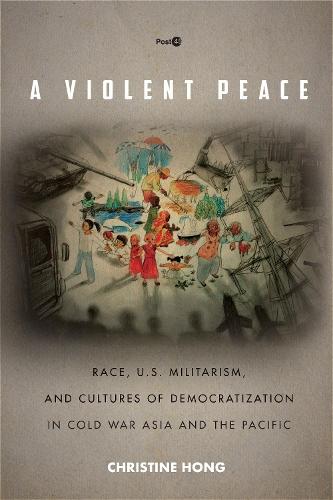
A Violent Peace offers a radical account of the United States' transformation into a total-war state. As the Cold War turned hot in the Pacific, antifascist critique disclosed a continuity between U.S. police actions in Asia and a rising police state at home. Writers including James Baldwin, Ralph Ellison, and W.E.B. Du Bois discerned in domestic strategies to quell racial protests the same counterintelligence logic structuring America's devastating wars in Asia. Examining U.S. militarism's centrality to the Cold War cultural imagination, Christine Hong assembles a transpacific archive-placing war writings, visual renderings of the American concentration camp, Japanese accounts of the atomic bombing of Hiroshima, black radical human rights petitions, Korean War-era G.I. photographs, Filipino novels on guerrilla resistance, and Marshallese critiques of U.S. human radiation experiments alongside government documents. By making visible the way the U.S. war machine waged informal wars abroad and at home, this archive reveals how the so-called Pax Americana laid the grounds for solidarity-imagining collective futures beyond the stranglehold of U.S. militarism.
Full Product Details
Author: Christine Hong
Publisher: Stanford University Press
Imprint: Stanford University Press
Edition: New edition
ISBN: 9781503603134
ISBN 10: 150360313
Pages: 320
Publication Date: 11 August 2020
Audience:
Professional and scholarly
,
College/higher education
,
Professional & Vocational
,
Postgraduate, Research & Scholarly
Format: Hardback
Publisher's Status: Active
Availability: In Print

This item will be ordered in for you from one of our suppliers. Upon receipt, we will promptly dispatch it out to you. For in store availability, please contact us.
Reviews
A Violent Peace is a tour de force, a brilliant rebuttal to the myth of America as defender of human rights abroad and racial justice at home. Christine Hong demonstrates how radical black and Asian intellectuals' penetrating critiques represent the real democratizing project. Beautifully written and persuasively argued, this book is a seismic shift in Cold War cultural history and our geopolitical imagination. -- Robin D. G. Kelley Bursting with brilliance, clarity, and insight, this stunningly original and expansive work excavates the cross-racial, transnational origins of today's militarized modernity. Christine Hong unearths the hidden linkages between race, capital, and occupation in making our postwar global order and points us to alternative conceptions of community and solidarity that defy the borders of modern sovereignty. This book is a game-changer. -- Chandan Reddy
A Violent Peace is a tour de force, a brilliant rebuttal to the myth of America as defender of human rights abroad and racial justice at home. Christine Hong demonstrates how radical black and Asian intellectuals' penetrating critiques represent the real democratizing project.Beautifully written and persuasively argued, this book is a seismic shift in Cold War cultural history and our geopolitical imagination. -- Robin D. G. Kelley * University of California, Los Angeles * Bursting with brilliance, clarity, and insight, this stunningly original and expansive work excavates the cross-racial, transnational origins of today's militarized modernity. Christine Hong unearths the hidden linkages between race, capital, and occupation in making our postwar global order and points us to alternative conceptions of community and solidarity that defy the borders of modern sovereignty. This book is a game-changer. -- Chandan Reddy * University of Washington *
Author Information
Christine Hong is Associate Professor of Literature and Critical Race and Ethnic Studies at the University of California, Santa Cruz. Her political commentary has appeared in The Nation and on Democracy Now! and Al Jazeera.