Overview
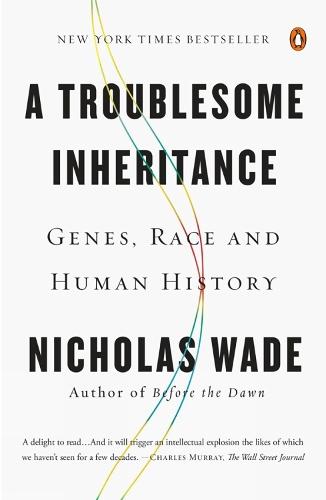
A New York Times bestseller--Drawing on startling new evidence from the mapping of the genome, an explosive new account of the genetic basis of race and its role in the human story. Drawing on startling new evidence from the mapping of the genome,an explosive new account of the genetic basis of race and its role inthe human story Fewer ideas have been more toxic or harmfulthan the idea of the biological reality of race, andwith it the idea that humans of different races arebiologically different from one another. For thisunderstandable reason, the idea has been banishedfrom polite academic conversation. Arguing thatrace is more than just a social construct can get ascholar run out of town, or at least off campus, ona rail. Human evolution, the consensus view insists,ended in prehistory. Inconveniently, as Nicholas Wade argues in ATroublesome Inheritance, the consensus view cannotbe right. And in fact, we know that populationshave changed in the past few thousand years-tobe lactose tolerant, for example, and to survive athigh altitudes. Race is not a bright-line distinction;by definition it means that the more humanpopulations are kept apart, the more they evolvetheir own distinct traits under the selective pressureknown as Darwinian evolution. For many thousandsof years, most human populations stayed wherethey were and grew distinct, not just in outwardappearance but in deeper senses as well. Wade, the longtime journalist covering geneticadvances for The New York Times, draws widely onthe work of scientists who have made crucialbreakthroughs in establishing the reality of recenthuman evolution. The most provocative claims inthis book involve the genetic basis of human socialhabits. What we might call middle-class socialtraits-thrift, docility, nonviolence-have beenslowly but surely inculcated genetically withinagrarian societies, Wade argues. These ""values""obviously had a strong cultural component, butWade points to evidence that agrarian societiesevolved away from hunter-gatherer societies insome crucial respects. Also controversial are hisfindings regarding the genetic basis of traits weassociate with intelligence, such as literacy andnumeracy, in certain ethnic populations, includingthe Chinese and Ashkenazi Jews. Wade believes deeply in the fundamentalequality of all human peoples. He also believes thatscience is best served by pursuing the truth withoutfear, and if his mission to arrive at a coherent summaof what the new genetic science does and does nottell us about race and human history leads straightinto a minefield, then so be it. This will not be thelast word on the subject, but it will begin a powerfuland overdue conversation.
Full Product Details
Author: Nicholas Wade
Publisher: Penguin Putnam Inc
Imprint: Penguin USA
Dimensions:
Width: 14.00cm
, Height: 1.80cm
, Length: 21.40cm
Weight: 0.264kg
ISBN: 9780143127161
ISBN 10: 0143127160
Pages: 288
Publication Date: 28 April 2015
Audience:
General/trade
,
General
Format: Paperback
Publisher's Status: Active
Availability: Manufactured on demand

We will order this item for you from a manufactured on demand supplier.
Reviews
Charles Murray, Wall Street Journal: [ A Troublesome Inheritance ] is a delight to read--conversational and lucid. And it will trigger an intellectual explosion the likes of which we haven't seen for a few decades. Ashutosh Jogalekar, Scientific American Extremely well-researched, thoughtfully written and objectively argued.... The real lesson of the book should not be lost on us: A scientific topic cannot be declared off limits or whitewashed because its findings can be socially or politically incendiary.... Ultimately Wade's argument is about the transparency of knowledge. Edward O. Wilson, University Research Professor Emeritus, Harvard University: Nicholas Wade combines the virtues of truth without fear and the celebration of genetic diversity as a strength of humanity, thereby creating a forum appropriate to the twenty-first century. Kirkus Reviews A freethinking and well-considered examination of the evidence that human evolution is recent, copious, and regional. Publishers Weekly Wade ventures into territory eschewed by most writers: the evolutionary basis for racial differences across human populations. He argues persuasively that such differences exist... His conclusion is both straightforward and provocative...He makes the case that human evolution is ongoing and that genes can influence, but do not fully control, a variety of behaviors that underpin differing forms of social institutions. Wade's work is certain to generate a great deal of attention. Edward O. Wilson, University Research Professor Emeritus, Harvard University Nicholas Wade combines the virtues of truth without fear and the celebration of genetic diversity as a strength of humanity, thereby creating a forum appropriate to the twenty-first century. The New Criterion Mr. Wade is a courageous man, as is anyone who dares raise his head above the intellectual parapet; he has put his argument with force, conviction, intelligence, and clarity.
Charles Murray, Wall Street Journal: [ A Troublesome Inheritance ] is a delight to read conversational and lucid. And it will trigger an intellectual explosion the likes of which we haven't seen for a few decades. Ashutosh Jogalekar, Scientific American Extremely well-researched, thoughtfully written and objectively argued . The real lesson of the book should not be lost on us: A scientific topic cannot be declared off limits or whitewashed because its findings can be socially or politically incendiary . Ultimately Wade s argument is about the transparency of knowledge. Edward O. Wilson, University Research Professor Emeritus, Harvard University: Nicholas Wade combines the virtues of truth without fear and the celebration of genetic diversity as a strength of humanity, thereby creating a forum appropriate to the twenty-first century. Kirkus Reviews A freethinking and well-considered examination of the evidence that human evolution is recent, copious, and regional. Publishers Weekly Wade ventures into territory eschewed by most writers: the evolutionary basis for racial differences across human populations. He argues persuasively that such differences exist His conclusion is both straightforward and provocative He makes the case that human evolution is ongoing and that genes can influence, but do not fully control, a variety of behaviors that underpin differing forms of social institutions. Wade s work is certain to generate a great deal of attention. Edward O. Wilson, University Research Professor Emeritus, Harvard University Nicholas Wade combines the virtues of truth without fear and the celebration of genetic diversity as a strength of humanity, thereby creating a forum appropriate to the twenty-first century. The New Criterion Mr. Wade is a courageous man, as is anyone who dares raise his head above the intellectual parapet; he has put his argument with force, conviction, intelligence, and clarity.
Author Information
Nicholas Wade received a BA in naturalsciences from King's College, Cambridge. He was thedeputy editor of Nature magazine in London and thenbecame that journal's Washington correspondent. Hejoined Science magazine in Washington as a reporter andlater moved to The New York Times, where he has beenan editorial writer, concentrating on issues of defense,space, science, medicine, technology, genetics, molecularbiology, the environment, and public policy, a sciencereporter, and a science editor.