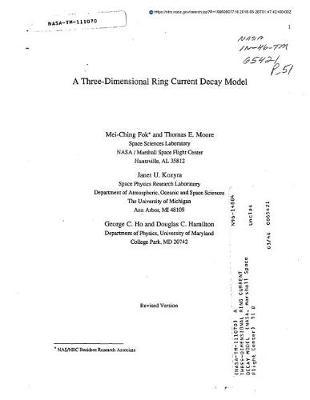
A Three-Dimensional Ring Current Decay Model

Author:   National Aeronaut Administration (Nasa)
Publisher:   Createspace Independent Publishing Platform
ISBN:  

9781722150617


Pages:   52
Publication Date:   06 July 2018
Format:   Paperback
Availability:   Available To Order   Availability explained
We have confirmation that this item is in stock with the supplier. It will be ordered in for you and dispatched immediately.

Our Price $65.97 Quantity:  
Add to Cart

Share |

A Three-Dimensional Ring Current Decay Model


Overview

This work is an extension of a previous ring current decay model. In the previous work, a two-dimensional kinetic model was constructed to study the temporal variations of the equatorially mirroring ring current ions, considering charge exchange and Coulomb drag losses along drift paths in a magnetic dipole field. In this work, particles with arbitrary pitch angle are considered. By bounce averaging the kinetic equation of the phase space density, information along magnetic field lines can be inferred from the equator. The three-dimensional model is used to simulate the recovery phase of a model great magnetic storm, similar to that which occurred in early February 1986. The initial distribution of ring current ions (at the minimum Dst) is extrapolated to all local times from AMPTE/CCE spacecraft observations on the dawn and dusk sides of the inner magnetosphere spanning the L value range L = 2.25 to 6.75. Observations by AMPTE/CCE of ring current distributions over subsequent orbits during the storm recovery phase are compared to model outputs. In general, the calculated ion fluxes are consistent with observations, except for H+ fluxes at tens of keV, which are always over-estimated. A newly-invented visualization idea, designated as a chromogram, is used to display the spatial and energy dependence of the ring current ion differential flux. Important features of storm-time ring current, such as day-night asymmetry during injection and drift hole on the dayside at low energies (less than 10 keV), are manifested in the chromogram representation. The pitch angle distribution is well fit by the function, j(sub o)(1+Ay(exp n)), where y is sine of the equatorial pitch angle. The evolution of the index n is a combined effect of charge exchange loss and particle drift. At low energies (less than 30 keV), both drift dispersion and charge exchange are important in determining n. Fok, Mei-Ching and Moore, Thomas E. and Kozyra, Janet U. and Ho, George C. and Hamilton, Douglas...

Full Product Details

Author:   National Aeronaut Administration (Nasa)
Publisher:   Createspace Independent Publishing Platform
Imprint:   Createspace Independent Publishing Platform
Dimensions:   Width: 21.60cm , Height: 0.30cm , Length: 27.90cm
Weight:   0.145kg
ISBN:  

9781722150617


ISBN 10:   1722150610
Pages:   52
Publication Date:   06 July 2018
Audience:   General/trade ,  General
Format:   Paperback
Publisher's Status:   Active
Availability:   Available To Order   Availability explained
We have confirmation that this item is in stock with the supplier. It will be ordered in for you and dispatched immediately.

Table of Contents

Reviews

Author Information

Tab Content 6

Author Website:  

Countries Available

All regions
Latest Reading Guide

April RG 26_2


Shopping Cart
Your cart is empty
Shopping cart
Mailing List