Overview
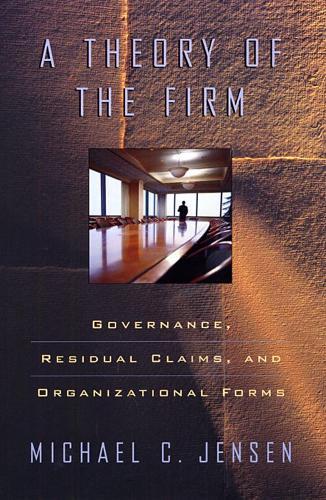
This collection examines the forces, both external and internal, that lead corporations to behave efficiently and to create wealth. Corporations vest control rights in shareholders, the author argues, because they are the constituency that bear business risk and therefore have the appropriate incentives to maximize corporate value. Assigning control to any other group would be tantamount to allowing that group to play poker with someone else's money, and would create inefficiencies. The implicit denial of this proposition is the fallacy of the so-called stakeholder theory of the corporation, which argues that corporations should be run in the interests of all stakeholders. This theory offers no account of how conflicts between different stakeholders are to be resolved, and gives managers no principle on which to base decisions, except to follow their own preferences. In practice, shareholders delegate their control rights to a board of directors, who hire, fire, and set the compensation of the chief officers of the firm. However, because agents have different incentives than the principals they represent, they can destroy corporate value unless closely monitored. This happened in the 1960s and led to hostile takeovers in the market for corporate control in the 1970s and 1980s. The author argues that the takeover movement generated increases in corporate efficiency that exceeded $1.5 trillion and helped to lay the foundation for the great economic boom of the 1990s.
Full Product Details
Author: Michael C. Jensen
Publisher: Harvard University Press
Imprint: Harvard University Press
Edition: New edition
Dimensions:
Width: 15.60cm
, Height: 1.90cm
, Length: 23.50cm
Weight: 0.381kg
ISBN: 9780674012295
ISBN 10: 0674012291
Pages: 323
Publication Date: 30 September 2003
Audience:
Professional and scholarly
,
Professional & Vocational
Format: Paperback
Publisher's Status: Active
Availability: Out of stock

The supplier is temporarily out of stock of this item. It will be ordered for you on backorder and shipped when it becomes available.
Reviews
The book provides the fundamental building blocks for agency theory and discusses a wide variety of topics, including the nature of man, the theory of the firm, specific and general knowledge, organizational structure, executive compensation and performance measurement. These essays, which span the past 25 years, illustrate how Jensen's views have evolved and expanded over time... Jensen's integrated theory is a noble attempt to combine economic analysis of markets and behavioral organization theorists' understanding of the internal aspects of organizations.--J. Barkley Rosser Journal of Economic Behavior and Organization
The book provides the fundamental building blocks for agency theory and discusses a wide variety of topics, including the nature of man, the theory of the firm, specific and general knowledge, organizational structure, executive compensation and performance measurement. These essays, which span the past 25 years, illustrate how Jensen's views have evolved and expanded over time... Jensen's integrated theory is a noble attempt to combine economic analysis of markets and behavioral organization theorists' understanding of the internal aspects of organizations. -- J. Barkley Rosser * Journal of Economic Behavior and Organization *
The book provides the fundamental building blocks for agency theory and discusses a wide variety of topics, including the nature of man, the theory of the firm, specific and general knowledge, organizational structure, executive compensation, and performance measurement. These essays, which span the past 25 years, illustrate how Jensen's views have evolved and expanded over time...Jensen's integrated theory is a noble attempt to combine economic analysis of markets and behavioral organization theorists' understanding of the internal aspects of organizations.
Author Information
Michael C. Jensen is Jesse Isidor Straus Professor of Business Administration, Emeritus, Harvard Business School.