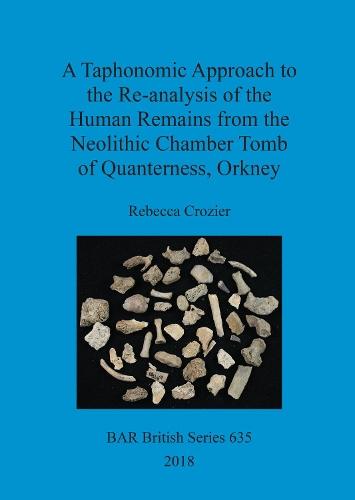
A Taphonomic Approach to the Re-analysis of the Human Remains from the Neolithic Chamber Tomb of Quanterness, Orkney

Author:   Rebecca Crozier
Publisher:   BAR Publishing
ISBN:  

9781407315713


Pages:   333
Publication Date:   27 February 2018
Format:   Paperback
Availability:   Available To Order   Availability explained
We have confirmation that this item is in stock with the supplier. It will be ordered in for you and dispatched immediately.

Our Price $178.54 Quantity:  
Add to Cart

Share |

A Taphonomic Approach to the Re-analysis of the Human Remains from the Neolithic Chamber Tomb of Quanterness, Orkney


Overview

Megalithic tombs in Orkney have yielded some of the largest volumes of human remains in Neolithic Britain. However, discrete skeletons are lacking; the researcher is often presented with formidable volumes of disarticulated and comingled remains. Themes of transformation, fragmentation and manipulation of the body permeate the literature, conferring on the megalithic structures significance as places of transition. Previously, the inherent complexity of the remains has made them an unattractive proposition for detailed study. However, advances in taphonomic analysis mean that techniques now exist for approaching such complex assemblages. A study has now been successfully carried out on the Orcadian remains, uncovering the wealth of new data presented in this volume. This data draws attention to subtle variations in funerary ritual between and within the tombs, and pushes for a dramatic reconsideration of our current understanding of the practices and cosmologies associated with these enigmatic structures.

Full Product Details

Author:   Rebecca Crozier
Publisher:   BAR Publishing
Imprint:   BAR Publishing
Weight:   1.328kg
ISBN:  

9781407315713


ISBN 10:   1407315714
Pages:   333
Publication Date:   27 February 2018
Audience:   Professional and scholarly ,  Professional & Vocational
Format:   Paperback
Publisher's Status:   Active
Availability:   Available To Order   Availability explained
We have confirmation that this item is in stock with the supplier. It will be ordered in for you and dispatched immediately.

Table of Contents

List of Figures List of Plates List of Tables Abstract 1 Introduction 1.1 Introduction 1.2 Aims 1.3 Summary 2 Archaeological Background 2.1 Introduction 2.2 Location 2.3 Environment 2.3.1 Modern Climate and Environment 2.3.2 Past Climate and Environment 2.4 Archaeological Background 2.4.1 Mesolithic Scotland 2.4.2 Mesolithic Orkney 2.4.3 A General Chronology of Neolithic Orkney 2.4.4 Settlement and Domestic Sites of Neolithic Orkney 2.4.4.1 Settlement in the Earlier Neolithic 2.4.4.2 Settlement in the Later Neolithic 2.4.5 Megalithic Tombs of Orkney 2.4.5.1 Background 2.4.5.2 Orkney-Cromarty-Type Tombs 2.4.5.3 Maeshowe-Type Tombs 2.4.5.4 Artefacts and Other Structures from the Orcadian Tombs 2.4.5.4a Artefacts 2.4.5.4b Faunal Remains 2.4.5.4c Fire 2.4.5.5 Tomb Distribution and Siting 2.4.5.6 The End of the Tombs? 2.4.6 Ritual Monuments 2.4.7 Art 2.4.8 Interpretations 2.5 Summary 3 Understanding Death in Neolithic Orkney: Current Themes 3.1 Introduction 3.2 The Significance of Death in the Archaeological Record 3.3 The Treatment of the Dead in Neolithic Orkney 3.3.1 Inhumation, Primary Burial and Direct Interment 3.3.2 Excarnation 3.3.3 Secondary Burial 3.3.4 Manipulation, Curation and Movement 3.3.5 The Use of Fire 3.3.6 A Complex Combination 3.3.7 Non-megalithic Locations 3.4 Ancestors and Individuals - the Symbolism of the Megaliths 3.4.1 Introduction 3.4.2 Critiques of the Ancestor Hypothesis 3.4.3 Ancestors and the Orcadian Megaliths 3.5 Orkney's Neolithic Funerary Rites in the Wider British and Irish Context 3.6 Conclusion 4 Taphonomy 4.1 Introduction 4.1.1 Chapter Outline 4.1.2 Introduction to Taphonomy 4.2 Decay and Disarticulation of the Body 4.2.1 The Onset of Decay 4.2.2 Putrefaction 4.2.3 Factors Influencing the Rate of Soft Tissue Decay 4.2.4 Rate of Decay for Children 4.2.5 Skeletal Disarticulation and Decay 4.3 Recognising 'Normal' Patterns of Preservation 4.4 Traumatic Taphonomic Variables 4.4.1 Fracturing in Bone 4.4.1.1 Compression 4.4.1.2 Tension 4.4.1.3 Twisting or Torsion 4.4.1.4 Bending 4.4.1.5 Shearing 4.4.2 Peri-mortem or Post-mortem? The Relative Timing of Fractures 4.4.3 The Intentional Modification of Human Remains 4.4.3.1 Cut Marks 4.4.3.2 Scrape Marks 4.4.3.3 Chop Marks 4.4.3.4 Percussion Pits 4.4.3.5 Trepanation 4.4.3.6 Interpersonal Violence 4.5 The Effects of Burning 4.5.1 Colour Change Due to Thermal Application 4.5.2 Thermal Fragmentation 4.5.3 Surficial Patterning 4.6 Animal Modification 4.7 Water as a Taphonomic Agent 4.8 Weathering 4.9 Insects 4.10 Bone Colour 4.11 Plant Roots 4.12 Taphonomic Signatures/Profiles 4.12.1 Taphonomic Profile for Cannibalism 4.12.2 Taphonomic Profile for Trampling 4.12.3 Taphonomic Profile for Excarnation and Secondary Burial 4.12.4 Taphonomic Profile of Successive Inhumation 4.13 Conclusion 5 Methods 5.1 Introduction 5.2 Selection of Material 5.3 Making Quanterness Accessible 5.4 The Zonation Method 5.5 Practical Analysis 5.6 Taphonomic Features Recorded 5.6.1 Skeletal Element Identification 5.6.2 Identification of Side 5.6.3 Zones 5.6.4 Weathering Stage 5.6.5 Fracture Type 5.6.6 Colour 5.6.7 Surface Features 5.6.8 Trauma 5.6.9 Burning 5.6.10 Fragment Size 5.6.11 Refitting 5.7 The Living Population - Demographic Information 5.7.1 Sex 5.7.2 Age Assessment 5.7.3 Pathology 5.8 Quantification of the Data 5.8.1 NISP and MNI 5.8.2 MNE and SER 5.9 Comparative Analysis 5.10 Making Use of the Zones 5.11 Level of Fragmentation 5.12 Dating of Quanterness Human Remains 5.13 The Faunal Remains from Quanterness 5.14 Additional Investigative Techniques 5.14.1 Scanning Electron Microscope Analysis 5.14.2 X-Ray 5.14.3 Experimental Work 5.15 Statistical Analysis 5.16 Conclusion 6 Sites 6.1 Introduction 6.2 Quanterness, Mainland 6.2.1 Introduction 6.2.2 The Cairn 6.2.3 The Chamber Deposits 6.2.4 Artefacts 6.2.5 The Human Remains 6.2.6 The Faunal Remains 6.2.7 Chronology 6.2.8 Summary 6.3 Quoyness, Sanday 6.3.1 Introduction 6.3.2 The Cairn 6.3.3 The Platform 6.3.4 The Finds 6.3.5 The Human Remains 6.3.6 Dating 6.3.7 Summary 6.4 Point of Cott, Westray 6.4.1 Introduction 6.4.2 The Cairn 6.4.3 The Finds 6.4.4 Human Remains 6.4.5 Chronology 6.4.6 The Mortuary Rite 6.4.7 Summary 6.5 Pierowall Quarry 6.5.1 Introduction 6.5.2 The Cairn 6.5.3 The Finds 6.5.4 Human Remains 6.5.5 Animal Bone 6.5.6 Dating 6.5.7 Summary 6.6 Isbister, South Ronaldsay 6.6.1 Introduction 6.6.2 The Cairn Exterior 6.6.3 The Cairn Interior 6.6.4 The Human Remains 6.6.5 Faunal Remains 6.6.6 Artefacts 6.6.7 Chronology 6.6.8 Summary 6.7 Cuween Hill 6.7.1 Introduction 6.7.2 The Cairn 6.7.3 Artefacts 6.7.4 Human Remains 6.7.5 Dating 6.7.6 Summary 6.8 Conclusion 7 Results: Quantification and Representation of Skeletal Remains 7.1 Introduction 7.2 Quantifying the Material 7.2.1 Quanterness NISP and Minimum Number of Individuals 7.2.2 Quoyness NISP and Minimum Number of Individuals 7.2.3 Point of Cott NISP and Minimum Number of Individuals 7.2.4 Pierowall Quarry NISP and Minimum Number of Individuals

Reviews

'This work forms a major contribution to the prehistoric archaeology of Orkney and will revolutionise interpretation of the funerary practices associated with megalithic tombs here and elsewhere.' Dr Eileen Murphy, Queen's University Belfast 'A completely new interpretation of the mortuary remains using a novel methodological approach. The result is a new and intriguing interpretation of the function of the site. . Makes a substantive and timely contribution to both mortuary archaeology and bioarchaeology in general.' Prof. Marc Oxenham, Australian National University, Canberra 'This is an original reanalysis, reworking the material in a very thorough manner. . Crozier's conclusions are interesting and unexpected.' Prof. Colin Richards, University of Highlands and Islands


'This work forms a major contribution to the prehistoric archaeology of Orkney and will revolutionise interpretation of the funerary practices associated with megalithic tombs here and elsewhere.'  Dr Eileen Murphy, Queen's University Belfast 'A completely new interpretation of the mortuary remains using a novel methodological approach. The result is a new and intriguing interpretation of the function of the site. . Makes a substantive and timely contribution to both mortuary archaeology and bioarchaeology in general.'  Prof. Marc Oxenham, Australian National University, Canberra 'This is an original reanalysis, reworking the material in a very thorough manner. . Crozier's conclusions are interesting and unexpected.'  Prof. Colin Richards, University of Highlands and Islands  


Author Information

Rebecca Crozier is a lecturer in the Department of Archaeology, specialising in human osteoarchaeology, at the University of Aberdeen. Geographically diverse, with projects in the UK and the Philippines, her research is focused on the reconstruction and understanding of past mortuary practices through the analysis of human remains.

Tab Content 6

Author Website:  

Countries Available

All regions
Latest Reading Guide

April RG 26_2


Shopping Cart
Your cart is empty
Shopping cart
Mailing List