|
|
|||
|
||||
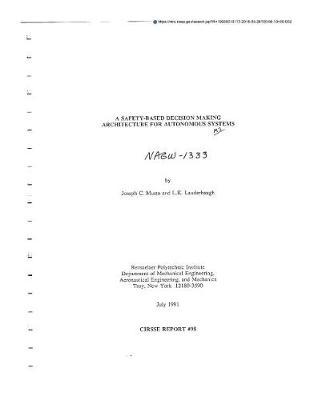
OverviewEngineering systems designed specifically for space applications often exhibit a high level of autonomy in the control and decision-making architecture. As the level of autonomy increases, more emphasis must be placed on assimilating the safety functions normally executed at the hardware level or by human supervisors into the control architecture of the system. The development of a decision-making structure which utilizes information on system safety is detailed. A quantitative measure of system safety, called the safety self-information, is defined. This measure is analogous to the reliability self-information defined by McInroy and Saridis, but includes weighting of task constraints to provide a measure of both reliability and cost. An example is presented in which the safety self-information is used as a decision criterion in a mobile robot controller. The safety self-information is shown to be consistent with the entropy-based Theory of Intelligent Machines defined by Saridis. Musto, Joseph C. and Lauderbaugh, L. K. Unspecified Center NASA-CR-191864, NAS 1.26:191864, RPI-CIRSSE-98 NAGW-1333... Full Product DetailsAuthor: National Aeronaut Administration (Nasa)Publisher: Createspace Independent Publishing Platform Imprint: Createspace Independent Publishing Platform Dimensions: Width: 21.60cm , Height: 0.20cm , Length: 28.00cm Weight: 0.111kg ISBN: 9781725041851ISBN 10: 1725041855 Pages: 36 Publication Date: 09 August 2018 Audience: General/trade , General Format: Paperback Publisher's Status: Active Availability: Available To Order We have confirmation that this item is in stock with the supplier. It will be ordered in for you and dispatched immediately. Table of ContentsReviewsAuthor InformationTab Content 6Author Website:Countries AvailableAll regions |
||||