Overview
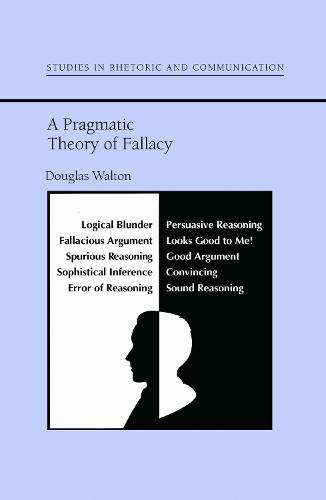
Takes a new analytical look at the concept of fallacy and presents an up-to-date analysis of its usefulness for argumentation studies Although fallacies have been common since Aristotle, until recently little attention has been devoted to identifying and defining them. Furthermore, the concept of fallacy itself has lacked a sufficiently clear meaning to make it a useful tool for evaluating arguments. Douglas Walton takes a new analytical look at the concept of fallacy and presents an up-to-date analysis of its usefulness for argumentation studies. Walton uses case studies illustrating familiar arguments and tricky deceptions in everyday conversation where the charge of fallaciousness is at issue. The numerous case studies show in concrete terms many practical aspects of how to use textual evidence to identify and analyze fallacies and to evaluate arguments as fallacious. Walton looks at how an argument is used in the context of conversation. He defines a fallacy as a conversational move, or sequence of moves, that is supposed to be an argument that contributes to the purpose of the conversation but in reality interferes with it. The view is a pragmatic one, based on the assumption that when people argue, they do so in a context of dialogue, a conventionalized normative framework that is goal-directed. Such a contextual framework is shown to be crucial in determining whether an argument has been used correctly. Walton also shows how examples of fallacies given in the logic textbooks characteristically turn out to be variants of reasonable, even if defeasible or questionable arguments, based on presumptive reasoning. This is the essence of the evaluation problem. A key thesis of the book, which must not be taken for granted as previous textbooks have so often done, is that you can spot a fallacy from how it was used in a context of dialogue. This is an innovative and even, as Walton notes, ""a radical and controversial"" theory of fallacy.
Full Product Details
Author: The University of Alabama Press
Publisher: The University of Alabama Press
Imprint: The University of Alabama Press
Edition: 2nd
Dimensions:
Width: 15.20cm
, Height: 2.00cm
, Length: 22.60cm
Weight: 0.523kg
ISBN: 9780817350475
ISBN 10: 0817350470
Pages: 344
Publication Date: 25 August 2003
Audience:
General/trade
,
General
Format: Paperback
Publisher's Status: Active
Availability: Out of stock

The supplier is temporarily out of stock of this item. It will be ordered for you on backorder and shipped when it becomes available.
Reviews
""By bringing to bear the pragma-dialectical orientation of the Amsterdam School, Walton enables us to reconceptualize fallacies as instances of failed communication, rather than incorrect interference."" --Lenore Langsdorf, Southern Illinois University-Carbondale
By bringing to bear the pragma-dialectical orientation of the Amsterdam School, Walton enables us to reconceptualize fallacies as instances of failed communication, rather than incorrect interference. --Lenore Langsdorf, Southern Illinois University-Carbondale
By bringing to bear the pragma-dialectical orientation of theAmsterdam School, Walton enables us to reconceptualize fallacies as instancesof failed communication, rather than incorrect interference.--Lenore Langsdorf, Southern Illinois University-Carbondale ""By bringing to bear the pragma-dialectical orientation of the Amsterdam School, Walton enables us to reconceptualize fallacies as instances of failed communication, rather than incorrect interference."" --Lenore Langsdorf, Southern Illinois University-Carbondale
Walton's concept of fallacy . . . develops through the joint inquiry into Aristotle's errors of reasoning and sophisms, and through the influence of the pragma-dialecticians, to the culmination in the 'new' pragmatic theory.
Author Information
Douglas Walton has published 33 books including Legal Argumentation and Evidence, One Sided Arguments: A Dialectical Analysis of Bias, Ad Hominem Arguments, Argumentation Schemes for Presumptive Reasoning, and A Pragmatic Theory of Fallacy.