Overview
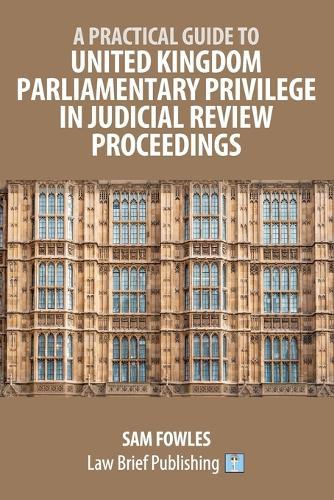
Questions of parliamentary privilege arise throughout judicial review. Any lawyer required to grapple with the meaning of the statute must also consider the implications of privilege (which may determine whether they can rely on parliamentary material to assist them in understanding the statute). Privilege has played a determinative role in matters concerning human rights, devolution, constitutional law, and even criminal prosecution (to name but a few). It is surprising, therefore, that there has hitherto been no attempt at a comprehensive account. This book aims to fill that lacuna. The book also turns a critical eye on privilege, exposing the contradictions inherent in justifications for privilege, the legal and political fictions on which it is based, and arguing that it often operates to frustrate or render otiose key elements of the constitution including the separation of powers and the democratic mandate. Privilege is distinct in modern jurisprudence in that, more than other legal concepts, judges tend to reason from first principles. This book equips the practitioner to engage with the jurisprudence at this level, while also providing a detailed account of the relevant authorities. It is, for this reason, intended to be useful to both practitioners and academics, providing the former with the tools they need to grapple with such arguments in advice and litigation and the latter with both theoretical and practical insights into an under-analysed but vital aspect of public law. Chapter 1 covers the origins and theoretical and constitutional basis for privilege. Chapter 2 provides a comprehensive account of the use of parliamentary material in judicial review. Chapter 3 addresses the limits of privilege, exploring when decisions in and around parliament can and cannot be challenged. Chapter 4 examines some critiques of privilege and suggests how the concept may evolve in future. The book draws on the author's personal experience of arguing privilege cases, including the leading Supreme Court authority (Miller v The Prime Minister [2020] AC 373) and before the Committee on Privileges. ABOUT THE AUTHOR Sam Fowles is a barrister specialising in judicial review. His practice includes constitutional law, judicial review, human rights planning and environment, information law, inquests, public inquiries, and public international law. He accepts instructions from government and claimants at all levels, including NGOs, companies, public bodies, individuals, and local government.
Full Product Details
Author: Sam Fowles
Publisher: Law Brief Publishing
Imprint: Law Brief Publishing
Dimensions:
Width: 15.60cm
, Height: 0.70cm
, Length: 23.40cm
Weight: 0.200kg
ISBN: 9781918241242
ISBN 10: 1918241244
Pages: 136
Publication Date: 30 April 2026
Audience:
General/trade
,
General
Format: Paperback
Publisher's Status: Active
Availability: Available To Order

We have confirmation that this item is in stock with the supplier. It will be ordered in for you and dispatched immediately.