Overview
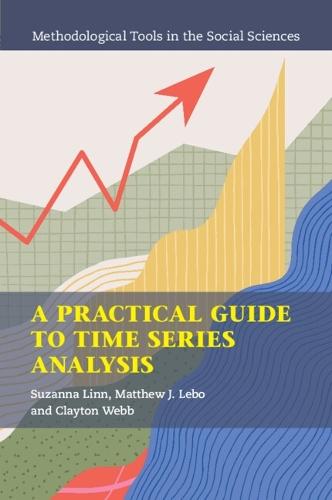
Understanding change over time is a critical component of social science. However, data measured over time – time series – requires their own set of statistical and inferential tools. In this book, Suzanna Linn, Matthew Lebo, and Clayton Webb explain the most commonly used time series models and demonstrate their applications using examples. The guide outlines the steps taken to identify a series, make determinations about exogeneity/endogeneity, and make appropriate modelling decisions and inferences. Detailing challenges and explanations of key techniques not covered in most time series textbooks, the authors show how navigating between data and models, deliberately and transparently, allows researchers to clearly explain their statistical analyses to a broad audience.
Full Product Details
Author: Suzanna Linn (Pennsylvania State University) ,
Matthew J. Lebo (University of Western Ontario) ,
Clayton Webb (University of Kansas)
Publisher: Cambridge University Press
Imprint: Cambridge University Press
Weight: 0.250kg
ISBN: 9781108407519
ISBN 10: 110840751
Pages: 536
Publication Date: 07 May 2026
Audience:
College/higher education
,
Tertiary & Higher Education
Format: Paperback
Publisher's Status: Forthcoming
Availability: Not yet available, will be POD

This item is yet to be released. You can pre-order this item and we will dispatch it to you upon it's release. This is a print on demand item which is still yet to be released.
Reviews
'They don't say so, but this impressive, comprehensive volume is the result of the authors' lifetimes of careful study of social science time series methods. Many of us have been privileged to hear presentations on their research leading to this milestone, and now everyone can benefit by reading this book and understanding the big picture they have been working towards.' Gary King, Albert J Weatherhead III University Professor, and Director of the Institute for Quantitative Social Science, Harvard University 'A Practical Guide to Time Series Analysis is an outstanding contribution to social science methodology. Linn, Lebo, and Webb teach readers how to construct and implement research designs that apply a wide range of frequentist methods for analyzing time series. Reading their book will enable scholars to make scientific progress in our understanding of communication flows, conflict dynamics, public opinion trends, and other important social processes.' John Freeman, Professor Emeritus, University of Minnesota 'The best methods books are written by those who don't just know a lot about the topic but also have a great deal of experience teaching the topic. By those who have spent years answering questions about how to approach the analysis of data that does not neatly fit into any of the theoretical examples typically given in the literature. This book is written by exactly such individuals, making it an excellent resource as a practical introduction to the application of time series analysis.' Mark Pickup, author of Introduction to Time Series Analysis
Author Information
Suzanna Linn is Distinguished Professor of Political Science in the Department of Political Science at Penn State University. She is a Fellow of the Society for Political Methodology and its immediate past president. She serves as associate editor of the Society's journal Political Analysis. Linn has served on the APSA and Midwest Political Science Association Councils. Her innovative research in political methodology and behavior appears in leading journals. Her book The Decline of the Death Penalty (Cambridge, 2008) won the Kammerer Award for best book on US national policy. Matthew J. Lebo is Professor of Political Science and Director of the Centre for Computational and Quantitative Social Science at Western University. His expertise is in political methodology and American politics. He has been a post-doctoral fellow at Harvard, Academic Visitor at Oxford, and a Visiting Professor at the University of Toronto and McGill University. Clayton Webb is an associate professor of Political Science at the University of Kansas. He received his Ph.D. from Texas A&M University. His areas of expertise are Political Methodology and International Relations. His work has been featured in Political Analysis, the American Journal of Political Science, and International Studies Quarterly.