Overview
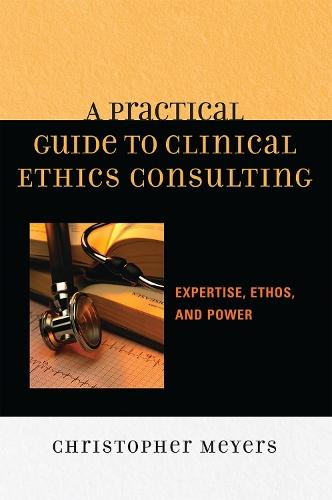
A Practical Guide to Clinical Ethics Consulting reasserts the philosophical method as foundational to ethics consulting. It does so in response to extensive attacks from social scientists, lawyers, theologians, and especially practitioners, all of whom disparage philosophy's reliance on abstract theory and conceptual analysis. Using clinical ethics consulting as an exemplar, Christopher Meyers argues that while many of the attacks are well founded, they are only partly so and not in the most important respects. Ethics consulting that relies too heavily on abstract analysis is of little use to practitioners; consultants must have adequate grounding in, and appreciation of, the concrete reality of working professionals. They must also be experienced enough to have the practical wisdom necessary to assist with real-world problems. Skills of philosophical analysis, when combined with instruction in empirical investigation, political awareness and appropriate character traits, are vital to ethics consulting. Ethicists need the theoretical and conceptual analysis skills that are a standard part of a philosophical education and mindset. The book provides both a defense of this central thesis and a detailed description of the empirical tools—and of the critical independence—necessary to effective consulting.
Full Product Details
Author: Christopher Meyers
Publisher: Bloomsbury Publishing Plc
Imprint: Rowman & Littlefield
Dimensions:
Width: 15.40cm
, Height: 0.80cm
, Length: 23.00cm
Weight: 0.191kg
ISBN: 9780742548282
ISBN 10: 0742548287
Pages: 112
Publication Date: 26 April 2007
Audience:
General/trade
,
General
Format: Paperback
Publisher's Status: Active
Availability: Manufactured on demand

We will order this item for you from a manufactured on demand supplier.
Reviews
Is there such a thing as ethics expertise? Are there ethics experts? Many discussions of ethics expertise suffer from an overly simple formulation of the issues. By contrast, Meyers' detailed account of the elements of ethics expertise and his discussion of how to it should be exercised provide an unusually careful defense of his affirmative answer to the question. Meyers book is the best entree I know to exploring the question of ethics expertise in depth.--David T. Ozar
Is there such a thing as ethics expertise? Are there ethics experts? Many discussions of ethics expertise suffer from an overly simple formulation of the issues. By contrast, Meyers' detailed account of the elements of ethics expertise and his discussion of how to it should be exercised provide an unusually careful defense of his affirmative answer to the question. Meyers’ book is the best entrée I know to exploring the question of ethics expertise in depth. -- David T. Ozar, Loyola University Chicago The book offers a refreshing view of the role of ethics advice and articulates a model to broaden the function and relevance of this advice from analyst to advocate. An enjoyable read. * Metapsychology Online * This book constitutes an excellent contribution....[It] presents not only a well documented defense of Meyer's thesis, but also a comprehensive description of the necessary tools for effective ethics consulting. * Medicine, Health Care and Philosophy * Unlike many other books in clinical ethics, this guide manages to hold high ideals for ethics practitioners, while keeping their work grounded in the culture and institutions in which ethical issues arise. The author provides practical advice for how one can provide needed ethical expertise without either being co-opted into the clinical perspective or dismissed. -- Deni Elliott, author of Ethics in the First Person: A Guide to Teaching and Learning Practical Ethics
Is there such a thing as ethics expertise? Are there ethics experts? Many discussions of ethics expertise suffer from an overly simple formulation of the issues. By contrast, Meyers' detailed account of the elements of ethics expertise and his discussion of how to it should be exercised provide an unusually careful defense of his affirmative answer to the question. Meyers book is the best entr e I know to exploring the question of ethics expertise in depth.--David T. Ozar
Author Information
Christopher Meyers is professor of philosophy at California State University, Bakersfield and serves as executive director of the Kegley Institute of Ethics. He is also on the faculty of the Department of Medicine at the Kern County Medical Center in Bakersfield. He has authored several journal articles and serves on several hospital boards.