Overview
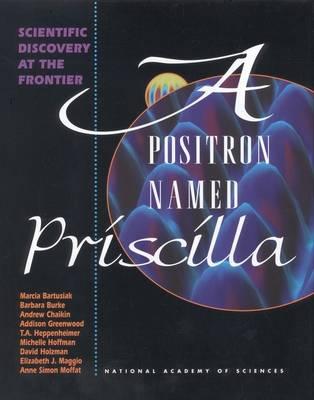
A Positron Named Priscilla is a book of wonder, offering a fascinating, readable overview of cutting-edge investigations by many of today's leading young scientists. Written for anyone who loves science, this volume reports on some of the most exciting recent discoveries and advances in fields from astronomy to molecular biology. This new book is from one of the world's most prestigious scientific institutions, the National Academy of Sciences. The Academy provides an annual forum for the brightest young investigators to exchange ideas across disciplines--an exchange that was the spark for A Positron Named Priscilla. Each chapter is authored by a popular science writer who offers helpful historical perspectives, clear and well-illustrated explanations of current scientific thinking, and previews of future developments. The scope of topics and breadth of discussion ensure interest at all levels. Topics include Planetary science and the compelling glimpse through the clouded atmosphere of Venus afforded by the spacecraft Magellan. Astrophysics and the emergence of helioseismology, a new field that allows researchers to probe the interior workings of the sun.Biology and what we have learned about DNA in the 40 years since its discovery; our current understanding of protein molecules, the ""building blocks"" of living systems; and the high-tech search for answers to the AIDS epidemic. Physics and our new-found ability to move and manipulate individual atoms on a surface. The book also tells the remarkable story of ""buckyballs,"" or buckminsterfullerenes, a form of carbon discovered only a few years ago, that have the potential to be used in a variety of important applications, from superconductivity to nanotechnology. Mathematics and the rise of ""wavelet"" theory, and how mathematicians are applying it in sometimes startling ways, from assisting the FBI with fingerprint storage to coaxing the secrets from a battered recording of Brahms playing the piano. Geosciences and the search for ""clocks in the earth"" to make life-saving earthquake predictions. A Positron Named Priscilla is a ""must"" read for anyone who wants to keep up with a broad range of scientific endeavor.
Full Product Details
Author: National Academy of Sciences ,
Anne Simon Moffat ,
Elizabeth J. Maggio ,
David Holzman
Publisher: National Academies Press
Imprint: National Academies Press
Dimensions:
Width: 20.30cm
, Height: 2.60cm
, Length: 25.40cm
Weight: 1.089kg
ISBN: 9780309048934
ISBN 10: 0309048931
Pages: 360
Publication Date: 01 February 1994
Audience:
Professional and scholarly
,
Professional & Vocational
Format: Hardback
Publisher's Status: Active
Availability: Out of stock

The supplier is temporarily out of stock of this item. It will be ordered for you on backorder and shipped when it becomes available.
Reviews
Capitalizing on an annual forum to showcase young investigators, the prestigious National Academy of Sciences is publishing science-writer versions of frontier research in 10 fields ranging from particle physics to AIDS. The writers are seasoned pros - prizewinning book or magazine authors and editors or correspondents for science journals. Frequently they also hold degrees - e.g., in engineering (T.A. Heppenheimer) or geology (Elizabeth Maggio) or physics (Marcia Bartusiak). Should be a winning combination, no? Not entirely, for a couple of reasons: Sometimes the writing is pitched too high for the general reader (Scientific American is clearly the model). Sometimes it is the nature of the subject: Fourier analysis and Fourier transforms are wondrous things of beauty in mathematics, but their extension to signal processing and wavelet analysis may leave the reader who has only elementary familiarity with sine and cosine curves floundering. Finally, the very frontier under discussion is frustrating: Do we really need to know, thanks to many space probes and samplings, that, no matter which hypothesis you mention, Venus maddeningly seems to offer both support and contradiction ? Having said that, let us acknowledge praiseworthy chapters. Certainly the title piece: It is all about the scanning tunneling microscope that allows investigators to trap and photograph atoms and elementary particles - Priscilla the positron for one. That same instrument has revealed the charms of fullerenes - the new soccer-ball shaped form of carbon (named after Buckminster Fuller's geodesic domes) that Science named Molecule of the Year in 1991. Finally, the chapter on AIDS offers one of the clearest expositions on the nature of HIV and its insidious undermining of the immune system. Chapters on earthquake prediction, protein folding, DNA duplication, the search for the top quark, and the nature of the sun's deepest interior provide intriguing clues, if not the last roundup, on frontier science. (Kirkus Reviews)
Author Information
Marcia F. Bartusiak, Barbara Burke, Andrew Chaikin, Addison Greenwood, T.A. Heppenheimer, Michelle Hoffman, David Holzman, Elizabeth J. Maggio, and Anne Simon Moffat for the National Academy of Sciences