Overview
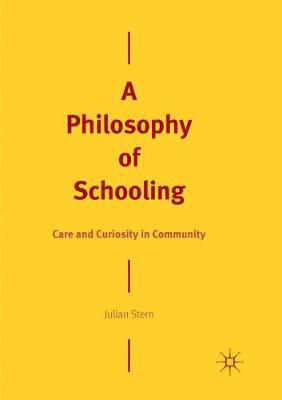
This book provides an optimistic account of the value and role of schooling. Schooling is a common but not universal approach to education and has need of its own distinctive justification, in contrast to other approaches such as home-based or work-based education. The book tackles and rejects the various large-scale ‘functional’ theories of schooling which continue to dominate current debates and policies, such as schooling supporting employment and the economy, or developing citizenship. Instead, it argues that schooling and schools should be viewed as places to learn community within and through community. The lived reality of relationships within schools, based on care and curiosity, is as strong as ever: and upon this foundation is built an original philosophy of schooling. This reflective book will appeal to students and scholars of philosophy of education and to all professionals concerned with schools.
Full Product Details
Author: Julian Stern
Publisher: Springer Nature Switzerland AG
Imprint: Springer Nature Switzerland AG
Edition: Softcover Reprint of the Original 1st 2018 ed.
Weight: 0.454kg
ISBN: 9783030100780
ISBN 10: 3030100782
Pages: 235
Publication Date: 02 February 2019
Audience:
Professional and scholarly
,
Professional & Vocational
Format: Paperback
Publisher's Status: Active
Availability: Manufactured on demand

We will order this item for you from a manufactured on demand supplier.
Reviews
It discusses a number of concepts that are often used in schools, such as `care', `community', `person' and `dialogue'. The value of the book is that it gives these terms substance and shows how these principles are interconnected. ... the merit of his book is that it does not take for granted that schools exist, and in this way, it invites all of us to think these questions through for ourselves. (Wouter Sanderse, British Journal of Educational Studies, November, 2018)
“It discusses a number of concepts that are often used in schools, such as ‘care’, ‘community’, ‘person’ and ‘dialogue’. The value of the book is that it gives these terms substance and shows how these principles are interconnected. … the merit of his book is that it does not take for granted that schools exist, and in this way, it invites all of us to think these questions through for ourselves.” (Wouter Sanderse, British Journal of Educational Studies, November, 2018)
It discusses a number of concepts that are often used in schools, such as 'care', 'community', 'person' and 'dialogue'. The value of the book is that it gives these terms substance and shows how these principles are interconnected. ... the merit of his book is that it does not take for granted that schools exist, and in this way, it invites all of us to think these questions through for ourselves. (Wouter Sanderse, British Journal of Educational Studies, November, 2018)
Author Information
Julian Stern is Professor of Education and Religion at York St John University, UK.