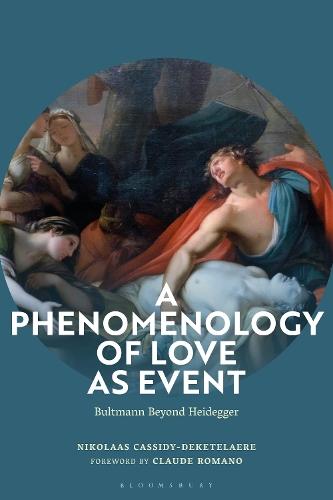
Full Product Details
Author: Nikolaas Cassidy-Deketelaere (KU Leuven, Belgium)
Publisher: Bloomsbury Publishing PLC
Imprint: Bloomsbury Academic
ISBN: 9781350538931
ISBN 10: 1350538930
Pages: 280
Publication Date: 22 January 2026
Audience:
Professional and scholarly
,
Professional & Vocational
Format: Hardback
Publisher's Status: Forthcoming
Availability: Manufactured on demand

Reviews
This phenomenology of love is an event. The publication of this book, of course, but also what it reveals. For Rudolf Bultmann is studied here as a philosopher and not only as a theologian. In this way, he rises to the level of Heidegger by developing a phenomenology of love, including from a human perspective, capable of rivalling the philosophy of being. Nikolaas Cassidy-Deketelaere has certainly written one of the best, most scholarly, precise, and insightful books of our time on the confrontation between these two major authors. * Professor Emmanuel Falque, Honorary Dean, Catholic University of Paris. * In his discussion of 1 Corinthians in 1926, Rudolf Bultmann argued that Paul’s hymn to love in chapter 13 was the true climax of the epistle, not the discussion of resurrection in chapter 15. This statement subtly reveals a crucial feature of Bultmann’s entire theology, as Nikolaas Cassidy-Deketelaere’s novel study demonstrates in detail. Cassidy-Deketelaere joins the ranks of scholars recognizing that Bultmann’s work is not only independent of Heidegger’s philosophy but provides a powerful corrective to it. Instead of anticipating death, Bultmann’s understanding of existence is rooted in the experience of the eschatological event of love. This is an important work that rightly acknowledges Bultmann’s originality and enduring significance. * David W. Congdon, University of Kansas, author of The Mission of Demythologizing: Rudolf Bultmann’s Dialectical Theology * Cassidy-Deketelaere succeeds wonderfully in retrieving Bultmann as a philosopher in his own right and rescuing him from the oblivion in which Heidegger had cast him. In doing so, Cassidy-Deketelaere takes us to the neo-Kantian origins of phenomenology and tends brilliantly to both its transcendental and empirical scope by developing a much needed, in this day and age, and perhaps in any age, account of love as an event in our lives and the lives of all us. * Joeri Schrijvers, Extraordinary Professor, School of Philosophy, North-West University Potchefstroom *
This phenomenology of love is an event. The publication of this book, of course, but also what it reveals. For Rudolf Bultmann is studied here as a philosopher and not only as a theologian. In this way, he rises to the level of Heidegger by developing a phenomenology of love, including from a human perspective, capable of rivalling the philosophy of being. Nikolaas Cassidy-Deketelaere has certainly written one of the best, most scholarly, precise, and insightful books of our time on the confrontation between these two major authors. * Professor Emmanuel Falque, Honorary Dean, Catholic University of Paris. * In his discussion of 1 Corinthians in 1926, Rudolf Bultmann argued that Paul’s hymn to love in chapter 13 was the true climax of the epistle, not the discussion of resurrection in chapter 15. This statement subtly reveals a crucial feature of Bultmann’s entire theology, as Nikolaas Cassidy-Deketelaere’s novel study demonstrates in detail. Cassidy-Deketelaere joins the ranks of scholars recognizing that Bultmann’s work is not only independent of Heidegger’s philosophy but provides a powerful corrective to it. Instead of anticipating death, Bultmann’s understanding of existence is rooted in the experience of the eschatological event of love. This is an important work that rightly acknowledges Bultmann’s originality and enduring significance. * David W. Congdon, University of Kansas, author of The Mission of Demythologizing: Rudolf Bultmann’s Dialectical Theology *
This phenomenology of love is an event. The publication of this book, of course, but also what it reveals. For Rudolf Bultmann is studied here as a philosopher and not only as a theologian. In this way, he rises to the level of Heidegger by developing a phenomenology of love, including from a human perspective, capable of rivalling the philosophy of being. Nikolaas Cassidy-Deketelaere has certainly written one of the best, most scholarly, precise, and insightful books of our time on the confrontation between these two major authors. * Professor Emmanuel Falque, Honorary Dean, Catholic University of Paris. * In his discussion of 1 Corinthians in 1926, Rudolf Bultmann argued that Paul’s hymn to love in chapter 13 was the true climax of the epistle, not the discussion of resurrection in chapter 15. This statement subtly reveals a crucial feature of Bultmann’s entire theology, as Nikolaas Cassidy-Deketelaere’s novel study demonstrates in detail. Cassidy-Deketelaere joins the ranks of scholars recognizing that Bultmann’s work is not only independent of Heidegger’s philosophy but provides a powerful corrective to it. Instead of anticipating death, Bultmann’s understanding of existence is rooted in the experience of the eschatological event of love. This is an important work that rightly acknowledges Bultmann’s originality and enduring significance. * David W. Congdon, University of Kansas, author of The Mission of Demythologizing: Rudolf Bultmann’s Dialectical Theology * Cassidy-Deketelaere succeeds wonderfully in retrieving Bultmann as a philosopher in his own right and rescuing him from the oblivion in which Heidegger had cast him. In doing so, Cassidy-Deketelaere takes us to the neo-Kantian origins of phenomenology and tends brilliantly to both its transcendental and empirical scope by developing a much needed, in this day and age, and perhaps in any age, account of love as an event in our lives and the lives of all us. * Joeri Schrijvers, Extraordinary Professor, School of Philosophy, North-West University Potchefstroom * In this study, Nikolaas Cassidy-Deketelaere convincingly argues that it is simply wrong to understand the work of Bultmann as a theological derivative of Heidegger’s philosophy. By developing a unique reading of Bultmann’s work as a phenomenology of love and as a precursor of the present-day turn to the event, Cassidy-Deketelaere brilliantly shows how Bultmann’s reflections on the experience of love rewrite Heidegger’s existential analytic in a fundamental way. * Dear Professor Gert-Jan van der Heiden, *
This phenomenology of love is an event. The publication of this book, of course, but also what it reveals. For Rudolf Bultmann is studied here as a philosopher and not only as a theologian. In this way, he rises to the level of Heidegger by developing a phenomenology of love, including from a human perspective, capable of rivalling the philosophy of being. Nikolaas Cassidy-Deketelaere has certainly written one of the best, most scholarly, precise, and insightful books of our time on the confrontation between these two major authors. * Professor Emmanuel Falque, Honorary Dean, Catholic University of Paris. *
Author Information
Nikolaas Cassidy-Deketelaere is a Postdoctoral Research Fellow at KU Leuven, Belgium.