Overview
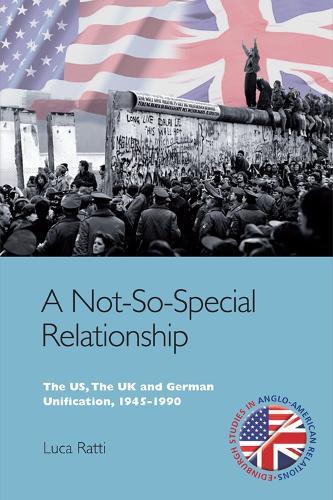
Germany's unification in October 1990 was one of the most momentous events in modern European history and world politics since the end of World War II. German unity ended the Cold War in Europe, accelerated the collapse of communist regimes across Eastern Europe, and the disintegration of the USSR in 1991. It also triggered NATO's transformation at the London and Rome summits of the Alliance and deepened Europe's political and economic integration with the signing of the treaty of Maastricht in 1992. This book offers new insights into the role that the Anglo-American 'special relationship' played in this process, and examines the impact that Germany's reunification had on Anglo-American and transatlantic relations.
Full Product Details
Author: Luca Ratti (Associate Professor in History of International Relations, Roma Tre University and the University of Rome)
Publisher: Edinburgh University Press
Imprint: Edinburgh University Press
Weight: 0.613kg
ISBN: 9781474437820
ISBN 10: 1474437826
Pages: 404
Publication Date: 12 August 2018
Audience:
College/higher education
,
Professional and scholarly
,
Tertiary & Higher Education
,
Professional & Vocational
Format: Paperback
Publisher's Status: Active
Availability: Manufactured on demand 
We will order this item for you from a manufactured on demand supplier.
Table of Contents
Part One: The ‘Special Relationship’and the German question during the Cold War 1. The U.S., the UK, and the German question from the first Cold War to détente (1945-1961)1.1 The ‘Special Relationship’ and Germany from Potsdam to the Federal Republic’s establishment 1.2 The Federal Republic’s Western integration: the Anglo-American allies and German rearmament1.3 The ‘Special Relationship’ and Germany before and after the 1953 East German riots1.4 The ‘Special Relationship’ and Germany from 1955 to the second Berlin crisis 2. The U.S., the UK and the German question from détente to the second Cold War (1961-1985)2.1 The ‘Special Relationship’ and the Federal Republic’s Ostpolitik (1961-1973)2.2 The ‘Special Relationship’, the GDR, and the CSCE2.3 The US, the UK, the German question and the second Cold War2.4 The ‘Special Relationship’ and the FRG in the early 1980s 3. The US, the UK and the German question at the Cold War’s end (1985-1989)3.1 Anglo-American reactions to the prospect of change in Germany (1985-1988)3.2 The GDR’s crisis, the fall of the Wall, and the Anglo-American schism3.3 US-West German convergence: Kohl’s blueprint and Baker’s response Part Two: Anglo-American relations and the diplomacy of German unification (1989-1990) 4. The US, the UK, and German unification4.1 The ‘Special Relationship’ evaporates: Britain’s search for a European bloc4.2 On the road to unification: ‘Two plus Four’ rather than ‘Two plus Zero’4.3 The not so ‘Special Relationship’: Ottawa and US rejection of a strengthened CSCE role4.4 The issue of a peace settlement: Anglo-American differences of tone and substance 5. The US, the UK, and German unification within NATO5.1 Germany’s relationship with NATO and Britain’s alignment with US positions5.2 The US, Germany, and the Camp David summit5.3 Anglo-German tension and Thatcher’s growing isolation5.4 The ‘Special Relationship’ and Germany’s place in the Atlantic Alliance5.5 Anglo-American views about the Status of Forces Agreement (SOFA) Conclusions: Still a ‘Special Relationship’ after Unification?
Reviews
Historical depth applied to a big theme can render rich lessons. That is what Luca Ratti accomplishes beautifully in his intricate exposé of subtle but important differences between the American and British governments on the question of Germany. On this question, the “special Anglo-American relationship” was often strained. Ratti explores why this was so and helps us think about the relationship after Brexit and President Trump, and what role Germany may play in it. -- Alexander Moens, Simon Fraser University, Vancouver When in May 1989 George H. W. Bush offered a 'partnership in leadership' to Germany and not Britain, Margaret Thatcher was in disbelief. Yet the fall of the Berlin Wall less than six months later confirmed the waning importance of the alleged 'special relationship' between the UK and the US. Because it covers an intriguing and all-too-neglected angle of the end of the Cold War and German unification, Luca Ratti’s book is a welcome and important addition to the fast-growing literature on this topic. -- Frédéric Bozo, Université de la Sorbonne Nouvelle
Author Information
Luca Ratti is Associate Professor in History of International Relations at the University of Rome 3. He holds a PhD in International Relations from the University of Cardiff and also teaches International Relations at the American University of Rome. He has written extensively on post-World War Two international history, specifically on U.S.-European relations, NATO’s evolution and eastern enlargement, European security and defense policies, and international relations theory.
Tab Content 6
Author Website:
Countries Available
All regions
|